Showing posts with label Tolkien-related. Show all posts
Showing posts with label Tolkien-related. Show all posts
Thursday, July 16, 2026
If Anyone Thinks I Grossly Misunderstood Tolkien ...
I mean, some of my readers unfortunately place Isaac Asimov over Tolkien.
They are probably less familiar than I with Tolkien's Letters. But they don't need to take my word for it:
"Middle-earth is NOT an imaginary world!"
Truett J. Billups | 16 juil. 2026
https://www.youtube.com/watch?v=x24IGkr7FP0
PS, a little correction against the idea of Tolkien being Anarchist or Communist:
No, the Shire is not 'Communist'
Ink and Fantasy | 18 July 2026
https://www.youtube.com/watch?v=B6CaPXssJMs
It can be noted that quotes in this video describe the synonym of pipeweed as "leaf" ... confirming what Tolkien said of Nicotiana./HGL

Thursday, May 28, 2026
Two Things About the Sawley Map
First, if you will look at the picture from wikimedia commons:

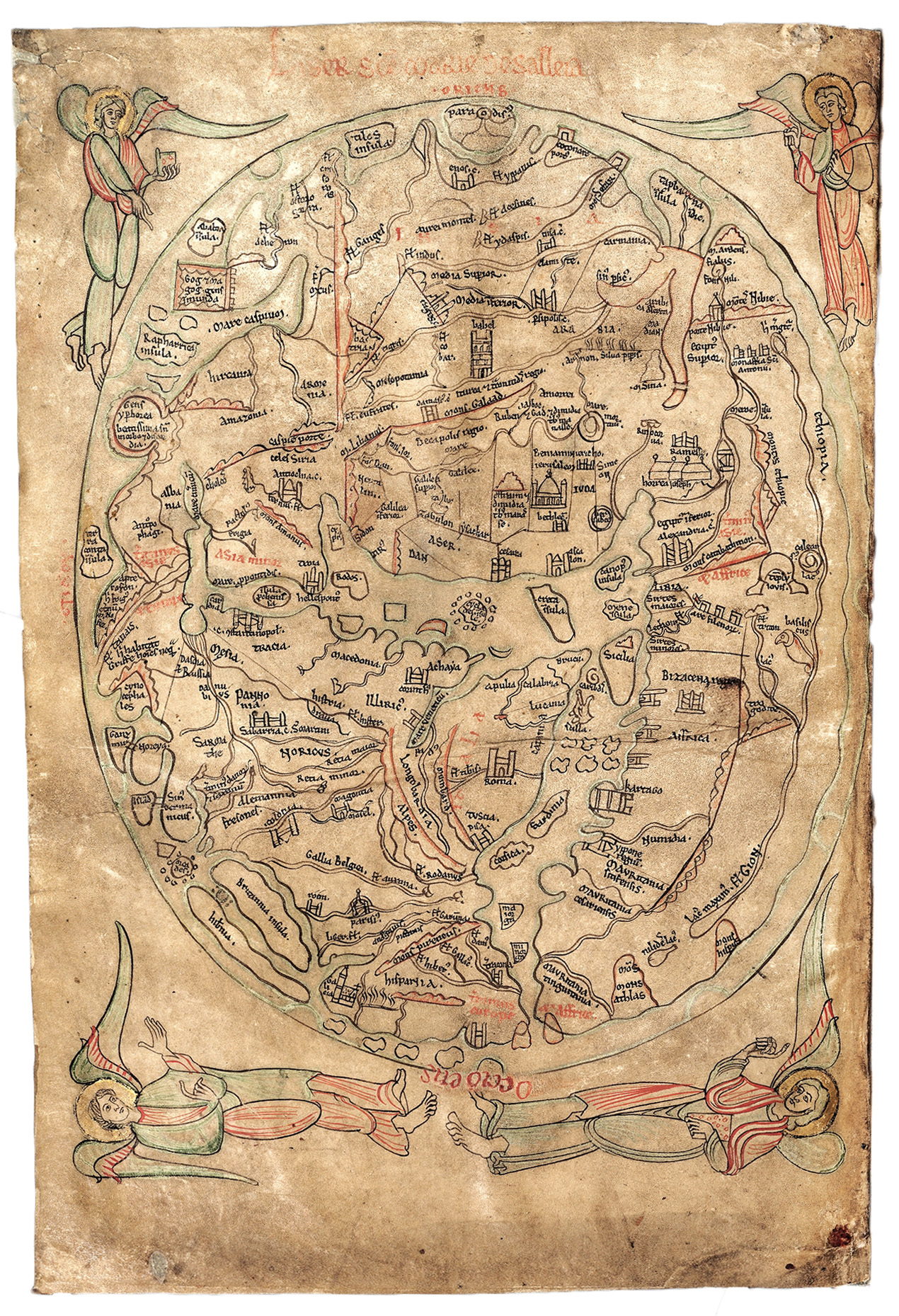
This work is in the public domain in its country of origin and other countries and areas where the copyright term is the author's life plus 100 years or fewer.
You will note that there are four angels.
This is a literalistic reference to Apocalypse 7:1. This doesn't mean that the author believed the earth to be flat, it just means the map is concentrating on what is presumed to be the land hemisphere. In actual fact, as discovered later, the Atlantic isn't on the Western edge of the land hemisphere, it's a water wedged inside it (with some of the displaced tectonics showing up around Baffin Bay, I'd say).
So, given this iconographic tradition, I'm certain I'm right to take the four corners as literal. The angels are also placed, as I place the corners, in the roughly NW, NE, SE and SW of the land hemisphere (or the truncated version they knew of it).
This is one item I'd note.
Another one is this. It was a piece of art. A personnalised art work accompanying the book Imago Mundi by Honorius of Autun. This specific map, smaller than an A4, only exists on this page of a copy of this book, i e second page (folio 1v) of manuscript 66 at Corpus Christi College, Cambridge.
https://en.wikipedia.org/wiki/Sawley_map
There are no follow up pictures that I know of*. No picture of Brittany or of the Holy Land or of Egypt or of Russia. No, there is no higher resolution than c. 1/2 the actual land hemisphere on 20 cm × 30 cm or 11.8 in × 7.9 in. If you are a general, it may be OK as a way to figure out a general travel route from Scotland to the Holy Land, for a Crusade, for instance, but it's not sth you can use in order to adapt a strategy to the actual terrain of an area.
Such smaller areas shown on maps of higher resolution didn't enter into the ceremonial purpose of viewing the inhabited world between the four angels of Apoc. 7:1. Nor were they needed to figure out a sea route across the Mediterranean or the North Sea.
Also:
Around 1,100 mappae mundi are known to have survived from the Middle Ages. Of these, some 900 are found in illustrated manuscript books and the remainder exist as stand-alone documents.
https://en.wikipedia.org/wiki/Mappa_mundi
To modern eyes, mappae mundi can look superficially primitive and inaccurate. However, mappae mundi were never meant to be used as navigational charts and they make no pretence of showing the relative areas of land and water. Rather, mappae mundi were schematic and were meant to illustrate different principles. The simplest mappae mundi were diagrams meant to preserve and illustrate classical learning easily. The zonal maps should be viewed as a kind of teaching aid – easily reproduced and designed to reinforce the idea of the Earth's sphericity and climate zones. T-O maps were designed to schematically illustrate the three land masses of the world as it was known to the Romans and their medieval European heirs.
As I said. Few and not very useful in the practical sense, apart from being a teaching aid. A very ligne claire or Hergé version of an image d'Épinal.
Even their existence is due to some cultural factors that cannot be presumed for just each and every kind of society with a similar level of technology.
Why do I mention this? The fact is, I gave an answer on why the Witchking of Angmar didn't know where the Shire was, even though it was part of the Northern kingdom, of Arnor, and the Witchking conquered it. Many had stated the Witchking didn't know the hobbits called it The Shire. I stated, the Witchking couldn't have found it on a map, because he didn't have any.
And he didn't have any, because maps were not an everyday object.
If Guderian wants to invade Russia or if Zhukov wants to take Berlin, they have no problems getting maps of enemy territory, because local and regional maps are everyday objects, printed in the millions. This is not how Attila the Hun got into France or even how the Teutonic order (as far as I know) planned their failed attempt at Tannenberg in 1410. Neither of them could trust someone to sneak in as a civilian behind enemy lines and just buy a map in a shop. There were no shops where you could buy maps. They were luxury items.
Now, Third Age 1409 and the previous and ensuing centuries is basically meant to be reminiscent of the Dark Ages or Age of Migrations, but a bit more devastating (mimicking the depopulation of much of Europe prior to the migration from Yamnaya). In Third Age 3018 and 3019 (main setting of Lord of the Rings), it's 1418 / 1419 in the Shire calendar, and that is a pretty good indication of the part of the Middle Ages that Tolkien was thinking of, in part, (like the end involves an alternative ending to the siege of Constantinople, one in which the invader is driven back).
The second best attack** on Tolkien's plotting turns around the equivalent of pretending that King Arthur could have walked into a shop to buy maps for the area around Constantiniple, in Nennius. Monty Python might have done that to the Arthuriad, but Tolkien wouldn't.
Hans Georg Lundahl
Nanterre UL
Pentecost Thursday
28.V.2026
PS, if for some reason you still don't get it, one influence Tolkien was on me was getting into the real Christian Middle Ages a bit more than the usual Disney slop or worse./HGL
*I'm by far no expert on this manuscript or the whole work, so there might be a surprise in for me. I only know it from wikipedia. ** The first and third best attacks are about getting into Morder, company of the ring versus armies of Gondor.
Saturday, April 11, 2026
Est-ce qu'un écrivain est un homme instruit ? Et, est-ce qu'un homme instruit aime Dostoïevski ?
Je n'ai pas lu Les Frères Karamazov. J'ai lâché Crime et Punition après la moitié, juste regardant à la page finale. Une nuit, quand j'étais en 10e ou 11e année scolaire, au lycée (Seconde ou Première selon le système français), j'ai lu la première moitié. J'ai dû interrompre pour petit-déjeuner et une journée de sport. L'expérience était traumatisante, à un tel niveau que je n'ai pas pu résumer la lecture où je l'avais lâché, ce livre.
J'ai par contre lu une bande dessinée, des Classics Illustrated. Sur la vie de cet auteur, l'activité avant la fausse exécution et le temps en Sibérie après. Assez franchement, j'aime moins bien l'écrivain (une fois les romans approchés) que la personne humaine.
Et la personne humaine n'est pas non plus ma tasse de thé totalement. Désolé, c'est pas avec moi qu'on discute ce Fiodor.
Suis-je donc mal instruit ? Et, est-ce que ça me disqualifie comme auteur ?
D'abord la question de principe. Un auteur doit pouvoir écrire de quelque chose qu'il connaît bien, pour l'avoir inventé très en détail (comme Tolkien inventa le Quenya) ou pour avoir bien étudié la question (comme Tolkien était expert de batailles, pas juste des siennes à la Guerre de 14—18). Mais "instruit" ? Pas si le mot renvoie à la reconnaissance et la familiarité avec un canon préexistant, dont selon certains Dostoïevski.
Platon n'avait pas lu Beaudelaire. Aristote n'avait pas lu Boileau. Virgile et Homère n'avaient pas lu les Inklings Tolkien et Lewis.* Si même être un auteur canonique ne vous oblige pas de connaître, reconnaître et aimer un certain canon litéraire, alors être auteur tout court ne vous n'y oblige pas non plus.
Si être auteur veut dire apporter un point de vue spécifique (certains définiraient être essayiste ainsi) simplement partager le point de vue d'une masse d'hommes est en contraste avec cette description. L'auteur n'est pas le bon écolier qui se fait instruire par les moyens que son prof juge les moyens de s'instruire. Il peut avoir un côté de ça, mais il ne l'est pas par essence.
Je ne suis pas le bon écolier ambitieux qui cherche des lectures en fonction de ce qui va socialement me gêner ou profiter. J'ai cherché la lecture d'Homère et de Virgile parce que CSL et JRRT semblaient les trouver très bons à lire. Et j'ai pris l'opinion de ces deux auteurs, pas en fonction d'une ambition sociale (à l'époque ça aurait été encore davantage foûtu de le faire en Suède), mais en fonction de mon propre goût.
Si je regarde un autre essayiste aussi de la Scanie, Frans G. Bengtsson, il cultiva Homère directement par son goût (et peut-être un brin d'ambition sociale, parce qu'Homère était déjà prestigieux), mais à ma meilleure connaissance, pas Dostoïevski.

Avant de connaître l'auteur*** des Mérovingiens qui laissent pousser les cheveux, je connus déjà Gilbert Keith Chesterton. À droite sur cette image° :

Apprécié°° jusqu'à par le pape:

Encore un homme ou deux qui n'étaient pas totalement fans de Dostoïevski. Pour Tolstoï, Chesterton admirait le raconteur mais déplorait le penseur.
Mais, quand même, Dostoïevski n'est pas rien. Il écrit très bien sur les faits de culpabilité, du choix moralement mauvais, de l'existence de la loi divine et de l'occurrence de sa négation par des méchants ! En effet. J'ai un jour décrit Tolkien comme un homme capable à donner des messages essentiels de Dostoïevski mais de le faire dans un récit pas trop sombre, donc lisible.
Pourtant, les Inklings, ce n'est pas juste Dostoïevski moins l'illisible (pour ma sensibilité, au moins, voir en haut), mais aussi une solide connaissance de Chesterton et de St. Thomas. C'est de Tolkien que je me vais vers Chesterton, et c'est de Chesterton que je me vais vers St. Thomas d'Aquin. Homme assez inconnu par Dostoïevski, chose à méditer pour ceux qui prétendraient que tous et chacun devraient connaître et apprécier un canon spécifique avant de devenir éventuellement des écrivains.
Et contrairement à Dostoïevski, le Docteur Angélique est lisible, pour moi.°°°
Je pense que d'aimer St. Thomas vaut aussi bien d'être considéré instruit comme d'aimer Dostoïevski. Au minimum. Mais comme dit, l'auteur n'a pas besoin d'être un homme instruit dans un canon litéraire. Item pour le fait d'aimer Chesterton et les Inklings, pas le moins si on y ajoute Hilaire Belloc et Charles Maurras.
Hans Georg Lundahl
Nanterre BU
Samedi de Pâques
11.IV.2026
Images sourcées: Frans G. Bengtsson (1894-1954), Swedish author, with his son Joachim.}} |Source =''en:Vecko-Journalen'', Christmas issue 1943 |Author =Unknown photographer. |Date =1943 or earlie; George Bernard Shaw, Hilaire Belloc, and G. K. Chesterton; Telegram sent by Cardinal Eugenio Pacelli (the future Pius XII) on behalf of Pope Pius XI to the people of England following the death of Chesterton


* JRRT et CSL, vu que parmi les Inklings se trouvaient aussi le fils de Tolkien, Christopher, et le frère de Lewis, Warren H. **De långhåriga merovingerna *** L'image avec le fils Joachim est par un photographe inconnu, de 1943 et en domaine public. ° Également en domaine public, 1927, The Guardian. J'apprécie également Hilaire Belloc, au milieu. °° L'image n'est pas en domaine public, car créé en 2013. Par contre les conditions CC BY-SA 3.0 me permettent de l'utiliser. Et l'ayant droit semble ne plus exister sur wikimedia: AmChestertonSoc = probablement American Chesterton Society. °°° Je pense avoir un peu mieux compris Prima Via que ce qu'en exprime Chesterton en son livre sur St. Thomas. What's the Nature of Theism and the Pagan Alternative to Theism in Romans 1? Par contre, Chesterton exprime très bien Tertia Via en son livre et après d'avoir feuilleté Gilson, il dicte la seconde moitié de son livre à sa sécretaire. Gilson réplique en disant qu'il avait raison. Did Chesterton Even Read Any Aquinas? w/ Dale Ahlquist.
Thursday, February 19, 2026
Some People Can't Tell Guido von List from Snorri Sturlason from Tolkien
I'd appreciate if guys like that were kind enough to end their efforts to detect the next Magician behind the next Hitler and leave that to competent people.
You don't validly discredit, you just smudge, Dollfuss by a reductio ad Hitlerum.
And you don't validly discredit, you just smudge, Snorri, Tolkien, or myself, by a reductio ad Guidonem von List./HGL
Thursday, December 25, 2025
Did Sth Like Quenya Exist?
Φιλολoγικά/Philologica: Laketown, but not Esgaroth · Did Sth Like Quenya Exist? · Creation vs. Evolution: What Can Tolkien's Vision Tell Us About Old Earth Compromise?
We know that one of Tolkien's ideas behind Quenya was looking for non-Indo-European words in Indo-European languages.
Ranka (and its Slavic counterpart Ruk) is unique to Balto-Slavic. Not Germanic, not Celtic, not Italic, not Greek, and I just checked with google translate it's not there in Armenian, Iranian, Indian (I checked Farsi and Kurdish for Persian, Bengali and Punjabi for Indian) either. So, he concluded it had to be there in the pre-Indo-European language, so he put it into Quenya.
Álft is unique to Old Norse. Not Greek, not Celtic, not Farsi (Kurdish borrows the English), not Polish, not Lithuanian, not Armenian, not Sanskrit. So, it had to be pre-Indo-European, and he put it in Sindarin, without the final T, and created a cognate, alqua to put into Quenya.
Avis in Latin, maybe with éan in Irish, as a word for bird is unique to Italo-Celtic. In Sindarin it's aew, in Quenya aiwë.
The idea is of course that behind many different Indo-European languages, there was a common pre-Indo-European substrate in NW Europe.
According to a theory in linguistics that substrate did exist, and it is related to Basque and it came with the people from the Steppe.
How quirky would that be to Tolkien to have to identify Noldor with the Wainriders? (The latter are obviously based on Yamnaya people).
Here are some videos about this theory:
Did the Corded Ware speak Basque? An alternative view on the spread of Indo European pt.1
Yamokante | 9 March 2025
https://www.youtube.com/watch?v=3J18e8jEMQU
They hailed from the East. An alternative view on the spread of Indo European pt.2
Yamokante | 10 March 2025
https://www.youtube.com/watch?v=sI9Vn1S8MtY
Who gave us our languages? An alternative view on the spread of Indo European pt.3
Yamokante | 14 March 2025
https://www.youtube.com/watch?v=Ku6VJ_AsTXM
Merry Christmas to all Tolkien fans out there!
Hans Georg Lundahl
Paris
Christmas Day
25.XII.2025
Tuesday, November 11, 2025
The Ancient World Usually Didn't Use Passports ... in the West
You know, not just Germanic and Celtic peoples, but Greeks, Romans, I think even Carthaginians, and old Israelites. Here is good old wiki on the passports in the West:
In the 12th century, the Republic of Genoa issued a document called Bulletta, which was issued to the nationals of the Republic who were traveling to the ports of the emporiums and the ports of the Genoese colonies overseas, as well as to foreigners who entered them.
King Henry V of England is credited with having invented what some consider the first British passport in the modern sense, as a means of helping his subjects prove who they were in foreign lands. The earliest reference to these documents is found in a 1414 Act of Parliament.[13][14] In 1540, granting travel documents in England became a role of the Privy Council of England, and it was around this time that the term "passport" was used. In 1794, issuing British passports became the job of the Office of the Secretary of State.[13] In the Holy Roman Empire, the 1548 Imperial Diet of Augsburg required the public to hold imperial documents for travel, at the risk of permanent exile.[15]
In 1791, Louis XVI masqueraded as a valet during his Flight to Varennes as passports for the nobility typically included a number of persons listed by their function but without further description.[8]:31–32
A Pass-Card Treaty of October 18, 1850 among German states standardized information including issuing state, name, status, residence, and description of bearer. Tramping journeymen and jobseekers of all kinds were not to receive pass-cards.[8]:92–93
Before World War I, in most situations only adult males could receive a passport; their family members were written in their passport if they traveled with them. Even if a married woman had her own passport, she could not use it without her husband present.[16]:93–94
The Bible mentions Artaxerxes giving a passport, but Persia is the East. Arthashastra, could be by Chanakya, a Brahmin of Chandragupta. Passports in Arthashastra seem to be about the countryside being treated as a restricted access area.
Passports were an important part of the Chinese bureaucracy as early as the Western Han (202 BC – 9 AD), if not in the Qin dynasty.
I think China counts as the East. And, I'll cite in full the last instance before these European ones:
In the medieval Islamic Caliphate, a form of passport was the bara'a, a receipt for taxes paid. Only people who paid their zakah (for Muslims) or jizya (for dhimmis) taxes were permitted to travel to different regions of the Caliphate; thus, the bara'a receipt was a "basic passport".
So, the idea was not even to protect sovereign territory, it was to keep people in place ...
Here is the chapter modern development cited:
A rapid expansion of railway infrastructure and wealth in Europe beginning in the mid-nineteenth century led to large increases in the volume of international travel and a consequent unique dilution of the passport system for approximately thirty years prior to World War I. The speed of trains, as well as the number of passengers that crossed multiple borders, made enforcement of passport laws difficult. The general reaction was the relaxation of passport requirements.[17] In the later part of the nineteenth century and up to World War I, passports were not required, on the whole, for travel within Europe, and crossing a border was a relatively straightforward procedure. Consequently, comparatively few people held passports.
During World War I, European governments introduced border passport requirements for security reasons, and to control the emigration of people with useful skills. These controls remained in place after the war, becoming a standard, though controversial, procedure.
So, the footnotes are 8, 13—17, and these read, omitting some links:
Torpey, John (2018). The Invention of the Passport.
A brief history of the passport Archived 2019-10-09 at the Wayback Machine – The Guardian
Casciani, Dominic (2008-09-25). "Analysis: The first ID cards". BBC. Retrieved 2008-09-27.
John Torpey, Le contrôle des passeports et la liberté de circulation. Le cas de l'Allemagne au XIXe siècle, Genèses, 1998, n° 1, pp. 53–76
Bixby, Patrick (2023). License to Travel: A Cultural History of the Passport. University of California Press. ISBN 978-0-520-39789-7.
One of the references to John Torpey is:
The transition from private to state control over movement was an essential aspect of the transition from feudalism to capitalism. Communal obligations to provide poor relief were an important source of the desire for controls on movement.
So, partly, in the West, the passport is a byproduct of social services. Here is a question: if someone enters your country without a passport and doesn't ask municipalities for help, what wrong is then done to the country?
In a proposed film project which Tolkien finally didn't approve, Frodo fills in ledgers in the Prancing Pony.
Tolkien replied "ledgers? what for? there wasn't any police, there weren't any passports" meaning obviously in the fictional setting the adaptation was going to reproduce. However, that fictional setting, though chronologically very much older (than actual time) was not socially more rudimentary than the Roman Empire or even the Byzantine Empire. Eriador, the larger region where the Shire and Bree are set (with the Prancing Pony being an inn in Bree), was once part of Arnor, which was one of the divisions of the Numenorean states. And that in some significant ways corresponds to Roman or Byzantine Empire. Which Tolkien, as a scholar and Medieval aficionado, knew pretty well.
Going over Quora answers, it seems Rome indeed didn't use passports in the usual sense, however, whereever you locally resided as citizen of the city state (including Rome or up to AD 79 Pompeii), you would be registered. But there were no police watching over the city, the citizens actually were doing duty as watchmen.
It seems things became more complicated with railways and steamboats ... Interpol was founded after 1918, after Roman Emperors were no more ruling in Vienna or St. Petersburg!
Hans Georg Lundahl
Paris
St. Martin's Day
11.XI.2025
Turonis, in Gallia, natalis beati Martini, Episcopi et Confessoris; cujus vita tantis exstitit miraculis gloriosa, ut trium mortuorum suscitator esse meruerit.
Thursday, October 16, 2025
Something About Tolkien Just Struck Me
We know from the essay On Fairy-Stories that he appreciated "Morlocks and Eloi" which are from the H. G. Wells novel or story The Time Machine.
In that story (shorter than most novels I've read, hence my hesitation on classifying it as one) a man from our time is projected into a far off future where neither Eloi nor Morlocks look perfectly like us. But they have in their contrast a certain affinity to Tolkien's own Eldar and Orcs.
Meanwhile, The Time-Machine is putting the visitor in a time so far into the future, that it's well beyond any reasonable expectation of Harmageddon. That's how our kind came to develop into Eloi and Morlocks.
And Tolkien's mythos in most of its forms, certainly after Book of Lost Tales, puts the Eldar and Orcs into a time far older than any Christian calculations of Creation or at least Flood. That's how we forgot about them, mostly.
I wonder how many stories of travelling back in time existed before Tolkien nearly wrote one in The Lost Road. From my childhood I recall a comic book with Tarzan where Tarzan and Jane get from their jungle home to Pal Ul Don, but on their way back get into Ancient Egypt. Very clearly a direct time travel story about back in time ... but is it from Edgar Rice Burroughs or from someone else on the franchise?
Wait ... The House of Arden and Harding's Luck are from 1908 and 1909, by E. Nesbit. However, this is within the Anno Domini era (even since it's general adoption by c. 1100 AD).
Pierre Boitard's Paris avant les hommes is to Rahan a bit like Tolkien's unfinished The Lost Road is to Silmarillion (specifically Akallabêth) and ultimately to The Lord of the Rings.
The progressive H. G. Wells had fun? We can have fun too ... basically./HGL
Friday, September 12, 2025
The Monsters ARE The Critics
Φιλολoγικά/Philologica: The Beowulf Poet Knew Homer · Other Characteristic of the Beowulf Poet: · The Monsters ARE The Critics · Assorted retorts from yahoo boards and elsewhere: On Beowulf and Clergy · Was Tolkien Any Good as a Philologist?
Any one who has read a rather famous essay by a decently known expert on Anglo-Saxon and early Middle English, namely J. R. R. Tolkien, will know, I'm alluding to its title "The Monsters and the Critics".
So much, I actually punned ... a more sober description would be, the monsters are the criticisms.
Let's get into what I recall of them from reading that essay, adding own reflections.
Grendel is described as Caines cynne (Cain's kinsman) and that obviously is also valid for his mother.
One can presume the poet either imagined misbegotten people with no full agency over their behaviour being demon possessed to do their evil stuff, or perhaps even imagined Grendel and his mother as undead. You see, the behaviour of Grendel is not totally unlike that of Glam, in Grettir's saga.
If Grendel is supposed to be undead, Beowulf is pretty much defeating a demon. Or two of them, Grendel's mother too.
If there is a line implying Grendel was actually dying only when Beowulf killed him (I think there was), this may be because the poet didn't believe in draugar like Glam, so preferred to make it a living culprit.
On his old age, he's facing a dragon which seems to be of the pterodactylish kind. In this case, Tolkien notes how the poet glides between describing a physical dragon and describing the "old dragon" who is the enemy of our souls.
Now, what are these enemies supposed to be a criticism of? Expendable Danes.
In Ludwigslied, the Vikings are slaughtered as defeated. No pity or remorse over slaying them, even justly in righteous defense, is expressed. They attacked the Franks, Lewis III kills them off, good riddance.
And the Beowulf poet replies:
- Grendel has lost humanity, and acts like a demon, he's killed, good riddance;
- apart from trying to avenger her son, dito for his mother, she's killed, good riddance;
- and a dragon is both a symbol of and guided by the Devil, the dragon's killed, good riddance.
While there is flesh and blood in the monsters, this comes pretty close to an echo of St. Paul who said:
For our wrestling is not against flesh and blood; but against principalities and powers, against the rulers of the world of this darkness, against the spirits of wickedness in the high places
[Ephesians 6:12]
Or in Tolkien's terms (after describing Orcs as expendibles) "there are no Orcs in real life." (I'll ask a Tolkien scholar what letter).
And if the Pagan Danes were seduced by demons to their unjust attack on Lewis III's West Francia, this is not much better luck for them than Danes being slaughtered by Grendel or Geats being slaughtered by a dragon.
The Beowulf poet was telling people very caught up in chivalrous or warlordlike cultures which glorified battles, "guys, remember we are Christians, remember who's the real enemy!"
It so happens, in one of the lines, he mentions Sigmund the dragon slayer (the poet in the hall, a bit like Demodocus to Homer, in the intention of the poet behind the poem, is foreboding the dragon slaying of Beowulf). A certain Sigfrid (named after another name of the dragon slayer) who came from England (where the poem could be heard) decided, he needed to go and give the Geats the road to real glory. He died as bishop of Wexio, in Smolandia, which may have been part of what earlier on was Beowulf's kingdom. Smolandia in the North borders East Geat-Land and in the West, West Geat-Land or as they are usually named in Latin (and English) Ostrogothia and Westrogothia. If Hygelac and Beowulf ruled Westrogothia and Ostrogothia, wouldn't he have ruled Smolandia too?
For some benighted people who say "Beowulf is Pagan" I'd just like to mention that the Beowulf poet was aware that the Danes and Geats of the time were Pagans, but he didn't go out of his way to mention false gods by name, he just dropped comments like "they knew not their maker" ... the poem is set among Pagans, but it is written by a Christian.
Hans Georg Lundahl
Paris
Feast of the Blessed Name of Mary
12.IX.2025
Festum sanctissimi Nominis beatae Mariae, quod Innocentius Undecimus, Pontifex Maximus, ob insignem victoriam de Turcis, ipsius Virginis praesidio, Vindobonae in Austria reportatam, celebrari jussit.
PS, seems that, given today's feast, Pope Innocent XI was saying, "Ludwigslied has a point too" .../HGL
Friday, January 24, 2025
"If you are a good king, things will be all right" (GRRM resumes the political thought of Tolkien and dismisses the notion)
Answering GRRM on JRRT's character Aragorn · "If you are a good king, things will be all right" (GRRM resumes the political thought of Tolkien and dismisses the notion)
Actually, Chesterton had a share of GRRM's scepticism.
See this line in a play called Blondel the Troubadour, which takes place in a novel called The Return of Don Quixote, the words being in the mouth of King Richard:
Shall I who sing with the high tree-tops at morning
Sink to be Austria; even as is that brute
And brigand that entrapped me, or be made
A slave, a spy, a cheat, a King of France?
And what crowns other shadow this the earth?
The evil kings sit easy on their thrones
Shame healed with habit; but what panic aloft
What wild white terror if a king were good!
What staggering of the stars; what prodigy.
Men easily endure an unjust master
But a just master no man will endure
His nobles shall rise up, his knights betray him
And he go forth, as I go forth, alone.
I happen to be born in Austria and so not quite sharing the sentiments of Richard Coeur de Lion in the play, at least not the ones about Austria.
But the point in the play is not the badness of Austria, alias Duke Leopold V, or supposed such, it's the comparison between Richard, valiant knight, and his brother John Lackland, capable of marrying off his daughter Joan before her eleventh birthday to a man (king of Scotland) who maybe didn't consider that in such cases waiting with consummation could be a thing, which led her to a less than satisfactory married life, and probably contributed to provoke the Pope Gregory IX to make 12 the legal minimum for a marriage valid and consummate for a girl (with some dispensations possible).
The other point is, Richard, the good king, was a failure. The play centres on a conspiracy theory according to which Richard didn't leave his reins to John by dying, but by going into exile ... because the good king was so much more opposed than the evil king.
So, I guess, apart from the more technical quibbles on taxation policies of Aragorn, GRRM had a fair point. A good king can be a blessing for the land if accepted. But it is likely that a good king is a disaster because rejected. Now, the fact is, the function of a king is to both symbolise and practically arrange the moral unity of his people. Even if he's not elected, he has a certain mutual agreement with his "constituents" ... if they are very bad, a good man cannot succeed in becoming and remaining, and that effectively and not as a puppet, their king. Precisely as if he is very bad, he won't be a success with a decently good people.
England in the time of the War of the Roses was hardly sufficiently bawdy (at least not about people better considered than peasants, confer the provocation against Wat Tyler) to fully accept the kind of royalty depicted by GRRM in Westeros. Edward II lost his crown due to sodomy or suspicion thereof. And the actual real life inspirations behind GRRM, as enumerated by Nancy Bilyeau, are not just outside the War of the Roses, but in more than one case probable smear campaigns, i e, if substantiated, it would have meant loss of power. Or even life.
The Royal Incest That Inspired the Writing of ‘Game of Thrones’
Nancy Bilyeau | Jul 26, 2019
https://tudorscribe.medium.com/the-royal-incest-that-inspired-the-writing-of-game-of-thrones-d2f8455f12ce
Less than a century later, Queen Anne Boleyn, the second wife of Henry VIII, was accused of incest with her brother, George, along with adultery with four men as part of the trial proceedings against her.
So, no, just as Aragorn could not have ruled in Westeros, the Lannisters could not have ruled in the England of the War of the Roses. But the thing is, what Gondor is described as is not the rotten atmosphere of Casterly Rock, we have people like Prince Imrahil and the captain of the guards Beregond and the loremaster who is a pain in the ... of a know-it-all, but not wicked and perfectly able to obey orders when insisted on, and the old woman who has some athelas. People who no doubt make the task easier for a good king than the Night's Watch killing off Jon Snow.
I think this part of GRRM's remark has also been answered.
Hans Georg Lundahl
Paris
Conversion of St. Paul, First Vespers
24~25.I.2025
Conversio sancti Pauli Apostoli, quae fuit anno secundo ab Ascensione Domini.
Apud Damascum natalis sancti Ananiae, qui fuit discipulus Domini, et eumdem Paulum Apostolum baptizavit. Ipse autem, cum Damasci, et Eleutheropoli, alibique Evangelium praedicasset, tandem, sub Licinio Judice, nervis caesus et laniatus, ac lapidibus oppressus, martyrium consummavit.
Chesterton's work is available on this link (the poem is around the midpoint of scrolling), here:
THE RETURN OF DON QUIXOTE
BY G. K. CHESTERTON
http://www.gkc.org.uk/gkc/books/Don_Quixote.txt
Monday, July 22, 2024
I'm Not the First to Ask
Assorted retorts from yahoo boards and elsewhere: Tolk Lang QQ · Tolkienophobia · As Tolk Lang QQ Keep Dropping In · Φιλολoγικά/Philologica: I'm Not the First to Ask · New blog on the kid: Since I'm Being Pestered by Tolkienophobes ...
AI actually had an answer. This means that others have answered before I asked, and before I intend to give my own answer.
Why are so many asking whether Tolkien really created his languages?
https://poe.com/chat/3gv3kdllz7j4j7xsc4o
There are a few key reasons why people often question whether J.R.R. Tolkien truly created the languages featured in his writings:
- Linguistic complexity: The languages Tolkien invented, such as Elvish languages like Quenya and Sindarin, are remarkably complex and sophisticated, with detailed grammatical structures, vocabularies, and writing systems. This level of linguistic complexity is impressive and leads some to doubt that a single person could have created them.
- Resemblance to real-world languages: While Tolkien's languages are unique, they do share some similarities with natural human languages, both in terms of grammar and sound. This has led some to speculate that Tolkien may have drawn inspiration from or adapted existing languages, rather than constructing them entirely from scratch.
- Tolkien's background: Tolkien was a philologist and professor of linguistics, and his deep knowledge and passion for languages likely contributed to the richness of his invented tongues. However, some question whether even his expertise could account for the full depth and breadth of the languages he created.
- Lack of complete documentation: Tolkien never fully documented or published the entirety of his linguistic work, leaving some gaps and uncertainties that fuel speculation about their origins.
However, the overwhelming scholarly consensus is that Tolkien did indeed create these languages himself, drawing upon his extensive linguistic knowledge and creative talents. While he may have been influenced by or incorporated elements of real-world languages, the depth and coherence of his invented tongues are a testament to his linguistic genius and imagination.
So, what do I make of it.
1. and 3. cancel out. If Tolkien was a philologist, he was amply equipped to imitate what in real languages is a teamwork over 20—40 generations since the language was a different one. As well as features we have not spotted the origin of. A very simple case: Tolkien knew Latin, so he knew a language could have different cases. When he knew that, would he really need a team to work out the cases for Quenya? He knew French had lost cases since Latin and Welsh had lost cases since Old Brythonic, what's so mysterious about a man using that knowledge to assume Sindarin had lost cases?
"Yeah, but keeping it in the head, all of this at the same time!"
Yes, he was interested in languages. I'm not presuming you could do it. You shouldn't presume I could keep all the soccer rules in the head while watching a game of soccer (that's why I rarely do so, I think I did so exactly twice in my life, twice as often as going to horse races). I'm more impressed by the fact that Tolkien could probably have understood a rugby match and a soccer match perfectly, which probably contributes more than a little to his battle scenes!
But as watching soccer is a more common hobby than learning languages to read old literature, I am too well aware that I would make myself ridiculous with conspiracy theories of Tolkien basing all battle scenes on real soccer games or underground live role playing battles.
Obviously, the AI was not exactly able to discern whether reasons given on the internet were very intelligent.
2. is admitted, but any natural language also is a mixture of traits and vocabulary shared with different other ones.
4. is irrelevant. Suppose Tolkien had been member of a secret society, which had spoken Quenya for generations, that would explain why we have gaps in the information, but it would not explain why Tolkien was able to tinker so much with Quenya. If it had been the case, Quenya would already have been fixed, and Tolkien couldn't have tinkered with it. Here is an example from Fauskanger, between 1930's Qenya and Lord of the Rings style Quenya:
On one point only does the Qenya Lexicon provide extensive information about a grammatical feature: the formation of the past tense of verbs. In well over 300 cases the past tense is listed alongside the more basic form of the verb. We find all the types we are familiar with from later Quenya, such as past tenses formed with the ending -ne (e.g. sesta- "compare", pa.t. sestane), with nasal infixion (e.g. kap- "jump", pa.t. kampe) or by lengthening the stem-vowel and adding -e (e.g. mel- "to love", pa.t. méle; see pp. 82, 45, 60). But there is also a great number of highly exotic formations, such as the ending -ya turning into past tense -sine or -tine (e.g. mauya- "to cry", pa.t. mausine; panya- "arrange", pa.t. pantine, pp. 60, 72), or even past tenses involving internal-vowel shifts (like milk- "have, keep, possess", pa.t. malke, or tump- "build", pa.t. tampe - pp. 62, 93). The "Qenya" past tenses should be subjected to a thorough study. True, some of the information provided clearly applies to "Qenya" only, presupposing its own peculiar phonological history; for instance, vowel-shifts in the past tense occur where we have stems involving syllabic consonants - the forms milk- > malke and tump- > tampe come from stems MLKL and TMPM. Such stems are no longer possible in Tolkien's later vision of Primitive Elvish, so in later Quenya, shifts like milk- > pa.t. malke would not be possible either (there is nothing to parallel this in the Etymologies). Yet in some cases the Qenya Lexicon may provide clues to mysteries in Tolkien's later Elvish. For instance, Gilraen's Sindarin linnod in LotR Appendix A has onen for "I gave".
The Qenya Lexicon Reviewed
https://ardalambion.net/qlreview.htm
The "scholarly consensus" in this case means those who have studied Tolkien Linguistics. As amateurs or at university. It may refer to three people, Helge Fauskanger, probably best standardiser of Neo-Quenya, David Salo, dito for Sindarin, and Carl F. Hostetter, director of the Yahoo group Elflang list.
The coherence of Tolkien's languages is also a testament to two other factors.
- Having no predecessor, he did not have to dodge excellent solutions for fear of copyright strikes.
- Not being homeless, he did not get his notebooks stolen or lost.
Hans Georg Lundahl
Paris
St. Mary Magdalene
22.VII.2024
Wednesday, June 5, 2024
Tolkien n'a pas tourné de film.
Un lecteur* nous précise que lors d'une conférence à laquelle il assistait à Strasbourg en hiver 2003, une personne a demandé à Mgr Williamson ce qu'il fallait penser du film de Tolkien. Mgr Williamson en a fait un éloge très chaleureux, précisant que Tolkien était un auteur catholique. A une personne qui lui rétorquait que le film était violent, Mgr Williamson a répondu qu'il existait une bonne violence, tout en se lançant dans une comparaison entre ce qui lui semblait une bonne et une mauvaise violence, au grand ébahissement d'une grande partie de l'auditoire.
Je me demande si Mgr. Williamson avait vu le film.
Le film était de toute manière pas de Tolkien, mais de Peter Jackson.
Je ne vais pas dire qu'il était mauvais, mais il n'était pas à la hauteur du roman. Et il n'était pas si catholique que le roman.
Le passage cité vient de l'Abbé Michel Marchiset. Son but est de discréditer Mgr. Williamson, but que je ne partage pas. Mais accessoirement, il attaque aussi Tolkien.
La première chose à comprendre est, Tolkien n'a pas tourné le film. La deuxième est que, Peter Jackson n'est pas Tolkien. La troisième est, Peter Jackson pèse plus dans la violence que Tolkien. Peut-être moins dans les version extendues qui sortent en DVD, mais assez notable dans les versions accessibles en 2003. Et, version extendue ou non, les Ents sont pas, comme chez Tolkien, des géants très amis avec les arbres, ils sont des arbres. Les Ents ne prennent pas leur décision d'attaquer Saroumane en délibération de plusieurs jours, selon leur lenteur habituelle, comme chez Tolkien, ils sont "éveillés" de cette lenteur comme d'une léthargie par un coup de passion.
La discussion et le débat priment beaucoup davantage chez Tolkien, version originale, version livres.
Mais les plaintes de l'Abbé ne se limitent pas à la violence.
Cette admiration déclarée de Mgr Williamson pour Tolkien et son univers pseudo-traditionnel et supra-confessionnel
Pseudo-traditionnel, ça passe. Une ouchronie n'est pas vraiment une chose connue par la tradition. Edoras n'est pas l'Athènes de Thésée, ni Hobbitebourg la cave des cinq Pandavas. Minas Tirith n'a pas été fondée par ce Romulus dont la tradition reste dans le martyrologe pour le Jour de Noël.** Comme Tolkien joue avec la réalité tout court, il joue avec les réalités connues par tradition, et les réalités qui entourent le phénomène de la tradition.
Par contre, qu'on ne prenne pas "pseudo-traditionnel" pour "réellement moderniste" — c'est "réellement fictif" ...
Supra-confessionnel ? Non. Les gens qui adorent Sauron et Morgoth ont très nettement la mauvaise confession. Il s'agit d'un paganisme assez brutal proche de celui des Aztèques ou Canaanéens.
Par contre, c'est vrai qu'il ne se situe pas dans l'histoire comme dans la Chrétienté catholique. Vu que la situation est visiblement (pour ceux qui connaissent le panorama un peu plus large à partir de Silmarillion ou les Lettres de l'auteur) une ère pré-Chrétienne, pas idolâtre, sauf pour les Satanistes qui sont les mauvais, et un milieu d'hommes qui n'est pas (ou pas explicitement, mais probablement pas) dans la lignée conduisant entre Adam et Abraham. D'une telle époque et d'un tel endroit, même parmi les non-idolâtres, on n'attend pas des prises de position entre Catholiques et Protestants.***
Si Monsieur l'Abbé l'ignorait, la littérature anglo-saxonne (ou sa partie préservée) est entièrement chrétienne. Beowulf parle de gens qui sont païens, même s'il ne parle pas de leur idolâtrie, car l'auteur est Catholique. Il me semble que Tolkien y avait vu une vision d'un ère païenne (ignorant le vrai Dieu) mais pas idolâtre, et que Tolkien y avait vu un idéal littéraire pour ce qui est de l'exploration des vertues et vérités purement naturelles. Son ouchronie est donc également (pour les bons) pas idolâtre, un peu moins ignorant le vrai Dieu, opposé à l'idolâtrie sataniste.
apprécié des milieux ésotéristes,
Oui ... sans de vouloir trop mélanger le très grand avec le très petit, Notre Seigneur l'est aussi.
Ah, mais pas dans toutes les dimensions de Sa réalité ?
Bon, Tolkien non plus. Jean-Louis Questin (cité comme preuve par l'Abbé) ne donne pas plus le Tolkien réel, que la Grande-Loge donne l'Évangile réel. Puisque la Bible est un livre sacré pour la Grande-Loge, elle a sans doute quelque lecture de l'Évangile, juste pas la bonne.
Christian Bourgois (Antibes, 21 septembre 1933 - Paris 12e, 20 décembre 2007) est un éditeur français, fondateur de la maison d'édition du même nom.
On peut donc très bien fonder des maisons d'édition à titre privé, ce n'est pas un privilège accordé par l'état ou les universités, merci de l'avoir exprimé, ça a un rapport avec mes affaires, mais ce n'est pas là que je voulais aller.
Le truc est, Christian Bourgois n'est nullement un Catholique. Il est aussi l'éditeur français de Tolkien. Si le magazine sur Tolkien est parmi les choses qu'on m'a volées, je me rappelle une citation de Vincent Ferré. Celui-ci pourra éventuellement confirmer. Or, selon ma mémoire, Christian Bourgois a détesté la théologie, mais aimé l'histoire. Pour lui, Tolkien était tout simplement trop catholique. Pas grave, s'il avait une bonne histoire à raconter. D'où la publication de Tolkien chez Christian Bourgois. Je pense qu'il était plus réaliste sur la théologie de Tolkien que ne l'est Jean-Louis Questin.
Lewis Carroll était de confession anglicane. S'il ne vivait pas d'une manière entièrement° édifiante, il s'efforçait d'écrire d'une manière édifiante.°° Le passage que Mgr. Williamson aime citer de Lewis Carroll est un bon avertissement de ne pas être naïf, pas un encouragement à la prédation. L'Angleterre n'est pas un pays officiellement prôneur de la pédocriminalité ou qui admire celle-ci juste parce que Lewis Carroll se trouvent parmi les grands classiques, là-bas. Les visites d'un de ses princes chez Epstein ont pu avoir pas mal de sources, je ne cherche pas la première ou même la principale dans le fait qu'il a lu Lewis Carroll.
Dans un autre écrit, Virgo-Maria N° 531, pour dénoncer Mgr. Williamson, la rédaction de cette publication cite 14 fois Lewis Carroll et juste une fois Tolkien. C'est quasi une admission que l'argument contre Tolkien ("apprécié des milieux ésotéristes") est trop faible. Avec Lewis Carroll il va aussi faire la tentative de le noircir parce que apprécié par Aleister Crowley (en personne) — en apportant une preuve de la wikipédie anglophone qui n'est plus là-dessus, je ne sais pas si la citation est génuine ou si c'était un abus de rédaction effacé avec justice. Même si la citation était génuine, l'idée d'un ésotérique de faire de Lewis Carroll une autorité ésotérique ne fait pas de Lewis Carroll un ésotériste.
Si les ésotéristes sont prêts à coopter toute la réalité visible comme des preuves pour leurs idées erronées, pourquoi se priveraient-ils de coopter aussi des auteurs ? Éventuellement Aleister Crowley avec Lewis Carroll, certainement Jean-Louis Questin avec Tolkien. Entretemps, autant que l'Abbé Michel Marchiset comprend mal les ésotéristes, autant il comprend mal Tolkien, à commencer du fait qu'il a identifié l'œuvre de cet auteur avec l'œuvre cinématographique de Peter Jackson.
Hans Georg Lundahl
Paris
St. Boniface, évêque et martyr
5.VI.2024
In Frisia sancti Bonifatii, Episcopi Moguntini et Martyris. Hic de Anglia Romam venit, indeque a beato Gregorio Papa Secundo in Germaniam missus est ut Christi fidem illis gentibus evangelizaret, et, cum maximam ibi multitudinem, praesertim Frisonum, Christianae religioni subjugasset, Germanorum Apostolus meruit appellari; novissime in Frisia, a furentibus Gentilibus gladio peremptus, una cum Eobano Coepiscopo et quibusdam aliis servis Dei, martyrium consummavit.
PS, si je dus dire à propos l'intérêt de Tolkien que le monde anglosaxonne est chrétien, catholique, le saint du jour nous le souligne./HGL
* L’admiration de Mgr Williamson pour Tolkien, Auteur apprécié des milieux ésotéristes[1]
Virgo-Maria N° 473, Samedi 5 janvier 2008
http://www.virgo-maria.org/articles_HTML/2008/001_2008/VM-2008-01-05/VM-2008-01-05-A-00-Mgr_Williamson-Tolkien.htm
** ab urbe Roma condita, anno septingentesimo quinquagesimo secundo; ce qui donne que la Rome encore royale a dû avoir tous les septs rois, série qui débute avec Romulus. Ceux qui prétendent celui uniquement fictif, parce que mythologique, donneraient à Rome juste les derniers trois rois. À commencer avec Lucius Tarquinius Priscus, dont le règne est traditionellement daté à 616–578 av.C. Et encore voudraient-ils probablement diminuer les longuers des règnes, pour avoir une Rome fondée vers 550 av.C. En fait, si les premières couches urbaines de Rome ont une datation carbonique à 550 av.C. cette datation vaut pour la plupart des années réelles entre 750 et 450. Elle tend donc à confirmer la fondation traditionnelle de Rome.
*** Tolkien comme personne les a faits. Il fustige beaucoup davantage la Réforme anglicane que les Méthodistes, pourtant il est resté catholique après la mort de sa mère, tandis qu'il dépensait pas mal de son temps avec de la famille méthodiste, entre son douxième année (l'année même de sa conversion, car il était au-dessus l'âge de la raison quand sa mère est reçue et dut donc faire sa propre conversion), et sa majorité. Plus là-dessus dans l'excellente vidéo avec Holly Oardway :
Holly Ordway: The Christian faith of JRR Tolkien
29 May 2024, Seen & Unseen
https://www.youtube.com/watch?v=tseMM6xMHpM
° Certains diraient davantage. Si Alice Liddell l'a évité une fois qu'elle était grandie, combien est-ce par prise de conscience véritable et combien par réactions excessives de la mère ?
°° Un truc qu'il a pour combattre les tentations (qu'il l'ait suivi ou non) est "il est impossible de se dire de ne pas penser à une chose, mais il est possible de se dire de penser sur une autre chose"
Sunday, August 27, 2023
Or Don't Recycle Them, After All
Recycle calendars · Or Don't Recycle Them, After All · No leap years on Mondays between 1872 and 1912?
I was just reflecting that, even if dates match up with weekdays, they need not match up with phases of the Moon, same way in 2024 as in 1968.
However, I considered - most people are not all that fidgety about phases of the Moon. While the calendar may print those circles that are blank or filled with black, or cut into semicircles with the right or left one black, on the wrong dates for the actual phases of the Moon, most people don't care.
But then I reflected "w a i t" ... "they do: Easter"
Easter Lord's Day back in 1968 was April 14. Easter next year will be on March 31. So, as calendars don't just mark Sundays, but specifically Easter and Pentecost among the other ones, two years need more to match than just the Sunday letters G,F (a k a "leap year starting on a Monday"). Otherwise, you can't use one's calendar for the other.
Like this year, Easter was on April 9 and back in 1967 on March 26. We are in fact 13th Sunday after Pentecost, but with a 1967 calendar, it would appear as 15th Sunday after Pentecost which is not really the case yet.
So, use the calendars that are meant for the year! Or reuse much older ones, if you can get them. Easter in 1996 (also a G,F year) was April 7th ... what about 1940? No. In fact, in 1940, Easter was on March 24, exceptionally early. So, 1912? No, April 7. Previous leap year starting on a Monday was 1872 ... and yes, it also had Easter on March 31 - like next year.
For Tolkien fans, there is another reason to not reuse a calendar from 1968 - there is no Tolkien calendar from back that year. As also not from 1872, though an art calendar from Sarehole that year might look more Shireish than one from 1968 ...
The first printing of a Tolkien calendar was in 1968 (why am I not surprised), and was thus for the year 1969. It was a question of fan art.
The first official Tolkien calendar by Ballantine's (his US publishers) was printed in 1972 and issued for 1973 - the year in which he died.
Speaking of these:
Tolkien Calendar 2024
Brand: HarperCollins, Illustrated by Alan Lee
https://www.amazon.com/Tolkien-Calendar-2024/dp/0008597669
Or try to make your own art calendar ... one suggestion I have made where I live is, make one with quotations (with URL to quoted blog post) from me ... if you wish to help me get known ... (try to make the calligraphy better than I would succeed with). Here is how the first table of days and week days should look:
| January | ||||||
| Su | Mo | Tu | We | Th | Fr | Sa |
| G | A | B | C | D | E | F |
| 1 | 2 | 3 | 4 | 5 | 6 | |
| 7 | 8 | 9 | 10 | 11 | 12 | 13 |
| 14 | 15 | 16 | 17 | 18 | 19 | 20 |
| 21 | 22 | 23 | 24 | 25 | 26 | 27 |
| 28 | 29 | 30 | 31 | |||
Hans Georg Lundahl
Paris
13th Lord's Day after Pentecost
27.VIII.2023
Friday, July 7, 2023
Pools and five porticos of Bethesda
Dr. Bergsma, in a video for Pints with Aquinas, mentioned that this construction - not a pentagonal shape, but an extra fifth portico between the two pools - has been found, or rather its foundations have been found. It was, apart from the foundations, completely erased in the year 70 AD.
So, apart from St. John providing proof for having been around (or at worst reusing information from one having been around) before the year 70 in Jerusalem - what more do we see?
We see a man, conscious of an already bygone world, giving glimpses of it.
I think it is fairly clear it was the Gospeller, rather than the Baptist, who was patron saint to John Ronald Reuel Philip Tolkien. For Philip, it was San Filippo Neri, by the way, not not the one mentioned in Acts.
Faramir referring to Númenor is one of Tolkien's self portraits - which, as we have just seen, is so St. John the Gospeller./HGL
Saturday, December 3, 2022
Ent-draughts identified?
Ent-draughts (The Lord of the Rings Wiki)
https://lotr.fandom.com/wiki/Ent-draughts
Nothing much is known about the contents of these drinks, only that they were made from the river-water and possibly mixed with other things.
If my identification is perhaps off when it comes to the content in Treebeard's place, it is probably not too far off.
https://en.wikipedia.org/wiki/Brottrunk
https://en.wikipedia.org/wiki/Kvass
The main ingredients except water are bread and fruits. Now, Treebeard arguably didn't have bread, but he would not have had problems getting fallen fruit to add into the water.
And whether the result involves alcohol or not depends on what is fermenting it (lactobacillus or yeast).
How much water has already been added to drain the nutrients and how long they have been in it since adding determin whether the result is mainly refreshing or mainly nourishing (alternatives mentioned in text of both LotR and this wiki).
It does taste earthy, and it has a colour varying shades of brown, green yellow. I think these qualities were mentioned in the text of the book.
Hans Georg Lundahl
Paris
St. Francis Xavier
3.XII.2022
Monday, October 31, 2022
I have really heard these Tolkien names with the wrong stress
You will get the complete list at the end, here we get started with correcting it.
You recall the rules. In words of three or more syllables, the length of last or third last syllable are immaterial, the important thing is the length of the second last syllable - stressed if long, following the stress if short.
A long syllable is one which a) has a long vowel, including a diphthong, or b) has a vowel followed by two consonants, including double consonant, excluding muta cum liquida.
Muta cum liquida are P, T, K (C), B, D, G or even F followed by (and not following) R or L.
Mórinehtar. HT = German ach-Laut plus T (or ich-Laut plus T).
This means the second to last syllable has the vowel E followed by TWO consonants, namely HT. They are not muta cum liquida, so the stress is on the second syllable.
Elessar. SS = long S, counts as two consonants, so, the second E is followed by two consonants that are not muta cum liquida. Hence, if you look for a rhyme on Elessar, try "lesser".
Isildur and Imladris. Their stress patterns get reversed.
With Isil and dur as two consecutive words, the stress would arguably be on the first and last syllable, but* when they are put together as one word, a name, the second I is followed by LD, two consonants, and they are not muta cum liquida, but on the contrary, liquida cum muta. So, Isildur would rhyme (very roughly) with Tilda.
In Imladris on the other hand, DR are precisely muta cum liquida, so, the second syllable is unstressed. This gives the first syllable the main stress - and the last a subsidiary one. If you want to rhyme on Imladris, try "kiss" or "miss" - though it's a bit sloppy to end a line in English with just a subsidiary stress where a main stress should be.
If the A had been long in itself, it would have had an accent (á, like the ó in Mórinehtar). So, the A is short in itself, it is followed by muta cum liquida which kind of counts as one consonant, because the muta adds so little to the liquida, so, it is unstressed as said.
If you want external confirmation, take the line:
In Imladris it dwells;
It should be pronounced, in exaggerated scanning, as:
in IM la DRIS it DWELLS
because all the other lines have three stresses. Here is a correct scan of the entire** poem:
SEEK for the SWORD that was BRO-ken;
in IM la DRIS it DWELLS;
THERE shall COUN-cils be TA-ken;
STRONG-er than MOR-gul-SPELLS.
THERE shall be SHOWN a TO-ken
that DOOM is NEAR at HAND,
for i-SIL-dur's BANE shall WA-ken,
and the HALF-ling FORTH shall STAND.
It doesn't help for Isildur, the wrong pronunciation would still be metrical, the line would either way have three stressed syllables, but you can see that the second line of the first half has the same rhythm as the second line of the second half, namely:
in IM la DRIS it DWELLS
confer
that DOOM is NEAR at HAND
None of the lines has just two stressed syllables, so the wrong pronunciation of Imladris is atrocious to the metre.
Mórinehtar, Elessar, Isildur and Imladris - next time you read them, you know how to pronounce them. Incidentally, in the English original, Tolkien is a great poet.***
Hans Georg Lundahl
Paris
All Hallows' Eve
31.X.2022
It seems the separate word for finishing -dur or -ndur in Quenya is actually núro - servant. Nothing with d- in Quenya. Original d- become l- and original nd- become n- - but get the d back in median position, either with or without n, -nd- after vowel or -d- after r or l./HGL
PPS - two more, but this is not about placing of the stress accent. Uinen and Cuivénen involve the diphthong UI - it is not meant to be WEE, but OOY, please!/HGL
* Consider in English how "insight" has stress on IN, but (in US or parts of) "insightful" has stress on SIGHT.
** The Barrow-Downs Discussion Forum : Faramir's (and Boromir's) Dream
http://forum.barrowdowns.com/showthread.php?t=12756
*** This is not the case for all translations!
Saturday, October 8, 2022
Easter Eggs Will Not Replicate a Style
Φιλολoγικά/Philologica: Easter Eggs Will Not Replicate a Style · Assorted retorts from yahoo boards and elsewhere: A Tintin Fan who cannot accept Hergé's work was admired by Degrelle
There is a video channel that offers breakdowns of the Episodes.
What Episodes? Well, those of The Rings of Power of course.
There is more than one, but the one I am right now looking at, (no, not watching) gives on the caption a count of how many "easter eggs" there are in an episode. 91 for episode 7, it seems.
Even so, quite a lot of fans are claiming "this is so not Tolkien" - and admitted, from what I have seen (not on Netflix itself), the writing is pretty different, way eerier.
Those who, like myself, enjoy both Tolkien's Middle-earth and Narnia will know that these while closer to each other than either is to Netflix, in style, they are pretty different.
Tom Bombadil could make company with Bacchus and Silenus, at a pinch, but the Ring-Bearer and his hobbit friends could not do so with the Pevensies of Prince Caspian.
There is a big difference in moral universe between being involved in a deal with the devil and trying to escape it (like the ring-bearer and like Krabat) and having a vocation to save a king from an usurper (like St. Joan).
Middle-earth is so much closer to That Hideous Strength, if you want a moral or style-wise parallel in C. S. Lewis. I am not speaking of style of prose (that's lost anyway in a film adaptation or TV series except for dialogue), but style of action.
And nevertheless, on a day back in Malmö, when I had re-read LotR (much easier in an apartment with less noise) and Narnia (I have managed even here in the streets of Paris), I could drew up a list of 40 "easter eggs" between the two, not deciding which ones were original to the author and which ones were borrowed from the other.
Ettinsmoor and Etten Moors is one of the examples, the quiet of Fangorn and of the Wood between the Worlds another, and I think that back then I missed the one that Jadis is basically a hypothesis on "Galadriel took the ring" ... I think even her hight matches that of the elves. But her morals doesn't. Galadriel refused to see subjects as just tools for her own enhancement, refused to do anything like saying the Deplorable word and so on. And if Jadis is Galadriel as a baddy, Puddleglum is Gollum as a goody.
The idea that a fan fic (and the Netflix franchise is one, only one contracted with the rights holder of the author) should totally replicate the style of the original is not really realistic. Write a sequel or a prequel to a story, that someone else wrote - you are bound to differ. My (incomplete) Chronicle of Susan Pevensie is different from anything in the Seven Chronicles of Narnia, and it should be. Jean de Meung did not continue Guillaume de Lorris as same style, and George Chapman did not write Christopher Marlowe - at least as far as C. S. Lewis' views on Roman de la Rose and Hero and Leander are concerned.
So, why would writing a prequel be different? The question is, for each who decides to view The Rings of Power - is the gain worth the shock of seeing Tolkien material treated in a non-Tolkien way?
Hans Georg Lundahl
Paris
St. Bridget of Vadstena
8.X.2022
23 Julii Romae natalis sanctae Birgittae Viduae, quae, post multas sanctarum locorum peregrinationes, divino afflata Spiritu, quievit. Ipsius autem festivitas octavo Idus Octobris celebratur.
7 Octobris In Suecia Translatio corporis sanctae Birgittae Viduae.
8 Octobris Sanctae Birgittae Viduae, cujus dies natalis decimo Kalendas Augusti, ac Translatio Nonis Octobris recensetur.
Sunday, October 2, 2022
Was God's Motive Ethic or Aesthetic When Creating?
1) Can a Christian Author be indebted to an Anti-Christian one? , 2) What does Subcreator Mean?, 3) Was God's Motive Ethic or Aesthetic When Creating?
Big spoiler, my position is, it was both. Generosity is both an ethic and an aesthetic motive.
I was just watching, yesterday, John Bowen for BBC programme Bookstand (1962) interviewing Tolkien. And one of the things they seemed to disagree on was this.
J.R.R Tolkien 1962 interview (subtitles)
7th of Jan. 2022 | Sîdh Aníron
https://www.youtube.com/watch?v=bi8q1Eopk2U
At 4:01 Tolkien says that as sub-creator (his highest comment on being an artist, doesn't mean being a magician) - because he is NOT the Creator - he rearranges the primary material into a "form that pleases, which maybe isn't necessarily a moral pleasing, it's partly an aesthetic pleasing."
Bowen, at 4:11 says "God, we may assume, made a moral rather than an aesthetic choice."
We are only, says Tolkien by 4:25 "looking at facets of one whole, but certainly an aesthetic whole"
So, Bowen tries to make it out that Tolkien is somehow in disagreement with how God created. Tolkien says he isn't, as far as he knows.
Let's take three books. God's of Pegana, by Lord Dunsany has definitely a very large overweight of the aesthetic over the ethic. Lord Dunsany was in fact an Atheist, and as such, the only function he ascribed to gods of mythologies would be an aesthetic one. Look Back in Anger has a high overweight for the ethic. It's one big exploration of how to be angry when being angry becomes unavoidable, by John Osborne (I had to read it in school). And Lord of the Rings, or Silmarillion, has a double edged blade on this issue, and so has The Hobbit.
If we assume that the best of these three authors, namely Tolkien, is more like God than the other two, we must imagine God's choice in creating as being both aesthetic and ethic. Generosity is the quality that is high in both of these domains.
Hans Georg Lundahl
Paris
17th Lord's Day after Pentecost
2.X.2022
Wednesday, September 21, 2022
What are the English Hobbit Names?
First of all, some of the readers of JRRT may know that none of the Hobbits in the original Westron (Shire dialect or not) is named what he's named in the pages of Lord of the Rings. Adûnaic is a language that to us would sound Oriental, and Westron is descended from it.
Tolkien has himself sufficiently analysed Samwise and Hamfast as "halfwit" and "stay-at-home" and some may recall that Frodo is - I would say a comprommise between the Latin and Danish forms of - Frotho or Frode, a king of Denmark or two kings of Denmark, the single or the second of which lived in the time of Caesar Augustus, the single or first of which hosted the grand-step-son of Odin and found out he was no god.
But what about Fredegar / Fatty, Peregrin / Pippin, Meriadoc / Merry?
If Frotho is a name from Gesta Danorum by Saxo Grammaticus and Frode from its Danish translation, there is also a Gesta Francorum, an older book, of which the main author is St. Gregory of Tours, but which continues into the times past where he left off, and that written by Fredegar of Tours. I am not sure whether Fredegar is a learned construct or a saint, but that is where Fredegar comes from. Fatty obviously needs no explanation, after he had been in certain dungeons, with lean diet, "Fatty no more" ...
Pippin is also a nearly self explanatory word, it is English for Apple-Seed, and perhaps Pippin is named like Sam Gamgee is acting somewhat in the vein of Johnny Appleseed. And his taste for beer matches Johnny Appleseed's affinity for cider and applejock. But what about Peregrin? There is a St. Peregrino Laziosi who was a cancer patient, is patron saint of cancer patients, and is probably the most known Servite Saint after the Seven Founders (most famous of whom is St. Alexius Falconieri). As St. Peregrine was healed from a cancer or infection in the leg just the last night before a leg amputation, he lived on to 85. Some learned men have said that that is a very fabulous age for the Middle Ages (though St. Alessio died at 109 or 110 years, born in 1200 and died in February 1310).
St. Merri or older spelling Merry is in Latin Meredicus - he was a hermit and abbot who died on Aug. 29th (decapitation of St. John) in AD 700. Obviously, as Tolkien points out, Merry was chosen as nickname because of the meaning "merry" but this doesn't preclude that he had seen or heard of the saint. If he found his distaste for the French by a hit-and-run car accident in Paris, he would probably have been able to see the Church of Saint-Merri.
Despite the fact Merry is used as nickname for Meriadoc, this is not a version of Medericus. A king and a saint are involved:
Conan Meriadoc, semi-mythical king of Brittany in Gaul
Meriasek, Breton saint, patron of Camborne
as the wiki said./HGL
PS : Happy Hobbit Day, Tolkien Fans!
Friday, August 12, 2022
Three are the things, I thought of in Tolkien lore
Well, actually lots more than three things as per my entire life, but these three lately, from my rereading of LotR.
1) Apparent double plot hole - but just apparent.
Let's take four scenes, which do not quite seem to add up, at a certain glance:
a) In Lothlorien, when leaving, the company are given cloaks, with the fairly obvious impression it is one per person, not more.
b) When Sam and Frodo leave, one of them says to destroy the boats, and the other says to leave one for themselves.
c) When Boromir is "buried", both cloaks are used to make him a bier and a boat (not leaking) to get him downstreams the river, hoping his corpse makes it to Gondor.
d) When the three runners, an elf and a dwarf and a man, make a certain pause, their elven cloaks are mentioned.
Now, this is the kind of thing that an editor would spot as plot holes and badger Tolkien to change, if they were of the modern kind that Jenna Moreci loves. And they would certainly not have allowed him plurals like "elves" and "dwarves" or an adjective like "elven" or a sentence like "helms too they chose" ... and as back then conlanging was not a thing, they might have cut down text blocks in Quenya or Sindarin very drastically. But back to the plot hole. One on which the editors would have concluded "why the epic burial scene - that's where the contradictions cluster!"
The most glaring part is the boats, and I can frankly find no better explanation than Frodo or Sam saying they were going to make holes and yet not doing that, and Tolkien forgetting to mention they changed their mind or forgot in the hurry.
Leaves the cloaks. I had thought of the fact, all of the company already had other cloaks before arriving in Lorien, so, they used the other cloaks for Boromir's burial. But the more obvious solution is, they didn't leave the cloaks with Boromir in the boat, except his own, they took them off the bier once the burial was done, and back onto their backs.
One use of Tolkien fandom is obviously a training ground for apologetics in the face of supposed Bible contradictions.
2) Between Middle-Earth and Narnia ...
I once made a list of 40 parallels between Tolkien and CSL, specifically Narnia. It included Etten Moors and Ettinsmoor, it included giants throwing stones for fun, and the travelleRRRs being a lot safer if they had been aiming at them, and quite a lot more.
Here are two. That the Wood between the Worlds owes something to Lothlorien, is pretty obvious - it may even have been on my list of fourty, one which I have long since lost.
But consider what would have happened to Galadriel if she had taken the ring - I'm sure I missed this one : it's Jadis. Galadriel even is kind of a giant, compared to Aragorn and Boromir ... Jadis is specified as being 7 foot tall (English feet). And Jadis is, three times over, "Galadriel, but having taken the ring" ... the last and most obvious time being when she stole an apple of immortality, but before that, in the world of Charn, she was so at least twice over, both when acquiring a secret and when using it - the secret of the Deplorable Word.
3) What is Tom Bombadil again ...?
Precisely as the (sometimes dreaded) Susan-fiction is the big fanfic in Narnia related fanfics, so what Tom Bombadil is, is arguably the great fan debate.
Now, let's start with a clue outside the lore of Middleearth, but close to Tolkien. Some guys have figured, The Green Knight was what was considered by anthropologists of religion a genius loci or some such stuff, and that Tom Bombadil was the same type of not quite defined in Christian theology supernatural. I am not denying that. Or the inlore idea he (like Ungoliant) could be parts of the music taking bodily shape (he for music of good ainur, Ungoliant for Melkor's discords) ... but there is another point.
The shapeshifter Beorn was very close to a genius loci too. See his relation to the Carrock.
And there are more parallels. There are hospitalities that are so simply earthy they are mundane. Bilbo's to the dwarves, Merry's and Fatty's to the three from Hobbiton, Farmer Maggott's and Butterbur's to the hobbits ... then there are those that are, if not elven, at least elfin, though in an earthy manner, in as much contrast with Rivendell or Lorien as Farmer Maggott to that of King Theoden. And there are two of these, Beorn and Tom Bombadil. I am now going to suggest, that as much as the bear was Beorn's "totem" so Tom Bombadil had another animal, whether or not he was shapeshifter or even mortal (Beorn had died before the main action of LotR, Tom Bombadil seems immortal).
There is an animal that can have its fur described by sometimes "yellow boots" and sometimes "blue coat" ... it doesn't wear hats, but on the head something can tickle like a feather. And the soles of what it has instead of feet certainly feel like leather.
It has different sounds, but one of them is a somewhat earthy, not at all aetheric, "song" which can send listeners to sleep.
It can bring the loved ones gifts that are decidedly not to normal human tastes. Confer how Tom Bombadil brings waterlilies - that means nenuphars, a flower bigger than most, but a small part of a plant, most of which is wet and muddy if you take it from one pond to another alive - the big leaves that lie on the water are wet on the lower side and the root of each is a yard long or more, reaching down to the muddy bottom of a pond.
The animal is decidedly "master" - if it jumps, it's not likely to land stumbling. But also prefers a territory with fixed limits and even witdrawing into limits even more fixed. Also known for great agility, like Tom and Goldberry show when serving. It is also known for being more casual than faithfully attached - it's perhaps from fidelity to Goldberry that he refrains from shapeshifting.
It is good at surviving getting wet but doesn't opt for the experience, and that is very harmonious with what Adventures of Tom Bombadil tells us, and at least two of the three animals he teases there are animals that this animal would also tease.
And Tom Bombadil is decidedly the happiest couple with Goldberry, even the happiest as an individual - as well as longlived - take an animal with a folklore reputation for longevity (veterinarians need not agree) and where in one language, its name is nearly homophonous with happy ...
On top of that, a poem about the animal says each individual has three names - a practical name (I think Tom is mentioned) and a bombastic name (Bombadil is not mentioned, but clearly fits styles like Quaxo), and a secret name (we don't get Tom Bombadil's secret name, because it is secret).
Hans Georg Lundahl
Paris
St. Claire of Assisi
12.VIII.2022
PS - I had forgotten a third earthy-elfin hospitality that was not elven in Tolkien's sense : how Merry and Pippin are received by Treebeard and Quickbeam in Fangorn. So, Beorn to bears, Treebeard to trees, Tom Bombadil to x - or else x just was an inspiration for his character ...
Tuesday, November 16, 2021
Parlant de fantasy, c'est quoi une langue imaginaire?
Posons une population imaginaire - les Syldaves et Borduriens, nettement dans le XXe siècle dans notre monde - ou dans notre monde un peu remanié (la Syldavie apparaît dans un contexte entre deux guerres et dans un contexte de guerre froide, et Tintin a à peu près le même âge), les Elfes et Gondoriens à la fin du IIIe Âge de la Terre de Milieu (censé se trouver, mais inconnu aux archéologues, vers 4000 à 7000 avant Notre Ère dans l'Europe de l'Ouest ou encore un peu plus à l'Ouest que ça, englouti depuis), le fermiers et Tusken Riders et Jawas de Tatooine il y a très longtemps dans une galaxie très éloignée, les cités paléolithiques de Pal-Ul-Don rencontrés par Tarzan ... - on peut souvent imaginer qu'ils parlent une langue autre que celle de l'auteur et du lecteur.
Mais attention - il y a deux types.
Il y a les langues fictives - l'auteur imagine que des tels ont telle langue, mais elle n'apparaît jamais dans le texte ou dans la bande son, elle peut être pour quelque raison tue ou encore remplacé par une langue qui en réalité ne peut pas être celle visée. Et il y a les langues construites.
Le syldave se trouve à mi-chemin entre les deux cas. C'est très peu probable que dans le Balkan il y ait une population parlant une langue de la famille basse-allemande, puisque le syldave ressemble en beaucoup le marrolsch, dialect urbain du flamand parlé à Brusselles, on peut de ce point de vue considérer le syldave comme une langue fictive - au lieu des mots et phrases en langue slave qu'on pourrait deviner d'une histoire où les Slaves arrivent en VIIe siècle on voit en écrit une langue très proche du marrolsch, comme dit.
D'un autre point de vue, Hergé a pris soin que le syldave ne soit pas strictement identique au marrolsch. Car en marrolsch on s'attendrait à "hei bennek, hei blavek" et on trouve en réalité "eih bennek, eih blavek" ... le flamand ou néerlandais ayant en écrit "Hier ben ik, hier blijf ik."
Si le héro d'un livre ou d'un film est lui-même d'une population imaginaire, alors c'est normal que sa langue soit une langue imaginaire remplacée par justement la langue de l'auteur et de son lectorat, et que dans les traductions elle paraisse dans la forme de la langue cible (pas forcément pour les noms propres, comme Tolkien aura insisté pour ce qui concerne le Westron). Donc, en ce qui concerne le lectorat, westique pour Frodo ou galactique pour Luke Skywalker, c'est une langue fictive. Après, Tolkien a fait un effort de faire aussi une langue construite, et on la trouve un peu dans les appendices.
Pour autres langues que le westique, si apparentées, Tolkien puise dans les langues apparantées à l'anglais - comme si un écrivain français avait par exemple utilisé le vieil espagnol comme "équivalent" du degré de parenté pour - et pour les non apparentés, Tolkien fait des langues construites et il expose le lectorat à leur écoute.
Il y a deux buts en construisant une langue : Zamenhoff avait un but utilitaire ou idéaliste pour une politique équitable entre les peuples, Tolkien avait un but artistique. N'empêche, les deux ont pensé les catégories grammaticaux* pour regarder ce qui va dans les qualités recherchées de leurs langues. Les pronoms non personnels et les adverbes qui y correspondent ont dans l'esperanto la possibilité de se rapporter comme "kiu" = qui? et "nenies" = à personne, nullius. Un i au milieu, une consonne (ou pour nen- une syllabe en plus) au début qui quantifie en inconnu, en personne ou rien du tout, en celui - et une désinence qui donne la catégorie, substantive ou adverbielle. Le quenya a également son truc pour les pronoms, personnels cette fois : sujets affixés comme désinences (aussi les possessives après un substantif) : utúvie-nye-s, je l'ai trouvé. Utúvie = il a trouvé, utúvie-nye, j'ai trouvé, utúvie-nye-s, je l'ai trouvé. Maryat, ses mains (à elle), ma, une main, ma-t, les deux mains, ma-rya-t, ses mains. Avec -rya- = s + ya.
Merci à Monsieur Fauksanger pour l'exemple:
Quenya - the Ancient Tongue : Pronouns
https://folk.uib.no/hnohf/quenya.htm#Heading12
Il paraît que George Lucas n'avait pas l'intérêt de construire des langues. Car la langue des Jawa, c'est du zoulou enrégistré et ensuite mis à double ou triple vitesse. Ça, c'est plutôt vraiment une langue fictive.
7 Languages Spoken in a Galaxy Far, Far Away | Star Wars
5 nov. 2021 | Olly Richards
https://www.youtube.com/watch?v=nebt6M1sTjg
Une autre langue de "là-bas" est remplacé par le kalmouk, et la langue des Sith semble être (si j'ai bien compris) un polonais légèrement "syldavisé" ... en lettres hébraïques parfois.
Certains prétendent peut-être que, pour avoir une grammaire, une langue a besoin d'avoir des gens qui la parlent réellement entre eux. Mais la grammaire de Zamenhoff est faite avant qu'il y avait d'autres espérantistes, et entretemps, il y a des quenyaphones (quoique pas monoglottes, j'espère).**
Hans Georg Lundahl
Paris
Sainte Gertrude
16.XI.2021
* Pour les deux exemples choisis, Zamenhoff a été inspiré par le Grec ancien, Tolkien par le Turc. Si τις et ουδενος ne semblent pas si proches, il y a toute une gamme dans laquelle ces pronoms s'insèrent, et pour le Turc, buldum = j'ai trouvé ou je l'ai trouvé, ellerim = mes mains, même désinence -m pour le sujet et le possesseur, donc.
** Si le quenya est d'une grammaire et d'un vocabulaire réels, ils ne sont pas complets dans l'œuvre de l'auteur. On a supplémenté depuis, quoique ce n'est "pas canonique" ... et c'est davantage facile de parler d'une battaille perdue ou de la mer que de demander le café, à moins d'y avoir recours.
Subscribe to:
Posts (Atom)