Showing posts with label eng. Show all posts

Wednesday, August 26, 2026

Why is St. Erasmus St. Elmo in Italian?


New blog on the kid: Why Did Tolkien Love Trees? · Φιλολoγικά/Philologica: Why is St. Erasmus St. Elmo in Italian?

First, I'm going out on a limb on citing a name from memory.

Heremod seems to have been on some point pronounced Herismod. I may be wrong, and I couldn't find it. Or even simpler, Erasmo was at some point pronounced Eramo, close enough to Heremod without an -s- inside. Because Italian tended to lose -s after vowel. Late Latin on a colloquial level had two cases, and for masculines of the second declinsion, the nominative singular and accusative plural both ended in -os (variously spelled -os or -us), while the accusative singular was -o and the nominative plural -i. Italian kept the two forms without an s, so, Erasmos could have been pronounces Eramo at some point.

Here is where Heremod comes in. It sometimes shortens to Hermod (in Norse myth the herald of the gods, probably after Hermes), and that sounds well within the reach of Ermo, one of the Italian versions of Erasmus.

And the other one? Helmut has an L were Hermod has an R, and so Helmut would be pronounced Elmo, precisely as Hermod would have been pronounced Ermo.

Since Helmut first was a given name, but since the 1500's also exists as a surname, we can take it Helmut is Medieval. Old enough, perhaps, to explain Elmo.

And, at least in the combination "fuoco di Sant'Elmo" the phrase is noted from the 1560's so presumably after the earlist mentions of Helmut./HGL

Saturday, August 22, 2026

Eugene of Savoy


It so happens that Eugene of Savoy was twice at least beating Turks. Vienna, 1683, along John III Sobieski, and Belgrade 1688. No one will suspect him of being a Muslim. Nevertheless, he will be from a culture having one trait which today is actually often associated with Muslims.

1) Prince Eugene Francis of Savoy-Carignano (18 October 1663 – 21 April 1736)
https://en.wikipedia.org/wiki/Prince_Eugene_of_Savoy

unmarried


Following ancestors are traced from the above article, by the fact that both he himself and quite a few of his ancestors have "father" and "mother" noted on the article. He will actually have an incomplete genealogy, nearly as incomplete as on English wikipedia, but he will have a pretty big genealogy anyway. We are, including himself, dealing with 51 persons, at least.

Parents

2) Prince Eugene Maurice of Savoy-Carignano, 2 March 1635 – 6 June 1673
3) Olympia Mancini, Countess of Soissons, 11 July 1638 – 9 October 1708
married Olympia was married on 24 February 1657 to Prince Eugène-Maurice of Savoy, Count of Soissons (1633–1673), by whom she had eight children, amongst whom was the famous field marshal Prince Eugene of Savoy.


The "married" notice will usually be from the wiki on the lady, if there is one.

Grandparents

4) Thomas Francis of Savoy, Prince of Carignano, 21 December 1596 – 22 January 1656
5) Marie de Bourbon, Countess of Soissons, 3 May 1606 – 3 June 1692
married
On 6 January 1625, Marie was married to Thomas Francis,[1] ninth child of Charles Emmanuel I, Duke of Savoy, and his wife Catherine Michaela of Austria.

6) Michele Lorenzo Mancini, Roma, 1602 – Roma, 5 luglio 1650
7) Girolama Mazzarini, Rome, 1608 or 1614 – Paris, 29 December 1656
married
Geronima married an Italian aristocrat, Baron Lorenzo Mancini, (1602–1650), son of Paolo Lucio Mancini and Vittoria Capoccii, on 6 August 1634.


Greatgrandparents

8) Charles Emmanuel I, Rivoli, 12 January 1562 – Savignano, 26 July 1630
9) Catalina Micaela of Spain (Madrid, 10 October 1567 – Turin, 6 November 1597)
married
The wedding took place in Zaragoza on 11 March 1585, and the couple made their entrance to Turin in Savoy on 10 August 1585.

10) Charles de Bourbon (3 November 1566 – 1 November 1612)
11) Anne de Montafié, Countess of Clermont-en-Beauvaisis, (21 July 1577 – 17 June 1644)
married
On 27 December 1601, she married Charles de Bourbon, Count of Soissons, son of Louis de Bourbon, Prince of Condé and Françoise d'Orléans-Longueville, a Prince of the Blood, who was also a military commander during the French Wars of Religion.

12) Francesco Alessandro Paolo Mancini, Abt 1580 - Abt 1637
13) Vittoria Capoccii
married
[unknown]

14) Pietro Mazzarino, o Mazzarini (Palermo, 1576 – Roma, 4 febbraio 1654),
15) Ortensia Bufalini (1575 – 1644)
married
[before 1602]


Great-greatgrandparents

16) Emmanuel Philibert, Chambéry, 8 July 1528 – Turin, 30 August 1580
17) Margaret of Valois, Duchess of Berry, St. Germain-en-Laye, 5 June 1523 – Turin, 15 September 1574
married
Shortly before her 36th birthday, a marriage was finally arranged for her by her brother King Henry II of France and her former suitor Philip II as part of the terms stipulated in the Treaty of Cateau-Cambrésis which was signed by the ambassadors representing the two monarchs on 3 April 1559. ... The wedding took place in tragic circumstances. On 30 June just three days after her marriage contract had been signed, King Henry was gravely injured during a tournament celebrating the wedding of his eldest daughter Elisabeth to the recently widowed King Philip. ... Margaret and her husband had only one surviving child: Charles Emmanuel I, Duke of Savoy who was born in January 1562, when Margaret was 38 years of age.

18) Philip II of Spain, Pimentel, 21 May 1527 – El Escorial, 13 September 1598
19) Elisabeth of Valois, Fontainebleau, 2 April 1546[1] – Aranjuez, 3 October 1568
married
Elisabeth married Philip II of Spain on 22 June 1559.

20) Louis de Bourbon, 1st Prince of Condé (Vendôme, 7 May 1530 – Jarnac, 13 March 1569)
21) Françoise d'Orléans-Longueville, Princess of Condé (Châteaudun 5 April 1549 – Paris 11 June 1601)
married
On 8 November 1565, in the Château de Vendôme, Françoise married Louis I de Bourbon, Prince of Condé,[1] the youngest brother of King Antoine of Navarre and a Huguenot general. ... After the night of the St. Bartholomew's Day massacre on 23 August 1572, she and her son quickly converted to Roman Catholicism to avoid persecution and possible assassination.

22) Louis (ou Ludovic) de Montafié, ??
23) Jeanne de Coësmes, princesse de Conti, dame de Lucé et de Bonnétable, née en 1560 [ou 1555], décéda le 27 décembre 1601[1] à Saint-Mars-de-Locquenay.
married:
D'abord mariée en 1574 à Louis (ou Ludovic) de Montafié, seigneur piémontais, comte de Montafié et Carignan, elle eut deux filles, Urbaine et Anne de Montafié. Après l'assassinat de son mari, alors capitaine du roi Henri III, à Aix-en-Provence le 6 octobre 1577, elle devint la première épouse de François de Bourbon, prince de Conti en 1582.


24—31) unknown

great-great-great-grandparents

32) Charles III of Savoy (10 October 1486 – 17 August 1553),
33) Infanta Beatrice of Portugal (Portuguese: Beatriz 31 December 1504 – 8 January 1538)
married
In Villefranche-sur-Mer on 29 September 1521, Beatrice married Duke Charles III of Savoy.

34) Francis I of France, 12 September 1494 – 31 March 1547
35) Claude of France, 13 October 1499 – 26 July 1524
married
On 9 January 1514, when her mother died, Claude became Duchess of Brittany; and four months later, on 18 May, at the age of 14, she married her cousin Francis at Saint-Germain-en-Laye.

36) HRE Charles V (24 February 1500 – 21 September 1558)
37) Isabella of Portugal, 24 October 1503 – 1 May 1539
married
In January 1526, Isabella traveled to Spain.[5] Upon her arrival, she met the Duke of Calabria, the Archbishop of Toledo and the Duke of Béjar at the Spanish-Portuguese border. They escorted her to Seville, where she would wait a week for Charles. In the end, their wedding took place the very next day just after midnight on 11 March in the Palace of Alcázar of Seville.

38) Henry II of France, 31 March 1519 – 10 July 1559
39) Catherine de' Medici (13 April 1519 – 5 January 1589)
married
The wedding, a grand affair marked by extravagant display and gift-giving,[22] took place in the Église Saint-Ferréol les Augustins in Marseille on 28 October 1533.

40) Charles de Bourbon, duc de Vendôme (2 June 1489 – 25 March 1537)
41) Frances of Alençon (1490 – 14 September 1550)
married
[In 1505, Françoise married Francis II, Duke of Longueville.] On 18 May 1513, Françoise married, secondly, Charles de Bourbon, Duke of Vendôme.

42) François d'Orléans, né le 2 mars 1513 à Châteaudun où il meurt le 25 octobre 1548 (à 35 ans), est un seigneur français de la Renaissance.
43) Jacqueline de Rohan-Gié (née vers 1520, morte en 1587), vicomtesse de Melun et dame de plusieurs seigneuries par son mariage avec François d'Orléans-Longueville,
married
elle se marie à Lyon, le 19 juillet 1536, à François d'Orléans (1513-1548) (2 mars 1513 - 25 octobre 1548), marquis de Rothelin (cadet des Orléans-Longueville, comtes de Neuchâtel ; il est le troisième fils de Jeanne de Bade-Hochberg-Neuchâtel et du duc Louis Ier), prince de Châtelaillon, vicomte de Melun et lieutenant de la compagnie de Longueville (1513-1548).


44—47) unknown
48—63) unknown

Great-Great-Great-Great-Grandparents

64) Philip II (5 February 1438 – 7 November 1497), known as the Landless, was Duke of Savoy from 1496 until his death in 1497
65) Claudine de Brosse (1450 – 13 October, 1513)
married
Claudine married Philip II, Count of Bresse on 11 November, 1485. She was his second wife, following the death of Margaret of Bourbon in 1483.

66) Manuel I (31 May 1469 – 13 December 1521), known as the Fortunate, was King of Portugal from 1495 to 1521.
67) Maria of Aragon (29 June 1482 – 7 March 1517) was Queen of Portugal from 30 October 1500 until her death in 1517 as the second wife of King Manuel I. Manuel was the widower of Maria's elder sister, Isabella.
married
Manuel and Maria were married in Alcácer do Sal on 30 October 1500,[3] and Maria was granted Viseu and Torres Vedras as her dower.

68) Charles of Orléans (1459 – 1 January 1496) (French: Charles d'Orléans) was the Count of Angoulême from 1467 until his death.
69) Louise of Savoy (11 September 1476 – 22 September 1531) was a French noble and regent, Duchess suo jure of Auvergne and Bourbon, Duchess of Nemours and the mother of King Francis I and Marguerite of Navarre.
married
At age eleven, Louise married Charles of Orléans, Count of Angoulême, on 16 February 1488 in Paris, though she only began living with him when she was fifteen. Despite her husband having two mistresses, the marriage was happy, and they shared a love of books.

70) Louis XII (27 June 1462 – 1 January 1515), also known as Louis of Orléans, was King of France from 1498 to 1515 and King of Naples (as Louis III) from 1501 to 1504.
71) Anne of Brittany (Breton: Anna; 25/26 January 1477[1] – 9 January 1514[2]) was suo jure Duchess of Brittany from 1488 until her death, and Queen of France from 1491 to 1498 and again from 1499 to her death. She was the only woman to have been queen consort of France twice.
married
Anne's third marriage contract, signed the day of her marriage (Nantes, 7 January 1499), was concluded under conditions radically different from those of the second. She was no longer a child, but a Dowager Queen, and determined to ensure the recognition of her rights as sovereign Duchess from that point forward. Although her new husband exercised the ruler's powers in Brittany, he formally recognized her right to the title "Duchess of Brittany" and issued decisions in her name.

72) Philip the Handsome (22 June/July 1478 – 25 September 1506), also called Philip the Fair, was ruler of the Habsburg Netherlands from 1482, including the counties of Artois, Burgundy and Charolais from 1493, and the first king of Castile from the House of Habsburg in 1506.
73) Joanna or Joan (also known as Joanna the Mad or Joan the Mad[1]; Spanish: Juana la Loca; 6 November 1479 – 12 April 1555) was queen of Castile from 1504 and queen of Aragon from 1516 to her death in 1555. married
In 1496, 16-year-old Joanna was betrothed to 18-year-old Philip of Austria, in the Low Countries. ... Joanna began her journey to Brabant in the Low Countries, which consisted of parts of the present day Netherlands, Belgium, Luxembourg, France, and Germany, on 22 August 1496. The formal marriage took place on 20 October 1496 in Lier, north of present-day Brussels. Between 1498 and 1507, she gave birth to six children, two boys and four girls, all of whom grew up to be either emperors or queens.


74—75 = 66—67
76—77 = 34—35

78) Lorenzo di Piero de' Medici (12 September 1492 – 4 May 1519) was the ruler of Florence from 1516 until his death in 1519. He was also Duke of Urbino during the same period.
79) Madeleine de La Tour d'Auvergne (1498 – 28 April 1519), was the penultimate representative of the senior branch of an ancient French House of La Tour d'Auvergne. She is best known for being the mother of Catherine de' Medici, the future Queen of France.
married
Madeleine married Duke Lorenzo II de' Medici in Château d'Amboise on 5 May 1518.

80) Francis or François de Bourbon (c. 1470 – 30 October 1495), Count of Vendôme, was a French prince du sang.
81) Marie of Luxembourg-Saint-Pol (c. 1472 — 1 April 1547) was the ruling Countess Regnant of Soissons and Saint-Pol between 25 October 1482 and 1 April 1547. She was additionally made Countess consort of Vendôme through her marriage to Francis, Count of Vendôme.
married
Marie's status and part of her French inheritance were restored upon her remarriage to Francis de Bourbon, Count of Vendôme, a prince du sang, in 1487.

82) René of Alençon (1454 – 1 November 1492) was a French nobleman. He succeeded his father Jean II of Alençon as Duke of Alençon.
83) Margaret of Lorraine, Duchess of Alençon (1463 at the castle of Vaudémont, Lorraine – 2 November 1521 in Argentan, Normandy) was a French noblewoman and a nun of the order of Poor Clares (Ordre des Clarisses). She was beatified in 1921.
married
When [her grandfather] died in 1480, she was sent back to Lorraine to her brother, René II. He arranged her marriage to René, Duke of Alençon, whom she wed in Toul on 14 May 1488.

84) Louis (Lewis) I d'Orléans, Duke of Longueville (1480 – Beaugency, 1 August 1516), was a French aristocrat and general, Grand Chamberlain of France and governor of Provence.
85) Johanna of Hachberg-Sausenberg (French: Jeanne de Hochberg; between 1485 and 1487 – 23 September 1543) was Countess regnant of Neuchâtel from 1503 to 1512 and again from 1529 until her death.
married
Born between 1485 and 1487, Johanna was the daughter of Philip of Hachberg, Count of Neuchâtel and Maria of Savoy. She inherited the rule of Neuchâtel from her father in 1503. In 1504, Johanna married Louis I d'Orléans, Duke of Longueville. As was the custom with female rulers at the time, her husband became her co-ruler.

86) Charles de Rohan, né vers 1478, mort le 6 mai 1528, fut seigneur de Gié, vicomte de Fronsac, comte de Guise et d'Orbec, seigneur du Verger et de Sablé.
87) Giovanna di Sanseverino (1479 - 1543)
married
Da er mit Charlotte d’Armagnac kinderlos blieb, heiratete er in zweiter Ehe Giovanna di Sanseverino, die Tochter von Bernardino di Sanseverino, Fürst von Bisignano, und Eleonore (Dianora) Todeschini Piccolimini d‘Aragona ... 1514?


88—127) unknown

And the summings up:

Men married
14 17 18 19 22 22 23 23 23 24 25 25 26 28 28 29 31
01 02 03 04 05 06 07 08 09 10 11 12 13 14 15 16 17

32 34 34 35 36 47
18 19 20 21 22 23

Min 14, Lower Quartile 22.5, Median 25,
Higher Quartile 31.5, Max 47

Women married
14 14 15 15 15 16 16 16 16 17 18 18 18 19 19 20 21 22
11 14 14 14 15 15 16 16 16 16 17 17 18 18 18 19 20 21
01 02 03 04 05 06 07 08 09 10 11 12 13 14 15 16 17 18

23 25 26 27 35 35
22 23 24 27 35 35
19 20 21 22 23 24

Min 11 or 14 (depending on how you count), Lower Quartile, 15.5 or 16, Median, 17.5 or 18,
Higher Quartile 21.5 or 22.5, Max 35

Men died
25 26 28 35 36 36 38 38 38 40 47 48 50 52 52 52 52 57 57
01 02 03 04 05 06 07 08 09 10 11 12 13 14 15 16 17 18 19

58 59 59 66 68 71 72
20 21 22 23 24 25 26

Min 25, Lower Quartile 38, Median 51,
Higher Quartile 58, Max 72

Women died
21 22 24 26 30 33 34 35 46 48 51 52 55 60 63 64 67 68
20 22 24 26 30 33 34 35 41 42 51 52 55 60 63 64 66 67
01 02 03 04 05 06 07 08 09 10 11 12 13 14 15 16 17 18

68 69 69 70 73 76 86
68 69 69 70 72 76 86
19 20 21 22 23 24 25

Min 20 or 21, Lower Quartile 34, Median 55,
Higher Quartile 68, Max 86


You may have noticed for "women married" that one of them formally married at 11 and began marital relations at 15. This means the minimum of "women married" is 11 years on the lower version, while the same person is third from left with 15 on the higher version. In the lower version, 4 women were married under 15, in the higher version 2. In the lower version further 6 are 15 or 16, and in the higher version that's seven.

Someone back in the 60's or 1960 itself made a case study of one Anglican or Puritan diocese mostly during the Civil War and Cromwell eras of England. He then concluded that while canon law permitted early marriages, this permission was rarely used. Married by 15 is 1/12 through 1/6. Married by 17 is 3/8 to 5/12. For men, unsurprisingly, ages are higher and only one man marries age 14 out of 23. Next older man was 17. The reason is, men have to be breadwinners (including as military vassals getting paid through their property) and that takes more time than reaching the canonic age.

There are things in Islam I don't like and there are things in radical Islam I don't like. But I'm not crusading, nor would Eugene of Savoy have done so, because many radical Muslims are no fans of European 18 or US (some states) 21 as minimal marriage age for a woman.

Hans Georg Lundahl
Paris
Immaculate Heart of Mary
22.VIII.2026

Octava Assumptionis beatae Mariae Virginis. Festum Immaculati Cordis ejusdem beatae Virginis Mariae

Monday, August 10, 2026

Good Books and Books


C. S. Lewis commented on a library which divided its books into two categories.

Good Books.
Books.

Famous Five would certainly be books, and so would P. G. Woodehouse. But not Tristram Shandy.

Good Books was more elusive. What quality is it that some books have at once (Ulysses or Finegan's Wake by James Joyce) and others acquire by age?

Difficulty.

This is the reverse of an observation on Homer, by Honor Cargill-Martin:

Who really wrote the Odyssey and the Iliad? Ancient historian answers your questions about Homer
Honor Cargill-Martin | 10 Aug. 2026
https://www.youtube.com/watch?v=Mk4TTFJJDfo


Once upon a time, Homer would have been "Books" ... or in her words:

So people are literally being raised on this stuff and that means that the texts are very familiar to them. They're not intimidated by them.


CSL intended to get people to stop frowning on popular literature (provided it isn't unchaste or over the top cruel), and Honor Cargill-Martin's observation comes in pretty handy in this context.
/HGL


PS, from the same essay, CSL mentioned that the Classics tend to be either very popular popular literature, or very "urgent" literature of a patriotic or religious type (so "urgent" it becomes popular). The Ghettysburgh adress, the Apologia pro Vita Sua and Mark Twain are examples of the three types. To me at least. As to future Classics, CSL mentioned as possibilities P. G. Woodehouse and The Thirty-Nine Steps by John Buchan./HGL

PPS, given The Thirty-Nine Steps have been filmed in 2008 by BBC, earlier in 1935 by Hitchcock and then again there was a parody on the Hitchcock film written and rewritten in 1996—2005, I think CSL was spot on .../HGL

Monday, July 27, 2026

Tiergarten 4, Aktion mortelle ... fasciste ?


Quoique ce soit de certains meurtres disputés par Faurisson, sur lesquels une certaine législation plus sotte que gaie me un peu cloue le bec (j'ai d'autres trucs à dire qui m'importent davantage et je n'ai pas envie de perdre mes blogs pour trop de franchise là-dessus), on n'a pas l'habitude de nier l'Aktion T4 sur les handicapés, ni l'eugénisme qu'on pratiquait déjà 6 ans plus tôt, à partir de février 1934.

Et je suis très loin de justifier ces pratiques.

Le problème devant moi est un peu je me déclare d'accord avec "fascisme" (en termes assez général pour inclure Mussolini avec réserves, Franco, Dollfuss et Schuschnigg, aussi des présidents constitutionnels comme Éamonn DeValera, Juan Perón, les septièmes fils lui diront merci, Józef Piłsudski, mais je valorise également Gasperi, Adenauer, Franz Josef Strauss), et certains vont me reprocher eugénisme ou euthanasie.

L'idée de l'eugénisme, de stériliser des gens trisomiques ou atteints de surdité héréditaire, ou encore des gens ayant vagabondé, et encore, si possible, davantage, de tuer des gens parce qu'ils sont un fardeau (et le fardeau peut être réel), ça me dégoûte énormément.

Si quelqu'un voudra me citer une allocution officielle du Duce où il défend ou propose ce genre de choses je rayerais le bon Benito* de ma liste de bons homme d'état.**

Entretemps, je voudrais faire considérer que l'idée de faire ce genre de choses ne venait nullement de l'Italie à un homme qui aurait dû rester peintre, mais de l'Angleterre et de l'Irlande du Nord. Et des États-Unis. Pour l'eugénisme, c'est déjà documenté que la Virginie stérilisait dès 1924. En Buck v. Bell*** un certains Wendell Holmes Jr.° décidait en 1927 d'accepter la pratique dégradante. Mais quid de l'euthanasie pour les faibles et malades ?

En 1931, un certain George Bernard Shaw l'avait suggéré. Il est cité dans cette vidéo :

The Not So Secret Society Running Britain
Josh D | 23 July 2026
https://www.youtube.com/watch?v=b_PCyFLAwrc


Ayez la bonté de ne pas me comparer à GBS ou à HGW, malgré le fait que je partage deux initiaux avec ce dernier. Je préfère nettement GKC et son ami Hilaire Belloc./HGL


* Le mauvais Benito étant Juarez ... le père du Duce l'admirait, moi non.
** Il s'y trouve, comme dit, avec des réserves.
*** https://fr.wikipedia.org/wiki/Buck_v._Bell
° https://fr.wikipedia.org/wiki/Oliver_Wendell_Holmes_Jr.

Monday, July 13, 2026

How Many Muslims Would Be OK With This?


HalalZilla | Muslims Fasting for Just One Hour in Murmansk, Russia
https://www.halalzilla.com/muslim-fasting-for-just-one-hour-in-Murmansk-Russia/21825


First of all, this info seems off:

When Ramadan falls in the summer months, the theoretical fasting time can be as short as one hour—or even nonexistent—because the sun barely dips below the horizon before rising again. Conversely, if Ramadan occurs in the winter, fasting could extend for more than 20 hours!


I'd say the opposite, though not a Muslim. It's when it's dark that they are allowed to eat.

But here is the more serious solution:

Many Muslims in Murmansk follow the fasting hours of the nearest city with a normal day-night cycle, such as Moscow, or use the timings of Makkah and Madinah as a reference.


The problem is, the Quran did not foresee this.

And actually, the problem for Ramadan in summer is, there is not even one hour night in Murmansk:

13 July 2026, Murmansk
https://www.timeanddate.com/sun/russia/murmansk


Night:
Not for this day

Astronomical Twilight:
Not for this day

Nautical Twilight:
Not for this day

Civil Twilight:
Not for this day

Daylight:
00 h 00 - 00 h 00, Total:24:00


23 July, there will be night in Murmansk. Or at least twilight, Sun below the horizon. 21 May, there was that too.

Over 30,000 Muslims including Azerbaijanis, Tatars, Bashkirs, Kazakhs and Uzbeks live in Murmansk.


Eid Al Adha marked in Murmansk
27.10.2012
https://azertag.az/en/xeber/eid_al_adha_marked_in_murmansk-79248


So, all these Azerbaijanis, Tatars, Bashkirs, Kazakhs and Uzbeks are doing a thing I think many Black and Arab Muslims wouldn't do: fast in a way not foreseen by the Quran.

When Ramadan falls in summer, any Muslim living there would need to in order to survive. 21 May to 23 July is too long not to eat. It's 62 days, longer than Jesus fasted from food. Was that Qoran really written for people around the world? As Christians, we don't have this problem, fasting rules are set by the Church and can be bent to things like this by the Church.

Hans Georg Lundahl
Paris
Pope St. Anicletus
13.VII.2026

Romae sancti Anacleti, Papae et Martyris, qui, post sanctum Clementem Ecclesiam Dei regens, eam glorioso martyrio decoravit.

Wednesday, July 1, 2026

Predecessors of Jan III Sobieski and Austrians


HGL's F.B. writings: Why Don't they Teach Gynaecology in These Schools? · Φιλολoγικά/Philologica: Predecessors of Jan III Sobieski and Austrians

In the III Generation, I'll only deal with the king before Sobieski, and I trace him back to his grandparents in the I Generation. In Generation I, I start with Sigismund III Vasa and his wife Anne of Austria, and her siblings, and trace their marriages and children in the II Generation. I omit any marriage that is neither in Austria nor in Poland, and I count ages only of first marriages in that statistic (but the second marriage of Sigismund III was the first marriage of Constance of Austria, so it's counted on the female side).

I Generation

Sigismund III Vasa 20 June 1566 – 30 April 1632 N.S. ⚭Anne of Austria, Queen of Poland 16 August 1573 – 10 February 1598

In April 1592, the betrothal was formally celebrated in the Imperial Court in Vienna; on 4 May, a proxy wedding was celebrated, after which Anna and her mother departed for the wedding in Krakow. Anne became the first wife of Sigismund III on 31 May 1592.


Constance of Austria 24 December 1588 – 10 July 1631

Her older sister Anna was the first wife of King Sigismund III Vasa. After her death Constance and Sigismund were married on December 11, 1605.


Maria Christina, Princess of Transylvania 10 November 1574 – 6 April 1621 ⚭ Sigismund Báthory 1573 – 27 March 1613

On 7 February 1595, it was received in Graz the formal petition of marriage between Maria Christina and Sigismund Báthory, ruling Prince of Transylvania, by the nobleman Stephen Bocskay. ... The formal marriage took place in Weissenburg on 6 August, and soon after Maria Christina moved to Transylvania.


Ferdinand II, Holy Roman Emperor 9 July 1578 – 15 February 1637 ⚭ Maria Anna of Bavaria 18 December 1574 – 8 March 1616

On 23 April 1600, Maria Anna married her first cousin[1] Ferdinand, Archduke of Inner Austria at Graz Cathedral. This marriage reaffirmed the alliance between the House of Habsburg and House of Wittelsbach.


Eleonora Gonzaga 23 September 1598 – 27 June 1655

The official wedding ceremony took place in Innsbruck on 2 February 1622[2] and celebrations were quite modest. Ferdinand II and Eleonora, who were accompanied by relatives, were married in the chapel of the imperial palace.


Margaret of Austria, Queen of Spain 25 December 1584 – 3 October 1611 ⚭ Philip III of Spain 14 April 1578 – 31 March 1621

Margaret married Philip III of Spain, her first cousin, once removed, on 18 April 1599.


Leopold V, Archduke of Austria 9 October 1586 – 13 September 1632 ⚭ Claudia de' Medici 4 June 1604 – 25 December 1648

After her husband's premature death, she was married, on 19 April 1626, to Leopold V, Archduke of Austria, and thus became Archduchess consort of Austria.


Archduchess Maria Maddalena of Austria 7 October 1589 – 1 November 1631 ⚭ Cosimo II de' Medici 12 May 1590 – 28 February 1621

In 1608, the 19-year-old Maria Magdalena was married to Cosimo de' Medici, Grand Prince of Tuscany.


Tomasz Zamoyski 1594 – 7 January 1638 ⚭ Katarzyna Ostrogska 1602–1642

He married Katarzyna Ostrogska in 1620 and had three children with her.


II Generation

Władysław IV Vasa 9 June 1595 – 20 May 1648 ⚭ Cecilia Renata of Austria 16 July 1611 – 24 March 1644

She married Władysław on 9 August in Vienna by proxy, and then in Warsaw in person on 12 September 1637, and the same day was crowned at St. John's Cathedral.


She married at 26 and had three children the one surviving oldest surviving to age 7.

Marie Louise Gonzaga 18 August 1611 – 10 May 1667

Under the pressure of the French government and other Western nations, Marie Louise Gonzaga finally married Władysław by proxy on 5 November 1645.[3] The proper wedding of Marie Louise and Władysław IV took place in Warsaw on 10 March 1646.


She married at 35 and had no children while her first husband lived.

John II Casimir Vasa 22 March 1609 – 16 December 1672 ⚭ Marie Louise Gonzaga (as already mentioned, widow after his brother).

Two years later, on 20 May 1648, Marie Louise was widowed by the sudden death of Władysław IV. John Casimir was eventually elected the next King of Poland and Grand Duke of Lithuania by the parliament, and married her on 30 May 1649.[3] During an 18-year marriage with John Casimir, she gave birth to two children, Maria Anna Teresa and John Sigismund, who died in infancy.


Meaning, both of them died in infancy.

Anna Catherine Constance Vasa 7 August 1619 – 8 October 1651 ⚭ Philip William, Elector Palatine 24 November 1615[1] – 2 September 1690[2]

However, Anne Catherine Constance finally married Philip William, heir of the Count Palatine of Neuburg and later Elector Palatine, in Warsaw on 8 June 1642.


Ferdinand III, Holy Roman Emperor 13 July 1608 – 2 April 1657 ⚭ Maria Anna of Spain 18 August 1606 – 13 May 1646

Maria Anna had left Madrid for Vienna in December 1629, fully three years after her engagement and nearly five years after the proposal for marriage was first mooted. ... In Vienna on 20 February 1631, Maria Anna was married to King Ferdinand of Hungary-Bohemia. The festivities lasted a whole month. The marriage was described as friendly. Maria Anna was described as happy-tempered, friendly and intelligent, and she relieved the feelings of the rather melancholic Ferdinand.


Maria Leopoldine of Austria 6 April 1632 – 7 August 1649

In Linz on 2 July 1648 Maria Leopoldine married the widowed Holy Roman Emperor Ferdinand III, thereby becoming Empress of the Holy Roman Empire, Queen of the Germans, Queen of Hungary and Queen of Bohemia. The wedding ceremony was splendid.


Ferdinand Charles, Archduke of Austria 17 May 1628 – 30 December 1662 ⚭ Anna de' Medici, Archduchess of Austria 21 July 1616 – 11 September 1676

Following failed plans for Anna to marry Gaston, Duke of Orléans, she was instead engaged to Ferdinand Charles, Archduke of Further Austria. In 1646, Anna left her native Florence for Innsbruck to be married. On 10 June, she was married to her double first cousin Ferdinand Charles.


Archduchess Maria Anna of Austria 13 January 1610 – 25 September 1665 ⚭ Maximilian I, Elector of Bavaria 17 April 1573 – 27 September 1651

On 15 July 1635 at the Augustinian Church, Vienna, Maria Anna married her uncle, Maximilian I, Elector of Bavaria, whose previous wife, Elisabeth of Lorraine, had died a few months earlier. The wedding was celebrated by Franz von Dietrichstein, Bishop of Olomouc.


Philip IV of Spain 8 April 1605 – 17 September 1665 ⚭ Mariana of Austria 24 December 1634 – 16 May 1696

In 1646, Mariana was betrothed to her cousin Balthasar Charles, Prince of Asturias, heir to the Spanish throne. His death soon afterwards left her without a prospective husband and her widowed uncle Philip IV without a successor. The solution was a marriage between Philip and his niece on 7 October 1649 at Navalcarnero, outside Madrid.


Sigismund Francis, Archduke of Austria 27 November 1630 – 25 June 1665 ⚭ Hedwig of Sulzbach 15 April 1650 in Sulzbach; died: 23 November 1681

She was married on 3 June 1665 per cura in the court chapel of Sulzbach to Archduke Sigismund Francis of Austria-Tyrol (1630–1665), who after his brother's unexpected death had resigned from his ecclesiastical positions in order to marry. The marriage was never consummated: while travelling to meet his bride, the Archduke fell seriously ill and died in Innsbruck twelve days after the marriage.


Michał Wiśniowiecki бл. 1575 — початок 1616 ⚭ Regina Wiśniowiecka 1589-1619

In 1603, at the age of 14, Regina married Polish-Ruthenian magnate Michał Wiśniowiecki in the city of Suceava, Moldavia.


Jeremi Wiśniowiecki 1612 – 20 August 1651 ⚭ Gryzelda Konstancja Wiśniowiecka 27 April 1623 – 17 April 1672

Gryzelda married Prince Jeremi Michał Wiśniowiecki h. Korybut on 27 February 1639 in Zamość and had one son, Michał Korybut Wiśniowiecki, King of Poland.


III Generation

Michał Korybut Wiśniowiecki 31 May 1640 – 10 November 1673 ⚭ Eleonore of Austria, Queen of Poland 21 May 1653 – 17 December 1697

Eleonore married King-Grand Duke Michael Korybut Wiśniowiecki, king of Poland and grand duke of Lithuania, on 27 February 1670 in the Jasna Góra Monastery.


I'll be giving the minima, the lower quartiles, the medians, the higher quartiles and the maxima.

Died
Men
30 33 34 34 39 40 41 42 43 45 48 52 58 60 65 74 78
01 02 03 04 05 06 07 08 09 10 11 12 13 14 15 16 17
Women
17 24 26 30 31 32 32 39 40 41 42 42 44 44 46 48 55 55 56 60 61
01 02 03 04 05 06 07 08 09 10 11 12 13 14 15 16 17 18 19 20 21

Men, 30, 39, 43, 58, 78
Women, 17, 32, 42, 48, 61

Married first time
Men
18 18 21 21 22 22 26 26 26 26 28 29 34 40 42
01 02 03 04 05 06 07 08 09 10 11 12 13 14 15
Women
14 14 14 15 15 16 16 16 18 18 19 20 21 22 24 25 25 26 29 35
01 02 03 04 05 06 07 08 09 10 11 12 13 14 15 16 17 18 19 20

Men, 18, 21/22, 26, 28/29, 42; two out of fifteen age 18.
Women, 14, 15/16, 18/19, 24/25, 35; eight out of twenty below 18, further two out of twenty 18, so ten out of twenty 18 and younger, down to 14.


Yes, in the cultural background before John III Sobieski came to rescue Austria, teen marriages, especially on the female side, were a thing. And neither the King of Poland, Grand-Duke of Lithuania, nor Leopold I, Holy Roman Emperor, were Muslims. Some may note that John III Sobieski was, in 1684, named Fidei Defensor, by Pope Innocent XI. Defender of the FAITH, not of the "faiths" ...

Hans Georg Lundahl
Paris
Feast of the Most Precious Blood
1.VII.2026

Festum pretiosissimi Sanguinis Domini nostri Jesu Christi.

Sunday, June 28, 2026

Are Christians Grafted In?


Well, some are.

And if some of the branches be broken, and thou, being a wild olive, art ingrafted in them, and art made partaker of the root, and of the fatness of the olive tree Boast not against the branches. But if thou boast, thou bearest not the root, but the root thee Thou wilt say then: The branches were broken off, that I might be grafted in Well: because of unbelief they were broken off. But thou standest by faith: be not highminded, but fear
[Romans 11:17-20]


It also says, some of the natural branches are broken.

Which ones?

The ones that rejected Jesus Christ.

What is a natural branch that is still on the root? A Christian of Jewish origin.

What is an ingrafted branch, first grown on a wild olive? A Christian of Non-Jewish origin.

What is a broken branch? A non-Christian Jew, which is what the word Jew most usually means in some languages.

Meanwhile, there is a real replacement, from Aaronic to Apostolic priesthood. Melchisedec was not called a Cohen because he was a secular official, he was a priest of the Most High. The wine and bread were not a diplomatic meal, but his sacrifice. And that means, there is today a non-rejected sacrifice, but one which is not of the Jewish rite, as the word is usually understood, but of the Catholic rite.

That replacement is very real.

Hans Georg Lundahl
Paris
Sts Peter and Paul
(after first vespers)
28—29.VI.2026

Romae natalis sanctorum Apostolorum Petri et Pauli, qui eodem anno eodemque die passi sunt, sub Nerone Imperatore. Horum prior, in eadem Urbe, capite ad terram verso cruci affixus, et in Vaticano juxta viam Triumphalem sepultus, totius Orbis veneratione celebratur; posterior autem, gladio animadversus, et via Ostiensi sepultus, pari honore habetur.

Sunday, June 14, 2026

Meaning of the name Shiluva


I saw a cite with clearly AI or guess work answers.

Šiluva is a place in Lithuania. Now, English doesn't have Š on the keyboard, so girls named for it are spelled Shiluva in the US.

Now, why would a girl be named after a place? Well, what about Lourdes? Or Christian girls named Fatima ?

Exactly, Šiluva is also a place with a Marian apparition, but I think it's pronounced on the first* syllable, Sean Hiller pronounces it on the second last (also second) syllable:

The Forgotten Marian Apparition That Shook the Reformation
Sean Hiller | 11 June 2026
https://www.youtube.com/watch?v=9gT3CUIy3Gs


* I was wrong, so was Hiller, it's actually last syllable:

Welcome to Šiluva!
Šiluvos šventovė | 25 March 2019
https://www.youtube.com/watch?v=0ULYNyEustY

Found Some on Nachmanides' Debate


Nachmanides’ strange understandings of demons, hell, souls, women’s period, rape, and other subjects
https://booksnthoughts.com/nachmanides-strange-understandings-of-demons-hell-souls-womens-period-rape-and-other-subjects/


Here are two things:

Nachmanides insisted that the midrashic tales are true accounts of past events. His commentaries to Genesis 11:28 and 32 are excellent examples of his manner of thinking ...


and:

Interestingly, Nachmanides’ belief that midrashic legends are recollections of actual historical events brought him trouble in his old age and led to his need to escape from Spain and flee for Israel. In 1263, he was involved in a public religious debate with the apostate Jew, Pablo Christiani, in Barcelona before King James I concerning the validity of Judaism. Pablo contended that some of the midrashic stories that Nachmanides had insisted were true occurrences foreshadowed the birth and mission of Jesus.[4] Nachmanides sidestepped Pablo’s trap by disclaiming his belief in the truthfulness and the authority of midrashim, and said that they are only legends.[5]


So, the convert Christian Pablo Christiani was more literalist than Nachmanides could afford to remain, interesting ...

Is it because Judaism is an apostasy and leads to more apostasy, unless repented?/HGL

Wednesday, June 10, 2026

Fort Mc Henry and Moscow, What's the Connection?


Φιλολoγικά/Philologica: Castelnuovo (Bosnia) and Lexington (Massachusetts) · Fort Mc Henry and Moscow, What's the Connection? · New blog on the kid: Independence Day or Traitor Day?

They were respectively defended against the English and against Napoleon Bonaparte.

And they were so around 14th of September, Feast of the Holy Cross, two years apart.

The fire of Moscow was a catastrophic urban fire that destroyed almost all of Moscow in September 1812 during the French occupation of the city following the French invasion of Russia. The Russian troops and most of the remaining civilians had abandoned the city on 14 September 1812 just ahead of French Emperor Napoleon's troops entering the city after the Battle of Borodino.


And:

"The Star-Spangled Banner" is the national anthem of the United States. The lyrics come from the "Defence of Fort M'Henry",[2] a poem written by American lawyer Francis Scott Key on September 14, 1814, after he witnessed the bombardment of Fort McHenry by the British Royal Navy during the Battle of Baltimore in the War of 1812. Key was inspired by the large U.S. flag, with 15 stars and 15 stripes, known as the Star-Spangled Banner, flying triumphantly above the fort after the battle.


I never knew this story until one young woman, hired to sing it in English, sang "El pendón estrellado" in Spanish. Then I looked it up. On youtube.

Now, defending Fort McHenry and defending Moscow, if at all, was two very different operations. Here is Moscow, and, as mentioned, the Russians left, but what happened next is disputed:

There is disagreement among historians over the cause of the fire. One theory holds that the fire was deliberately ordered or organized by Russian authorities, particularly Governor-General Fyodor Rostopchin, as part of a scorched-earth strategy intended to deny the occupying French army shelter and supplies.


This man was father of the children's author Countess de Ségur and grandfather of the Catholic clergyman Louis-Gaston de Ségur.

Here is Fort McHenry:

The Battle of Baltimore took place between British and American forces on September 12–14, 1814, during the War of 1812. Defending American forces repulsed sea and land invasions off the busy major port city of Baltimore, Maryland, by British forces preventing the United States' third largest city at the time from falling to British forces and ending the British Chesapeake campaign.

The British and Americans first met at the Battle of North Point.[10] Though the Americans were tactically defeated and forced to retreat, the battle was a successful delaying action that inflicted significant casualties on the British including the commanding general Robert Ross, halted their advance, and allowed the defenders at Baltimore to prepare for an attack.

The resistance of Baltimore's Fort McHenry during bombardment by the Royal Navy inspired Francis Scott Key to compose the poem "Defence of Fort M'Henry", which later became the lyrics for "The Star-Spangled Banner," the national anthem of the United States.

At Fort McHenry, some 1,000 soldiers under the command of Major George Armistead awaited the British naval bombardment. Their defense was augmented by the sinking of a line of American merchant ships at the adjacent entrance to Baltimore Harbor in order to further thwart the passage of British ships.

...

On the morning of September 14, the 30 ft × 42 ft (9.1 m × 12.8 m) oversized American flag, which had been made a year earlier by local flagmaker Mary Pickersgill and her 13-year-old daughter, was raised over Fort McHenry, replacing the tattered storm flag which had flown during battle. It was responded to by a small encampment of British riflemen on the right flank, who fired a round each at the sky and taunted the Americans just before they too returned to the shore line. Originally, historians said that the oversized Star Spangled Banner Flag was raised to taunt the British, but that is not the case. The oversized flag was used every morning for reveille, as was the case on the morning of September 14.


Taunt the British, it did, though. The description given elsewhere is, the flag (the storm-flag, not the oversized one) had been put back and back and back in place while Brits shot at those upholding it. Letting the flag sink would have been a sign, and that sign was not given. I'm reminded of a man who has used his blogs as a kind of flag, and who has been shot at, if not with bullets, at least with scorched earth tactics, false friendliness, denial of basic needs, like hygiene and sleep, by men who resent that blog. To whom they are what a red flag is to a bull.

It might taunt some Brits and Canadians that Mary Pickersgill's 13-year-old daughter didn't go to school but participated in sewing a flag. Just as it taunts some that Our Lady at 12 or 13 or 14 or sth was pregnant with Our Lord.

So, perhaps the connection is, Our Lord who Reigned from the Cross, didn't support fully Freemasons (a leopard head) against a Bear that had some piety, but did support their allies against a Lion that was losing its piety, quickly.

Just How Many Young-Earth Creationists Are There in the U.S.? says, c. 40 % of Americans are Young Earth Creationists. They are far fewer in the UK: After carrying out detailed face-to-face interviews with over a hundred Christians and Muslims, Unsworth designed her own survey. Of 2,116 people in Britain, she found that only 3% reject the idea that plants and animals have evolved from earlier life forms, whilst 6.8% reject the idea that humans have evolved from non-human life forms. Only 4% would qualify as young earth creationists.

Meanwhile, in France Young Earth Creationism is actively opposed, as per Antoine Bret: I became a Christian in France, without ever encountering young-earth creationism. I’d say that most Evangelicals in France (about half a million) feel uneasy about evolution, but not so much with the age of the universe. Faith and Science in France and Spain: An Interview with Antoine Bret Meanwhile, if Russians want schoolbooks that are Young Earth Creationist they don't need to resort to Harun Yahya, they have better stuff from inside. Or had, not sure how much Putin has since then discouraged it. Or Kirill.

There is also the difference that in France, Freemasons were recent usurpers of power. In the US, they were founding fathers. The only people in place to oppose England. The difference is a bit like the difference of Romulus worshipping Jupiter and of Julian the Apostate doing so. However, even in Russia, on Holy Cross day, the French were temporarily victorious, the Russian garrison withdrew from Moscow. Perhaps so that a certain Storopchyn could show Tatar cruelty in action.

Hans Georg Lundahl
Nanterre UL
St. Margaret of Scotland
10.VI.2026

[16 Novembris] Edimburgi, in Scotia, natalis sanctae Margaritae Viduae, Scotorum Reginae, amore in pauperes et voluntaria paupertate celebris. Ipsius tamen festivitas quarto Idus Junii celebratur.
[10 Junii] Sanctae Margaritae Viduae, Scotorum Reginae, quae sextodecimo Kalendas Decembris obdormivit in Domino.

Wednesday, June 3, 2026

Ancient Anatolian Farmers: Arrival, Preseli Blue Stones, Stone Henge, and End


In the French edition* of National Geographic, August 2022, I find that the Early European Farmers arrived in 4000 BC, the stone circle in Preseli or Carn Menyn was built in 3300 BC and Stone Henge raised in 2500 BC. A space of 1500 years. Longer than Sweden has been unified (since c. 1000 AD) or Spain (since c. 1492). About the time from Clovis and St. Clotilda to ourselves.

Let's take this in my recalibration, shall we. I'll cite my tables, but because of a probably deliberate misunderstanding, but possibly shared by some without deliberation, first I'll clear something up. The format of my tables.

Real year BC
carbon 14 level (usually theoretic) back in that year in the atmosphere —> carbon date.


I say "usually theoretic" because for the years I have labelled nodes and numbered in Roman numerals, I base that on carbon dated archaeology and on (usually Biblical) historical real dates. Those nodes, I'm not giving the currently measured level of carbon 14, I'm giving the lower than 100 pmC level that it must have had back in the day in order to account for the discrepancy between the real date and the carbon date.

Example. En Geddi is excavated, and one of the habitations ended in the carbon date 3500 BC. That would be a carbon age of 5450 BP, calibrated, I presume. Now, if 5450 BP had been obtained as the raw date with the currently accepted halflife, the Cambridge halflife, it would mean the reed mats in the cave with the temple treasures have 0.5^(5450/5730) = 51.723 pmC. However, I hold that they are younger than 3500 BC, namely the date of Genesis 14 (Asason Tamar being mentioned as attacked and identified in Chronicles as En Geddi). In my Biblical chronology, that being the one of the Christmas day reading from the Martyrologium Romanum, the date would be 2015 BC - c. 80 years = c. 1935 BC. Why c. 80 years? It was after Abraham's vocation (chapter 12) at age 75 and before the birth of Ishmael (chapter 16) when he was 86.

The discrepancy is 1565 years. My proposal is, the reed mats were 1565 years old in carbon dating, given the then atmosphere and if carbon daters had been brought back in a time machine, because the then current atmosphere was 1565 years old. In other words, it had a carbon level of 82.753 pmC. Now, Genesis 14 is my node IV, and for years between nodes, I do a mathematically somewhat advanced interpolation.

So, Early European Farmers arise in Anatolia 7000 BC, leave Anatolia in 6000 BC, arrive in Britain in 4000 BC, build Carn Menyn in Preseli in 3300 BC and then Stone Henge in 2500 BC. Carbon dated.

III—IV

2442 BC
57.683 pmC, dated as 6990 BC

2327 BC (!)
63.519 pmC, dated as 6079 BC
2304 BC
64.676 pmC, dated as 5906 BC

2028 BC
78.316 pmC, dated as 4048 BC
2005 BC
79.432 pmC, dated as 3909 BC


Ancient Anatolian farmers are archeologically identifiable since some time before 2442 BC, which is when Shem died. They went into Europe between 2327 and 2304 BC, before Serug was born. They arrived in Britain between 2028 and 2005 BC, around when Abraham was born.

IV—V

1877 BC
83.97 pmC, dated as 3321 BC
1857 BC
84.371 pmC, dated as 3262 BC


The stone circle in Preseli was built between 1877 and 1857 BC. Terah had died, Jacob and Esau were soon to be born.

V—VI

1678 BC
89.449 pmC, dated as 2600 BC
1656 BC
91.353 pmC, dated as 2404 BC


So, the main stone circle of Stone Henge is from between 1678 and 1656 BC, somewhat after Joseph died in Egypt and somewhat longer before Moses was born.

Let's resume.

Ancient Anatolian Farmers are a thing in 2442 BC, get into Europe in 2327 / 2304 BC (a bit more than a century later) and arrive in Britain between 2028 and 2005 BC, c. 300 years after they got into the Balkans, a bit more than 400 years after they are a big thing in Anatolia.

They arrive in Britain in 2028 / 2005 BC, they build Preseli stone circle in 1877 / 1857 BC, c. 150 years later, and they relocate it to Stone Henge in 1678 / 1656 BC, c. 200 years after Preseli and c. 350 years after they arrived.

According to the paper in National Geographic, the Yamnaya invaders replaced them. Some others would disagree:

The modern English inherited around 50% of their genes from early European farmers, 36% from western European hunter-gatherers, and 14% from the ancient north Eurasians. According to the study, published in Nature, modern Scots can trace 40% of their DNA to the early European farmers and 43% to hunter-gatherers, though David Reich, a senior author on the study at Harvard University, said the differences were not significant.


Perhaps Y-chromosomes were more replaced than the genome overall, but there are Y-chromosome lineages going back to Western Hunter Gatherers, who lived in Britain before the Ancient Anatolian Farmers arrived. Like I2. Also, did R1b arrive only with Yamnaya wave, or with Early European Farmers?**

The modern English inherited around 50% of their genes from early European farmers, 36% from western European hunter-gatherers, and 14% from the ancient north Eurasians. According to the study, published in Nature, modern Scots can trace 40% of their DNA to the early European farmers and 43% to hunter-gatherers, though David Reich, a senior author on the study at Harvard University, said the differences were not significant.

DNA study reveals third group of ancient ancestors of modern Europeans
Ian Sample, science editor | Thu 18 Sep 2014 09.50 CEST
https://www.theguardian.com/science/2014/sep/18/ancient-ancestors-europeans-dna-study


Meanwhile, it is nearly certain that the society that built Stonehenge fell. National Geographic speculates on plague, a milder but still not innocuous strain of Yersinia pestis. If they were indeed menaced by plague, it was not the best move to cluster in high density around huge cult places, of which Stonehenge wasn't even the biggest. Just as in 2020, a certain cluster of Pentecostals in Alsatia counted 5000 people in a single huge tent meeting. I noted that Catholic mass, not being a question of the priest's personal charisma, and Catholic society having usually many priests, isn't as likely to get 5000 people in one place. Also a Catholic mass (at least of the Latin rite) is c. 45 min. while a tent meeting lasts longer.

Hans Georg Lundahl
Nanterre UL
St. Clotildis
3/VI.2026

Lutetiae Parisiorum sanctae Clotildis Reginae, cujus precibus vir ejus Clodoveus, Rex Francorum, Christi fidem suscepit.

* See: Sommaire du magazine National Geographic du mois d'Août 2022 : Les mystères de Stonehenge
De National Geographic | Publication 28 juil. 2022, 21:36 CEST
https://www.nationalgeographic.fr/histoire/2022/07/sommaire-du-magazine-national-geographic-du-mois-daout-2022-les-mysteres-de-stonehenge


** I can't access the newspaper, but I do access the online article of these two:

A Predominantly Neolithic Origin for European Paternal Lineages
Patricia Balaresque et al. | PLoS Biol. 2010 Jan 19;8(1):e1000285.
https://pmc.ncbi.nlm.nih.gov/articles/PMC2799514/


= 10.1371/journal.pbio.1000285

The Times: First farmers in Britain were horsemen from the Steppes
https://www.thetimes.com/world/russia-ukraine-war/article/first-farmers-in-britain-were-horsemen-from-the-steppes-pb2b6txfc

Thursday, May 28, 2026

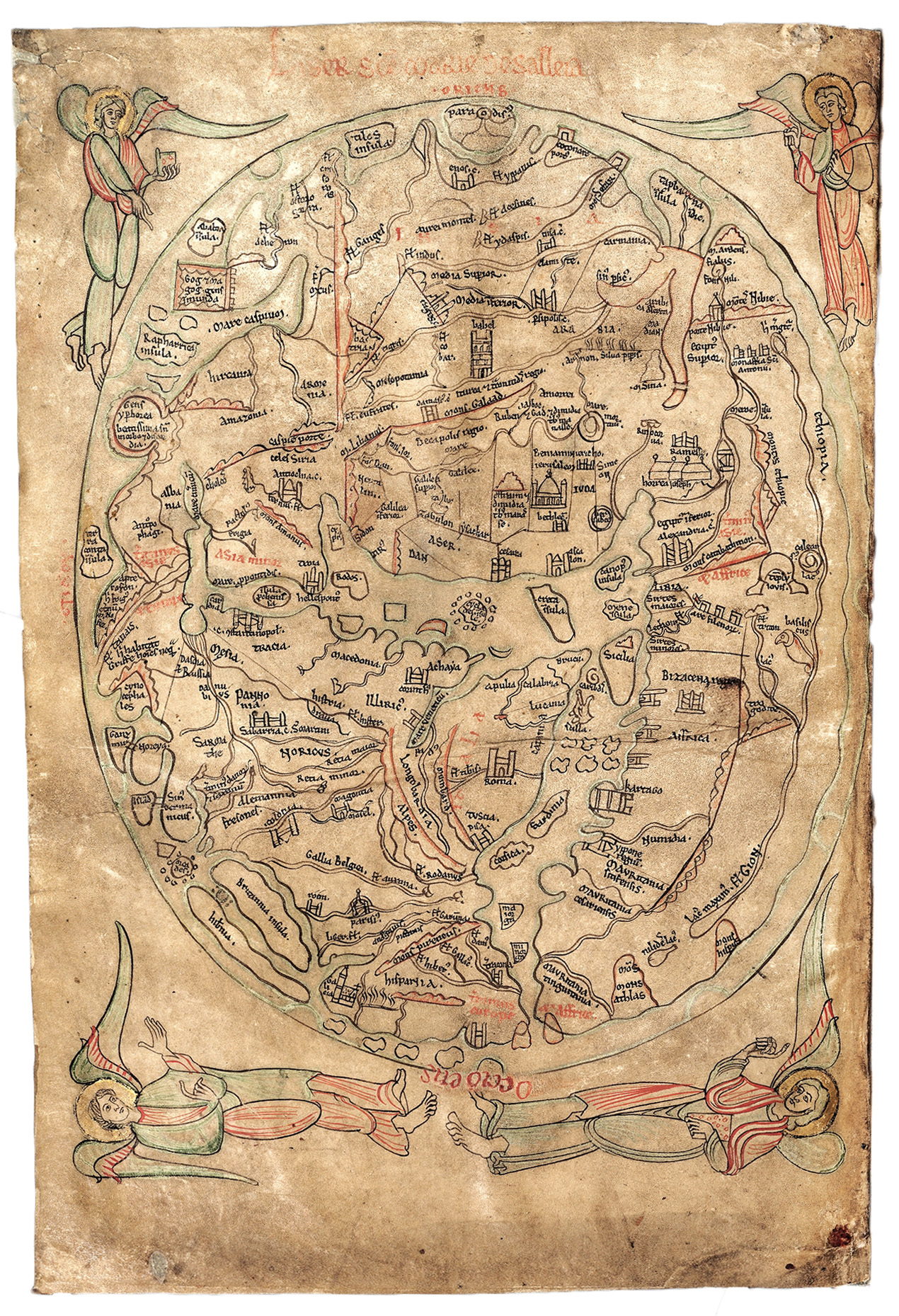
Two Things About the Sawley Map


First, if you will look at the picture from wikimedia commons:


This work is in the public domain in its country of origin and other countries and areas where the copyright term is the author's life plus 100 years or fewer.


You will note that there are four angels.

This is a literalistic reference to Apocalypse 7:1. This doesn't mean that the author believed the earth to be flat, it just means the map is concentrating on what is presumed to be the land hemisphere. In actual fact, as discovered later, the Atlantic isn't on the Western edge of the land hemisphere, it's a water wedged inside it (with some of the displaced tectonics showing up around Baffin Bay, I'd say).

So, given this iconographic tradition, I'm certain I'm right to take the four corners as literal. The angels are also placed, as I place the corners, in the roughly NW, NE, SE and SW of the land hemisphere (or the truncated version they knew of it).

This is one item I'd note.

Another one is this. It was a piece of art. A personnalised art work accompanying the book Imago Mundi by Honorius of Autun. This specific map, smaller than an A4, only exists on this page of a copy of this book, i e second page (folio 1v) of manuscript 66 at Corpus Christi College, Cambridge.

https://en.wikipedia.org/wiki/Sawley_map

There are no follow up pictures that I know of*. No picture of Brittany or of the Holy Land or of Egypt or of Russia. No, there is no higher resolution than c. 1/2 the actual land hemisphere on 20 cm × 30 cm or 11.8 in × 7.9 in. If you are a general, it may be OK as a way to figure out a general travel route from Scotland to the Holy Land, for a Crusade, for instance, but it's not sth you can use in order to adapt a strategy to the actual terrain of an area.

Such smaller areas shown on maps of higher resolution didn't enter into the ceremonial purpose of viewing the inhabited world between the four angels of Apoc. 7:1. Nor were they needed to figure out a sea route across the Mediterranean or the North Sea.

Also:

Around 1,100 mappae mundi are known to have survived from the Middle Ages. Of these, some 900 are found in illustrated manuscript books and the remainder exist as stand-alone documents.


https://en.wikipedia.org/wiki/Mappa_mundi

To modern eyes, mappae mundi can look superficially primitive and inaccurate. However, mappae mundi were never meant to be used as navigational charts and they make no pretence of showing the relative areas of land and water. Rather, mappae mundi were schematic and were meant to illustrate different principles. The simplest mappae mundi were diagrams meant to preserve and illustrate classical learning easily. The zonal maps should be viewed as a kind of teaching aid – easily reproduced and designed to reinforce the idea of the Earth's sphericity and climate zones. T-O maps were designed to schematically illustrate the three land masses of the world as it was known to the Romans and their medieval European heirs.


As I said. Few and not very useful in the practical sense, apart from being a teaching aid. A very ligne claire or Hergé version of an image d'Épinal.

Even their existence is due to some cultural factors that cannot be presumed for just each and every kind of society with a similar level of technology.

Why do I mention this? The fact is, I gave an answer on why the Witchking of Angmar didn't know where the Shire was, even though it was part of the Northern kingdom, of Arnor, and the Witchking conquered it. Many had stated the Witchking didn't know the hobbits called it The Shire. I stated, the Witchking couldn't have found it on a map, because he didn't have any.

And he didn't have any, because maps were not an everyday object.

If Guderian wants to invade Russia or if Zhukov wants to take Berlin, they have no problems getting maps of enemy territory, because local and regional maps are everyday objects, printed in the millions. This is not how Attila the Hun got into France or even how the Teutonic order (as far as I know) planned their failed attempt at Tannenberg in 1410. Neither of them could trust someone to sneak in as a civilian behind enemy lines and just buy a map in a shop. There were no shops where you could buy maps. They were luxury items.

Now, Third Age 1409 and the previous and ensuing centuries is basically meant to be reminiscent of the Dark Ages or Age of Migrations, but a bit more devastating (mimicking the depopulation of much of Europe prior to the migration from Yamnaya). In Third Age 3018 and 3019 (main setting of Lord of the Rings), it's 1418 / 1419 in the Shire calendar, and that is a pretty good indication of the part of the Middle Ages that Tolkien was thinking of, in part, (like the end involves an alternative ending to the siege of Constantinople, one in which the invader is driven back).

The second best attack** on Tolkien's plotting turns around the equivalent of pretending that King Arthur could have walked into a shop to buy maps for the area around Constantiniple, in Nennius. Monty Python might have done that to the Arthuriad, but Tolkien wouldn't.

Hans Georg Lundahl
Nanterre UL
Pentecost Thursday
28.V.2026

PS, if for some reason you still don't get it, one influence Tolkien was on me was getting into the real Christian Middle Ages a bit more than the usual Disney slop or worse./HGL

*I'm by far no expert on this manuscript or the whole work, so there might be a surprise in for me. I only know it from wikipedia. ** The first and third best attacks are about getting into Morder, company of the ring versus armies of Gondor.

Can Jews for Judaism Explain "le Olam" ?


Why Psalm 110 Terrifies Modern Judaism
Christian Chronicles | 24 May 2026
https://www.youtube.com/watch?v=UyRDxy6hFLE


This is the Classic Christian challenge, simply taking note of what's in the Psalm.

King David is talking of the Messias as of "my lord" ... the argument isn't that "LORD" and "lord" are the same word in Hebrew, though it becomes so back when reading the tetragrammaton as "Adonai" (now, for some reason, they prefer "HaShem"). The argument is that whoever King David was talking about was not King David and not just simply any descendant who needed to see David as lord, since father or ancestor. This point is missed in the Jewish response I just read.

That person is by God the most High, by the LORD, invited to sit at His right hand.

That person is also a priest, namely the same type as Melchizedek was. And that forever.

Each of these is more or less explained by Jews for Judaism, in the link below, written or compiled by Bentzion Kravitz:

Psalm 110 - A Jewish Perspective
https://jewsforjudaism.org/knowledge/articles/psalm-110-a-jewish-perspective


King David is, they say, putting words into the mouths of Levites, to sing about him when he has the temple consecrated. So ... wait, is each Levite singing about King David or King Solomon as "my lord"? Why aren't they unitedly singing of King David as "our lord" if King David meant this to be words in the mouth of Levites, not said in his own person?

This also has the weakness that the temple actually was consecrated by David's son Solomon.

The seat at the right hand is not in some heavenly sphere, the right hand simply means protection, specifically military such.

And Melchizedec was "Cohen" insofar as he was King, not an actual priestly function.

Now, it is true that "Cohen" is used of King David's sons II Kings/Samuel 8. It's also true that King David once behaved like a Cohen, by eating of the breads of presence, and it's not improbable that the Temple fixed the illegality by an adoption, making King David an Aaronite by adoption. However, Catholic commentary tends to accept the Jewish explanation that this means some kind of peace time officers, like of the palace, rather than strictly temple functions. We see this kind of mingling (as per my suggestion) of Aaronite and Davidic later on too, since Mary and Joseph were of the house of David, but Mary's cousin was the wife of a Cohen (strict Aaronitic sense).

In sum, the psalm refers to King David as lord of Levites (plural), protected by God, holding office (not a priestly one) in Jerusalem.

Here is where this breaks down.

If David was putting words into the mouths of plural Levites, and the word is about himself, why is he "my lord" and not "our lord"?

If sit at my right hand is no more than "be secure in my protection" why is Daniel seeing a heavenly vision? Here:

I beheld therefore in the vision of the night, and lo, one like the son of man came with the clouds of heaven, and he came even to the Ancient of days: and they presented him before him And he gave him power, and glory, and a kingdom: and all peoples, tribes and tongues shall serve him: his power is an everlasting power that shall not be taken away: and his kingdom that shall not be destroyed
[Daniel 7:13-14]


As we are at the wording of David in the psalm, how many nations did king David judge through Israel?

I only recall Philistines. The Amalecites were already killed off by Saul.

He shall judge among nations, he shall fill ruins: he shall crush the heads in the land of the many
[Psalms 109:6]


Seems more like Daniel 7 than King David.

Now, suppose King David were "Cohen like Melchizedec" simply by ruling from Jerusalem, there are two problems.

First, Melchizedec as ruler of Jerusalem or Salem is called, specifically Melech. He is called Cohen "of God the Most High" as if it were a priestly title, and in connection with an oblation of bread and wine, which can be seen as a kind of sacrifice, leading up to a blessing, another priestly act:

For from the rising of the sun even to the going down, my name is great among the Gentiles, and in every place there is sacrifice, and there is offered to my name a clean oblation: for my name is great among the Gentiles, saith the Lord of hosts
[Malachias (Malachi) 1:11]


If Catholicism is true, Holy Mass fulfills both Ps 109 and Malachias 1.

But more, whoever King David is talking about is this kind of Cohen like Melchizedec "for ever" or "le Olam" .... here is where Bentzion Kravitz gets very weak:

Therefore, the term priest as in “priest of G-d, the most high” in Psalm 110:14 can also refer to a leader.

That David would be a “priest forever after the manner of Melchizedek.” means that the privilege of being ruler of Jerusalem would always remain to David and his descendants forever.

“To David and his offspring, forever” Psalm 18:51


The sons of King David were not designated as priests of the most High, but if they actually could be so designated, one of them was a prophet. They were also not ruling Jerusalem when II Kings / Samuel 8 was about.

And the "forever" in Psalm 18 compounds with the difficulty for Judaism. Sons of David have not been ruling Jerusalem as kings since Nebuchadnezzar came and then once more under Serubbabel. Herod wasn't one. Titus wasn't one. Constantine wasn't one, nor even his mother St. Helen. Heraclius wasn't one and his enemy Chosroës II wasn't one. Omar wasn't one. Mehmed VI wasn't one, nor his older brother Mehmed V. Nor George V, nor Ben Gurion.

If physical or political rule of earthly Jerusalem is meant, the throne "forever" has stood empty, not for 2000 years, but for even longer. This parallels the disingenuous interpretation of Genesis 49:10. And as we there deal with Judah, not king David, and as there is an actual term, that political sovereignty was taken out of the hands of the Jews after Herod the Great died, so the expectation of nations has already come.

Hans Georg Lundahl
Nanterre UL
Pentecost Thursday
28.V.2026

Thursday, May 21, 2026

Perhaps I Had Too High Hopes For You, Tovia Singer


Why didn't you say so, Tovia Singer? · Perhaps I Had Too High Hopes For You, Tovia Singer

I mean "the moment it matters, you don't understand" in your video on Genesis 6 or your foolish dream about winning a war against Iran proving Ezechiel 38 refers to such ethnic Israelites who practise Judaism and their relatives ... and even worse, in so doing disproving the Church Fathers.

However, I began an answer on the Biblical authors of the New Covenant, these being 8 or possibly 9 people (some claiming Hebrews was not by St. Paul, but by Gamaliel's other disciple, St. Barnabas).

"We don't even know who the NT authors were"

In general.

I think I have heard this one before, but about the OT authors too.

No, Moses didn't write the Pentateuch. Daniel's prophecy of the two rams wasn't in the time of Nebuchadnezzar or Cyrus and the whole book is later. There were two Isaias.

Tovia, you seem to give some credence to one author being Paul, and then you divorce him from the main character of the second half of Acts and from the author of the Pastorals. That's a fair parallel to accepting the Isaias of IV Kings 19 as author of part of Isaias.

You know why we both know Moses wrote the Pentateuch, even if he was not the primary source for Genesis 9 and even if Deuteronomy 34 was written by Joshua? Because that's what the tradition says. The tradition among Christians, which we inherited from Second Temple Jews, the tradition among Samarians who refuse the book of Ruth, the tradition among Jews, also inherited from Second Temple Jews, which is not the same thing. If one of these traditions is right, whichever it is, Moses wrote the Pentateuch.

I'm not ignorant of which is true, I'm just keeping the argument accessible to those who have parts of the Catholic truth.

You would say the Jewish tradition is the true one, I disagree, vehemently, but on this theory too, Moses wrote the Pentateuch.

Now, the same applies to why we believe Daniel is the author of Daniel and the two rams prophecy was given to one deported by Nebuchadnezzar. And to why Isaias has one author.

This presumes, we normally trust tradition on who wrote what book. Even outside sacred scriptures. I trust tradition that Julius Caesar penned Commentarii de Bello Gallico. I trust tradition that Arrian wrote a work on the Life of Alexander the Great. _Anabasis of Alexander._ I also trust tradition that he was not at all a contemporary but had access to lost works by such, by two of Alexander's generals.

It's not trusting a tradition on an authorship which takes a special argument, it's not trusting one. Saying "Moses wrote the Pentateuch, Daniel wrote Daniel, Caesar wrote the Gallic War, Arrian wrote Anabasis of Alexander, Xenophon wrote an older Anabasis, from which I will recall "pente parasangas"* until I die, presumably, but Paul didn't write Timothy and his disciple didn't write Acts" is special pleading. As such it needs a special argument.

Luke and Acts were written much later.

I will here not content myself with referring to your video.

You gave the reasons, 1) Luke copies Mark, Mark is post-AD 70, and 2) Acts so late that Luke missed out on Paul being executed under Nero. I've heard a reason 3) that Mare Adriaticum was in the time of St. Paul still called Mare Illyricum and so the change occurred in 140 AD, showing an anachronism.

1a) Luke copies Mark.

Not according to tradition.

Now, you could say, tradition is in this specific case not to be trusted, since there is a Synoptic thing going on, seeming to indicate there is some copying.

Here is my response.

I'd tend to go with the version in Stromata, by Clement of Alexandria. Matthew was written first. Then Luke, ignoring Matthew, wrote his Gospel.

He brought it to Peter in Rome to get it approved (so, this is, if so, an early attestation of Papacy, since Luke was probably in the Holy Land when he collected the witness accounts).

Peter already knew Matthew, and spontaneously picked up scrolls, one brought by Luke and one he already had by Matthew. He started reading in alternation from both (starting after the childhood accounts, which are complementary). He also inserted some remarks on his own. Mark was his secretary and thought he was finally dictating a Gospel, so started to take this down as dictation.

Peter remarks what Mark is doing and authorises that as a Gospel and Luke after it.

This story pretty fully accounts for the Synoptic unity or near unity of loads of text.

Two more details. It's not all that probable that this alternate reading went on all the time without either of St. Peter or St. Mark noticing what happened. It's also not excluded, the reading time being in English one hour for silent reading and someone has stated reading it aloud took 1 h 30 min. If St. Peter's enthusiasm lasted that long, St. Mark takes a palm in good secretary taking down-ship. Indeed, among other patronages, he's not just invoked for Alexandria, where he was the first bishop, and Venice, where his relics are since the Crusades, but also precisely secretaries.

The other possibility is, Peter noticed what was happening, perhaps halfway through, perhaps earlier, took it as a sign of the Holy Ghost, and then continued. Perhaps he didn't tell St. Mark, whose witness in Alexandria would have been accessible to Clement the Stromatist.

The other thing is, while St. Luke was doing his interviews, it's very probable the Christians he interviewed already had the Gospel of St. Matthew, were used to hearing episodes or pericopes from it (you already know, some other readers of mine don't know, in Hebrew that's a Parashah). This may well have coloured the wording they reported to St. Luke.

So, no, forget the Prussian Kulturkampf shtick that "Matthew and Luke copied Mark" ...

1b) Mark is post-AD 70

This is based on the idea that Jesus did not predict the destruction of the Temple.

You have pretended to find fault with how He predicted it, namely the words "not a stone shall be left on a stone" and you point to the Western Wall.

First, it's clearly not from Herod's time.

Coin discovery sheds new light on sacred Jerusalem site
Nov. 24, 2011, 1:38 AM GMT+1 / Source: The Associated Press | By Matti Friedman
https://www.nbcnews.com/id/wbna45419597


But that would still be before AD 70, so what's going on?

Christians have proposed, and I'll add a third:

  • Western Wall is the wrong site
  • Western Wall is outside the actual temple as such and part of a surrounding complex, like around the Court of the Gentiles
  • Jesus prophecied only about the stones already standing in His time, the Western Wall was added later (Archelaus II, perhaps).


Or even "not a stone on a stone" describes a figure of speech or is sufficiently fulfilled in all the buildings that were destroyed.

So, the idea that the prophecy is wrong doesn't stand.

The idea that the prophecy is added after the event has been pretended about Daniel's two rams prophecy too, as I've mentioned.

2) Acts is written so late that Luke didn't get the memo that Paul was executed under Nero.

Or, Acts is written under Emperor Claudius, making the Gospel of Luke early too.

At this time, St. Paul was in prison, but definitely not executed yet. The reason that the martyrdom of Peter and Paul isn't mentioned is that the book was already finished when it happened.

3) Mare Illyricum became Mare Adriaticum in 140 AD

This seems to be one reading of the texts, there is no official declaration that "Mare Illyricum" should be renamed "Mare Adriaticum" from the time of Hadrian or his successor. It's simply the idea of a man who found "Mare Illyricum" in Cicero, I presume, perhaps Caesar too and "Mare Adriaticum" in a post 140 text, not sure which.

Here is wiki on the ancient names, I'm omitting a subsequent paragraph of the section that gives non-Classic names:

The origins of the name Adriatic are linked to the Etruscan settlement of Adria, which probably derives its name from Illyrian adur 'water, sea'.[2] In classical antiquity, the sea was known as Mare Adriaticum (Mare Hadriaticum, also sometimes simplified to Adria) or, less frequently, as Mare Superum '[the] upper sea'.[3] The two terms were not synonymous, however. Mare Adriaticum generally corresponds to the Adriatic Sea's extent, spanning from the Gulf of Venice to the Strait of Otranto. That boundary became more consistently defined by Roman authors—early Greek sources place the boundary between the Adriatic and Ionian seas at various places ranging from adjacent to the Gulf of Venice to the southern tip of the Peloponnese, eastern shores of Sicily and western shores of Crete.[4] Mare Superum on the other hand normally encompassed both the modern Adriatic Sea and the sea off the Apennine peninsula's southern coast, as far as the Strait of Sicily.[5] Another name used in the period was Mare Dalmaticum, applied to waters off the coast of Dalmatia or Illyricum.[6] During the early modern period, the entire sea was also known as the Gulf of Venice (Italian: golfo di Venezia),[7] although that name is now informally applied only to the northern area of the sea, from Maestra Point in the Po Delta to Cape Kamenjak on the Istrian Peninsula.

https://en.wikipedia.org/wiki/Adriatic_Sea#Name


But suppose this were the case, suppose this were an anachronism. I didn't look it up, so I gave the other possibility.

Like scribes in the Tabernacle and Temple changed names in the Torah to update, after the cities of Exodus 1:11 were renamed, so also a Christian scribe could have changed the name after 140. But I find it likelier that wiki is right, and that the prevalence of the name Adriatic ows more to Acts than to Emperor Hadrian.

"Paul ... definitely was not a Pharisee."

He does not apply Pharisaic thinking.

From the parallel passage on the Gospels, I presume you mean, he's not getting into legal stuff. And when he does, as in Timothy, you say it's another person and not Paul.

The problem here is, on the Christian view, which is the right one, the old law was done away with when Jesus died. Debating what work you can or can't do on a Sabbath after Good Friday is like debating how the Holy Roman Emperor proceeds when naming a duke, after 1806 and 1918.

So, lot's of the things St. Paul learned when he studied under Gamaliel, simply doesn't apply any more, and that's why he's not using that type of questions. Jesus famously was saying the thing about donkeys before he was crucified, when the Old Law still was in full force, except Judah had lost the sceptre, Rome didn't allow Jews to carry out death penalties, and if they did so anyway, it was illegal lynchings. Also, people were High Priests on a rotational basis and that's unlike the rules foreseen by Moses about Aaron.

"He is also quoting from Menander."

If you don't believe the Messiah has come, you won't try to be relevant to people who need to accept him.

St. Paul did believe He had come, had asked for the Gentiles on top of the Jews, and so St. Paul was complying by being an efficient missionary to Gentiles.

"Completely at home in the Greco-Roman world"

As you are in the US of A. You may disapprove of things, some I would approve of, but you know your stuff. You don't take California for a Caliphate, even if that's part of where the name came from.**

For instance, you mention Einstein. Princeton. How is that less abhorrent than Menander?

I mean, his cousin Alfred is making decent statements about music history. He compares Gregorian music to Synagogal recitation and finds common ground, but a huge difference in Gregorian having a smoothing out of rhythmical differences and no chromatism.

But the guy who pretends everything is determined? He was worshipping a false god.

"He is applying Middle Platonic thinking everywhere."

Like Philo and Josephus aren't doing so? Josephus was also a former Pharisee, and Philo did some parallel work to them. Between Philo and Pharisees, St. Paul at least scores one Pharisaic point in clearly believing the Resurrection of the Dead.

"Pharisee means the exact same thing as Orthodox Jew."

No. The earliest Pharisees were not yet parts of Rabbinic Judaism. The earliest tractates of the Mishna are pre-Christian, therefore not anti-Christian. This is by the way not the case with Sanhedrin 59a, Yohanan Ben Zakkai. He wrote after the Destruction of Jerusalem. This arguably totally switched the way the LXX was viewed (OT accessible to Gentiles).

"Paul claims to be a Pharisee."

You mention Philippians 3, and here is a passage which might solve the objections you have to that claim:

Though I might also have confidence in the flesh. If any other thinketh he may have confidence in the flesh, I more Being circumcised the eighth day, of the stock of Israel, of the tribe of Benjamin, an Hebrew of the Hebrews; according to the law, a Pharisee According to zeal, persecuting the church of God; according to the justice that is in the law, conversing without blame But the things that were gain to me, the same I have counted loss for Christ
[Philippians 3:4-7]


In other words, if there is a noticeable lack of Pharisaic thinking in St. Paul's letters, it's because he gave that up.

"Always talking of himself."

Always be wary if someone throws this around about someone he disapproves of!

I check Romans, quick overview: a few verses in the presentation, chapter 1, three verses in chapter 9 ... no, he actually isn't.

I have recently been obliged to talk about myself for a purpose, and some might pretend this is a very representative sample. It also isn't.

Only Luke in Acts claims Paul was a student of Gamaliel.

This is dealt with in the part about Acts and Luke, and it is dealt with in part in above objections to his being such.

But did you know that wiki on Gamaliel states that he was a grandson of Hillel, but even so, he is passed over when Pirkei Abot gives the lineage of the Hillel school, reference to 1—2.

Perhaps Gamaliel too was not very typical as emerging "Orthodox" Judaism was concerned. Perhaps the very little there is of Gamaliel in the Mishna is due to Yohanan Ben Zakkai being the gatekeeper between Second Temple Judaism, recently destroyed, and emerging Rabbinic Judaism.

Did I forget anything?

I suppose I'll be watching your video again, just to make sure, maybe write a PS or maybe another post, but in the meantime, I'll finish this one. I came to notice, one passage in St. Paul would probably have appealed to basically every Pharisee:

For the justice of God is revealed therein, from faith unto faith, as it is written: The just man liveth by faith For the wrath of God is revealed from heaven against all ungodliness and injustice of those men that detain the truth of God in injustice Because that which is known of God is manifest in them. For God hath manifested it unto them For the invisible things of him, from the creation of the world, are clearly seen, being understood by the things that are made; his eternal power also, and divinity: so that they are inexcusable

Because that, when they knew God, they have not glorified him as God, or given thanks; but became vain in their thoughts, and their foolish heart was darkened For professing themselves to be wise, they became fools And they changed the glory of the incorruptible God into the likeness of the image of a corruptible man, and of birds, and of fourfooted beasts, and of creeping things Wherefore God gave them up to the desires of their heart, unto uncleanness, to dishonour their own bodies among themselves Who changed the truth of God into a lie; and worshipped and served the creature rather than the Creator, who is blessed for ever. Amen

For this cause God delivered them up to shameful affections. For their women have changed the natural use into that use which is against nature And, in like manner, the men also, leaving the natural use of the women, have burned in their lusts one towards another, men with men working that which is filthy, and receiving in themselves the recompense which was due to their error And as they liked not to have God in their knowledge, God delivered them up to a reprobate sense, to do those things which are not convenient Being filled with all iniquity, malice, fornication, avarice, wickedness, full of envy, murder, contention, deceit, malignity, whisperers Detractors, hateful to God, contumelious, proud, haughty, inventors of evil things, disobedient to parents

Foolish, dissolute, without affection, without fidelity, without mercy Who, having known the justice of God, did not understand that they who do such things, are worthy of death; and not only they that do them, but they also that consent to them that do them
[Romans 1:17-32]


This would be a Midrash if you like on

Behold, he that is unbelieving, his soul shall not be right in himself: but the just shall live in his faith.
[Habacuc 2:4]


And why would it be worse to cite Menander than to cite Bugs Bunny?

Hans Georg Lundahl
Nanterre UL
Thursday in Pentecost Novena
21.V.2026

The post was mostly in reference to:

Rabbi Tovia Singer - Are the New Testament Authors REALLY Jewish? 2331
TeNaK Talk (TaNaCh) | 13 May 2026
https://www.youtube.com/watch?v=564eZ2eeoZ0


* 15 to 22 1/2 miles, or 24 to 36 km, it seems the exact value is not fully known. Too brisk a walk for me, I'm sure, even back in 2004. After one thirty km day, I had sores. ** See Will There Be a Real Hobbiton or Beruna? There Is California.

Wednesday, May 20, 2026

Charges Against C. S. Lewis


Assorted retorts from yahoo boards and elsewhere: On CSL and Mike Schmitz · New blog on the kid: Did C. S. Lewis Publically Attack Catholicism? · Φιλολoγικά/Philologica : Charges Against C. S. Lewis

Found a meme on FB, an Evangelical attacking C. S. Lewis about doctrinal matters:


Some of the charges are true, and in some cases, they are charges against Catholicism and so against me too.

Purgatory is a real place ... he insisted it didn't include flames, though, despite 1 Cor 3:15. I wish he had been more into this. And less into excusing the Reformation by blaming the "flame imagery".

Catholic sacraments are necessary ... again, I wish he had been more into this. He did not explicitate what exact view he held of the Eucharist, but felt some need to excuse the Reformation by taking a distance from Real Presence and Transsubstantiation.

Anglicans and under their influence by now also Lutherans do have seven sacraments, but recognise only some of them as "Gospel sacraments" ... C. S. Lewis confessed regularly, but unfortunately to a priest who had no actual power to absolve him.

Some of the charges are true, and I take a distance.

The Bible is not inspired or inerrant ... he actually believed the Bible inspired but not everywhere inerrant, especially on topics outside doctrinal or moral core doctrine. To him it was good enough if the Bible conveyed truth, even if on some issues it didn't convey literal fact.

Evolution is true ... this to the amount that he didn't believe in a literal Adam. Lots of Church of England didn't already before he returned to it. There is some indication in late essays he was maybe reconsidering this, but in two works of the 1940's, this was very unfortunately the case. In Miracles, it matters less, he enumerates Evolution among the truths that only quasi transcendent claims of reason could reveal with certainty to us. In Problem of Pain, it matters more, he gives a whole chapter on what happened instead of the actual story in Genesis 3.

The Bible is not literal ... more like diversly literal or otherwise in diverse books. Genesis he classed as mythology, so, not literally true.

Obviously, I cannot be held solidaric with these actual errors given I have explicitly stated my adherence to the opposite truths.

Some are what I consider and he would probably also have considered debatable topics.

Christ did not atone for our sins ... by substitutionary atonement, as Evangelicals understand it, if so understood, it is actually correct. Jesus was not temporarily damned so we needn't be. He was temporarily dead, so we could be raised. But He won our delivery from sin by other means, i e sacrifice.

CSL was not totally into the Catholic view of Christ's sacrifice, which has more of atonement in the Evangelical sense than his position had, he certainly believed Jesus saves us through the Cross, and he was content to say "I don't understand how, I just believe that."

Pagan religions have truth ... if we take this as them having some truth, that is obvious.

There is a God Who created Heaven and Earth is a truth admitted by unbelievers like Jews and Muslims.

There is a clear question on how much such truth can be hoped to contribute to an adherent's salvation. I would say, and CSL would not say "if he didn't convert from that community, it didn't contribute enough, though."

God is found inside man ... how so?

If you mean "inside man, as opposed to in Bible or Church", that's not just a heresy, but a heresy CSL didn't utter.

CSL would have stated, and I would agree, that some things that happen inside man, for instance universally valid reasoning, even if we are sometimes inattentive enough to reason invalidly or on false premisses, or universally valid moral principles (sth other than "universally agreed" as in conventions!) are known if not always obeyed, do in fact point to God being the reason why they exist.

Natural Man is not condemned ... what "natural man"?

The word "natural" in the context of man or his habits is used in two different ways. CSL as a linguist knew both.

  • as opposed to elaborate, studied, cultured, possibly overcultured and degraded to unnatural man, and in this sense Christianity does not condemn natural man;
  • as opposed to regenerate man, and in this sense not just all of Christianity, but CSL with it admits that man on his own, without redemption, is headed for damnation.


I suppose some sects are so good at making the "discipleship" a perversion of human nature, that they tend to confuse the two senses. For instance, it's natural man in the first sense that is disgusted at Double Predestination, and yet a Calvinist will pretend this is just the reflex of Unregenerate Man, Incurved into himself. This is obviously a well known and old example, but there are some newer ones too.

White Magic is good ... when and where?

CSL would have classed what Jacob did with painted staffs in Genesis 30 as "magic", and somehow he considered that even so God allowed it back in this confused time, when very little of revelation was public and known on earth.

CSL might have classed what St. Raphael did in Tobit as magic, in this case, it's his prerogative as an angelic being. It's men who are forbidden to use angelic powers at their own command, since the only angels providing such to some would be demons.

In the parallel creation called the world of Narnia, he supposed there was no such rule. Perhaps because in Narnia, the magic would not have been provided by demons. He would probably have denied that in our world it would be licit to call on help magically by blowing a horn, aware that no one likely to hear it would be willing or able to provide help.

When Merlin offers help, his help is accepted, but with a caution, and someone tells him that such things "were never quite licit even back in your day"

And some of the charges are simply false.

Hell is fiction ... if you had said "Hell is unreal" you would have been up to something about what CSL thought.

He thought that every damned person in Hell is unreal, like a drama queen is unreal. Like you are telling someone "get real" you don't imagine you are God calling them into existence. You are calling them out of a real or supposed unreality of their own self perception and perception of their circumstances.

That kind of unreality, Hell, on his view, has plenty of, and Satan was the first drama queen. And it "rubs off on the landscape" too. But Hell is as unreal as a person or place gets without not existing at all, Hell is not unreal like a fictional story. As a Platonist, CSL believed "reality" or in other words "being" has several different graditions, not just that God is more an IS than any created thing is, but also that there are differences within creation.

God's creation was flawed ... if you mean "before sin", no. As he admitted Evolution, he admitted sadness and pain before human sin, but he put this down to creation being corrupted by Satan. I think Copeland has said the same thing, and does so in connection with Gap Theory, the creation days supposedly coming after "Satan's Flood" after a flood in between Genesis 1:1 and Genesis 1:2 over God condemning how Satan had misruled and corrupted earth.

This is wrong too, but CSL never said this was how God's creation originally was.

Mysticism supersedes the Bible ... no. He definitely does not say mysticism supersedes external authority, whether of Bible or of Church Magisterium.

We should pray to the dead ... he said we and the dead can pray for each other, he clearly didn't feel at home in directly asking dead, presumably having died in Christ, to pray for him.

On praying to the saints, Anglicans are divided from Catholics by a ban ... which CSL respected. On praying with them, well, Anglican "common prayer" as well as Lutheran "mass" (but not a valid one) have liturgic traces of the Catholic mass and both say things to the effect of "Therefore with Angels and Archangels, and with all the company of heaven, ..." so, CSL insisted we have the right to pray WITH the saints, but while he respected his friend Tolkien under a different ecclesial authority praying to them, he didn't do that.

God is not the only object of worship ... again, I don't see CSL even took up praying the Hail Mary, just so as to avoid making some person other than the Three Persons of the Trinity an object of any kind of cultus.

In Catholicism, God is the only object of the cultus or worship of adoration. CSL unfortunately (like other Protestants) took this to other kinds of cultus as well, denying saints dulia or hyperdulia. The most Marian prayer he allowed himself was arguably the Magnificat, because he thought it was OK to pray with Her.

We also adress Her with the words of Gabriel and Elisabeth, of an angel and a priestwife of the Old Testament, and some prayers from the tenderness of the faithful over the centuries. He didn't, alas.

Hans Georg Lundahl
Nanterre BU
Wednesday of the Pentecost Novena
20.V.2026