Tuesday, October 3, 2023
Daughters of Leonor de Alvim
Daughters of Joan of Ponthieu, Dame of Epernon · Daughters of Leonor de Alvim
Medium years 1515~1516. Here my starting point, going back to her mother by mother and down again daughter by daughter is Catherine of Aragon.
Leonor de Alvim
https://en.wikipedia.org/wiki/Leonor_de_Alvim
Leonor de Alvim (c. 1356 – 1388) was a Portuguese noblewoman. She belonged to a family from Entre-Douro-e-Minho and was the daughter of João Pires de Alvim and his wife Branca Pires Coelho. She became the heir to her father due to the lack of male children.
[No wiki says at what age she married Barroso]
Beatriz Pereira de Alvim (1380–1414) was a Portuguese noblewoman, the only child of Nuno Álvares Pereira and his wife Leonor de Alvim.[1]
On 8 November 1401, she married Afonso, Count of Barcelos, illegitimate son of king John I of Portugal.[2] She died before her husband became Duke of Braganza.
Isabel of Barcelos (October 1402 – 26 October 1466), also known as Isabel of Braganza, was a lady of the Portuguese nobility during the Late Middle Ages. She was the daughter of Afonso I, Duke of Braganza and Beatriz Pereira de Alvim, and she married Infante John, Lord of Reguengos de Monsaraz, her half-uncle, son of John I of Portugal.
In 1424, John married his half-niece Isabella of Barcelos, daughter of his half-brother Afonso of Barcelos.
Isabella of Portugal (Isabel in Portuguese and Spanish) (1428 – 15 August 1496) was Queen of Castile and León as the second wife of King John II. She was the mother of Queen Isabella I of Castile.
She was married to King John II of Castile as his second wife. His first wife, Mary of Aragon, had given him four children, though only one, the future Henry IV of Castile, had survived. Henry had been joined to Blanche II of Navarre in an unconsummated marriage for seven years and was called "El Impotente." Because of this, John decided to seek another wife, preferably with a French princess. However, his trusted adviser and friend Alvaro de Luna decided a Portuguese alliance was better politically, and negotiated a match with the much younger Isabella.[1] The two were wed on 22 July 1447 when John was 42 and Isabella 19.
Isabella I (Spanish: Isabel I; 22 April 1451 – 26 November 1504),[2] also called Isabella the Catholic (Spanish: Isabel la Católica), was Queen of Castile from 1474 until her death in 1504. She was also Queen of Aragon from 1479 until her death as the wife of King Ferdinand II.
Spouse Ferdinand II of Aragon (m. 1469) / They married immediately upon reuniting on 19 October 1469 in the Palacio de los Vivero in the city of Valladolid.
Catherine of Aragon (also spelt as Katherine, Spanish: Catalina; 16 December 1485 – 7 January 1536) was Queen of England as the first wife of King Henry VIII from their marriage on 11 June 1509 until their annulment on 23 May 1533. Born in Spain, she was Princess of Wales while married to Henry's elder brother, Arthur, Prince of Wales, for a short period before his death.
The daughter of Isabella I of Castile and Ferdinand II of Aragon, Catherine was three years old when she was betrothed to Prince Arthur, heir apparent to the English throne. They married in 1501, but Arthur died five months later.
Mary I (18 February 1516 – 17 November 1558), also known as Mary Tudor, and as "Bloody Mary" by her Protestant opponents, was Queen of England and Ireland from July 1553 and Queen of Spain as the wife of King Philip II from January 1556 until her death in 1558.
Now aged 37, Mary turned her attention to finding a husband and producing an heir, which would prevent the Protestant Elizabeth (still next-in-line under the terms of Henry VIII's will and the Act of Succession of 1544) from succeeding to the throne. Edward Courtenay and Reginald Pole were both mentioned as prospective suitors, but her first cousin Charles V suggested she marry his only legitimate son, Philip. ... Their wedding at Winchester Cathedral on 25 July 1554 took place just two days after their first meeting.[98] Philip could not speak English, and so they spoke a mixture of Spanish, French, and Latin.
Isabella, Princess of Asturias (2 October 1470 – 23 August 1498) was the eldest daughter and heir presumptive of King Ferdinand II of Aragon and Queen Isabella I of Castile. She was Queen of Portugal as the wife of King Manuel I from 30 September 1497 until her death the following year.
Her first marriage was to Prince Afonso, the only son and heir of King John II of Portugal from his marriage with Eleanor of Viseu.[7] The wedding, by proxy, took place in the spring of 1490 in Seville. On 19 November of that year, Isabella arrived in Badajoz, ...
Joanna (6 November 1479 – 12 April 1555), historically known as Joanna the Mad (Spanish: Juana la Loca), was the nominal queen of Castile from 1504 and queen of Aragon from 1516 to her death in 1555.
Joanna was married by arrangement to the Austrian archduke Philip the Handsome on 20 October 1496.
Eleanor of Austria (15 November 1498 – 25 February 1558), also called Eleanor of Castile, was born an Archduchess of Austria and Infanta of Castile from the House of Habsburg, and subsequently became Queen consort of Portugal (1518–1521) and of France (1530–1547). She also held the Duchy of Touraine (1547–1558) in dower. She is called "Leonor" in Spanish and Portuguese and "Eléonore" or "Aliénor" in French.
Manuel and Eleanor married on 16 July 1518. They had two children: the Infante Charles (born 18 February 1520 – died 15 April 1521) and the Infanta Maria (born 8 June 1521, and who was later one of the richest princesses of Europe).
Maria of Portugal, Duchess of Viseu (18 June 1521 – 10 October 1577; Portuguese pronunciation: [mɐˈɾiɐ]) was an Infanta of Portugal, the only daughter of King Manuel I of Portugal and Eleanor of Austria.
Although she did not lack suitors and had several marriage proposals, Maria never married.
Isabella of Austria (18 July 1501 – 19 January 1526), also known as Elizabeth, was Queen of Denmark, Norway and Sweden as the wife of King Christian II. She was the daughter of King Philip I and Queen Joanna of Castile and the sister of Emperor Charles V. She ruled Denmark as regent in 1520.
On 11 July 1514, one week short of her 13th birthday, Isabella was married by proxy to King Christian II of Denmark with Emperor Maximilian I, her grandfather, standing in for the king. She remained in the Netherlands, but is said to have fallen in love with her spouse at the sight of his painting, and asked to be taken to Denmark. A year after the wedding, the Archbishop of Nidaros was sent to escort her to Copenhagen. The marriage was ratified on 12 August 1515, when she was 14 years old.
Dorothea of Denmark and Norway (10 November 1520 – 31 May 1580) was a Danish, Norwegian and Swedish princess and an electress of the Palatinate as the wife of Elector Frederick II of the Palatinate. She was a claimant to the Danish, Norwegian and Swedish thrones and titular monarch in 1559–1561.
On 18 May 1535, Dorothea married Frederick of the Palatinate in Brussels, and then in person in Heidelberg, from which they continued to their home in Neumarkt.
Christina of Denmark (Danish: Christine af Danmark; November 1521 – 10 December 1590) was a Danish princess, the younger surviving daughter of King Christian II of Denmark and Norway and Isabella of Austria. By her two marriages, she became Duchess of Milan, then Duchess of Lorraine.
On 23 September 1533 in Brussels, Christina was married by proxy to Francesco II Sforza, Duke of Milan, through his representative Count Massimiliano Stampa. On 3 May 1534, Christina made her official entry in Milan among great festivities, and on 4 May, the second wedding ceremony was celebrated in the hall of the Rocchetta.
Renata of Lorraine (French: Renée de Lorraine, German: Renata von Lothringen) (20 April 1544 – 22 May 1602) was a French noblewoman of the House of Lorraine who became a Duchess of Bavaria by her marriage to Duke William V.
Finally, on 22 February 1568, Renata married her paternal second, but maternal first cousin William, hereditary prince of Bavaria, in a large, elaborate ceremony and celebration in Munich that lasted 18 days. The event was described in detail by Massimo Troiano in his Dialoghi (1569).
Maria Anna of Bavaria (18 December 1574 – 8 March 1616) was a German princess, a member of the House of Wittelsbach by birth and an Archduchess consort of Inner Austria by marriage.
On 23 April 1600, Maria Anna married her first cousin[1] Ferdinand, Archduke of Inner Austria at Graz Cathedral.
Magdalene of Bavaria (German: Magdalena von Bayern) (4 July 1587 – 25 September 1628) was a German princess of the House of Wittelsbach who became Countess Palatine of Neuburg and Duchess of Jülich-Berg by marriage.
On 11 November 1613 at Munich, Magdalene married Wolfgang Wilhelm, Hereditary Prince of the Palatine-Neuburg, a close friend of her brother Maximilian; with this union, the Bavarian rulers hoped that the Lutheran Wolfgang Wilhelm would return to the Catholic faith.
Dorothea of Lorraine or Dorothée de Lorraine (24 May 1545 – 2 June 1621), was by birth a member of the House of Lorraine and by marriage to Eric II, Duke of Brunswick-Lüneburg, Duchess of Brunswick-Lüneburg-Calenburg.
On 26 November 1575 at Nancy, she married Eric II, Duke of Brunswick-Lüneburg, an old friend of her family and a recent widower from an unfortunate marriage with Sidonie of Saxony.
Mary of Austria (15 September 1505 – 18 October 1558), also known as Mary of Hungary, was queen of Hungary and Bohemia[note 2] as the wife of King Louis II, and was later governor of the Habsburg Netherlands.
On 22 July 1515, Mary and Louis were married in St. Stephen's Cathedral, Vienna. ... Due to their age, it was decided that the newly married couple would not live together for a few more years.
Catherine of Austria (Portuguese: Catarina; 14 January 1507 – 12 February 1578) was Queen of Portugal as wife of King John III, and regent during the minority of her grandson, King Sebastian, from 1557 until 1562.
On 10 February 1525, at the age of 18, Catherine married her first cousin, King John III of Portugal, she was married off to him by her mother Joanna I of Castile.
Dona Maria Manuela (15 October 1527 – 12 July 1545[1]) was the eldest daughter and second child of King John III of Portugal and his wife Catherine of Austria.
She married her double first cousin Philip II of Spain on 12 November 1543 at Salamanca.
Maria of Aragon (29 June 1482 – 7 March 1517) was Queen of Portugal as the second wife of King Manuel I, the widower of her elder sister Isabella.
Manuel and Maria were married in Alcácer do Sal on 30 October 1500,[3] and Maria was granted Viseu and Torres Vedras as her dower.
Isabella of Portugal (Portuguese: Isabel de Portugal; 24 October 1503 – 1 May 1539) was the empress consort of her cousin Charles V, Holy Roman Emperor, King of Spain, Archduke of Austria, and Duke of Burgundy. She was Queen of Spain and Germany, and Lady of the Netherlands from 10 March 1526 until her death in 1539, and became Holy Roman Empress and Queen of Italy in February 1530.
In January 1526, Isabella traveled to Spain. Upon her arrival, she met the Duke of Calabria, the Archbishop of Toledo and the Duke of Béjar at the Spanish-Portuguese border. They escorted her to Seville, where she would wait a week for Charles. In the end, their wedding took place the very next day just after midnight on 11 March in the Palace of Alcázar of Seville.[3][4]
Archduchess Maria of Austria (21 June 1528 – 26 February 1603) was the empress consort and queen consort of Maximilian II, Holy Roman Emperor, King of Bohemia and Hungary.[1] She served as regent of Spain in the absence of her father Emperor Charles V from 1548 until 1551 and was one of the most powerful empresses of the Holy Roman Empire.
On 15 September 1548, aged twenty, she married her first cousin Archduke Maximilian.[2] The couple had sixteen children during the course of a twenty-eight-year marriage.
Anna of Austria (2 November 1549 – 26 October 1580) was Queen of Spain by marriage to her uncle, King Philip II of Spain. During her last days of life she was also briefly Queen of Portugal.
In February 1569, Anna's engagement to her uncle Philip II was announced. In May 1570, they married by proxy. ... On 3 October Anna arrived on Spanish soil, ...
Elisabeth of Austria (5 July 1554 – 22 January 1592) was Queen of France from 1570 to 1574 as the wife of King Charles IX. A member of the House of Habsburg, she was the daughter of Maximilian II, Holy Roman Emperor, and Maria of Spain.
Elisabeth was first married by proxy on 22 October 1570 in the cathedral of Speyer. Her uncle, Archduke Ferdinand of Further Austria-Tyrol, was standing as proxy for Charles. After long celebrations, she left Austria on 4 November accompanied by high-ranking German dignitaries, including the Archbishop-Elector of Trier. ... King Charles IX of France and Archduchess Elisabeth of Austria were formally married on 26 November 1570 in Mézières; Charles, Cardinal de Bourbon performed the ceremony.
Joanna of Austria (in Castilian, Doña Juana de Austria; in Portuguese, Dona Joana de Áustria, 24 June 1535 – 7 September 1573) was Princess of Portugal by marriage to João Manuel, Prince of Portugal. She served as regent of Spain to her brother Philip II of Spain during his trips to England to marry Mary I from 1554 to 1556, and 1556 to 1559. She was the mother of King Sebastian of Portugal.
On 11 January 1552, at the age of sixteen, she married her double first cousin, the fourteen-year-old crown prince of Portugal, John Manuel of Portugal, by proxy in Toro. She arrived at the Portuguese court in November 1552.
Infanta Beatrice of Portugal (Portuguese: Beatriz [bi.ɐˈtɾiʃ]; 31 December 1504 – 8 January 1538) was a Portuguese princess by birth and Duchess of Savoy by marriage to Charles III, Duke of Savoy. She was the ruling countess of Asti from 1531 to 1538.
In Villefranche-sur-Mer on 29 September 1521, Beatrice married Duke Charles III of Savoy.
Infanta Beatriz of Portugal (13 June 1430 – 30 September 1506) was a Portuguese infanta, daughter of John, Constable of Portugal (fourth son of King John I of Portugal and his wife Philippa of Lancaster), and Isabella of Barcelos, a daughter of Afonso I, Duke of Braganza.
In 1447, Beatrice married her cousin Infante Ferdinand (Portuguese: Fernando), 2nd Duke of Viseu, son of King Edward of Portugal (her uncle).
Eleanor of Viseu (2 May 1458 – 17 November 1525; Portuguese: Leonor de Viseu [liuˈnoɾ ðɨ viˈzew]) was a Portuguese infanta (princess) and later queen consort of Portugal. She is considered one of her country's most notable queens consort and one of the only two who were not foreigners.
Eleanor married John, Prince of Portugal, on 22 January 1470. She thereby became the Princess of Portugal. The bride was eleven years old, and the groom was fourteen years old.
Isabel of Viseu (1459–1521) was a daughter of Infante Fernando, Duke of Viseu and his wife and cousin Infanta Beatrice, Duchess of Viseu. She was a member of the House of Aviz and later, House of Braganza.
O duque casara duas vezes; a primeira em 2 de maio de 1447, tendo apenas 17 anos de idade, com D. Leonor de Meneses (1430-1452), filha de Pedro de Meneses; a segunda, em 19 de setembro de 1472 com D. Isabel de Viseu (1459-1521), filha do infante D. Fernando, Duque de Viseu.
09 11 13 13 14 14 15 16 16 16 16 16 17 18 18 18 19 19 20 20 20 21 22 22 23 25 26 30 38
09 11 11 12 13 14 15 15 16 16 16 16 16 18 18 18 19 19 19 19 20 21 21 22 23 25 26 30 38
01 02 03 04 05 06 07 08 09 10 11 12 13 14 15 16 17 18 19 20 21 22 23 24 25 26 27 28 29
Min. 9, Lower quartile 15 or 16, Median 18, Higher quartile 21, Max 38.
Confer the other genealogy:
09 10 10 12 12 14 15 15 15 15 16 17 18 18 18 19 19 21 22 23
09 09 10 12 12 12 12 14 15 15 15 16 17 17 18 18 19 19 21 22
01 02 03 04 05 06 07 08 09 10 11 12 13 14 15 16 17 18 19 20
Min. 9, lower quartile 12 or 12 to 14, median 15 or 15 to 16, higher quartile 18 or 18 to 19 and max 22 or 23.
Why the difference? Partly, perhaps, the smallness of both samples. Let's see how they make a bigger one together ...
09 09 10 10 11 12 12 13 13 14 14 14 15 15
09 09 09 10 11 11 12 12 12 12 12 13 14 14
01 02 03 04 05 06 07 08 09 10 11 12 13 14
15 15 15 16 16 16 16 16 16 17 17 18 18 18 18 18 18 19 19 19 19
15 15 15 15 15 16 16 16 16 16 16 17 17 18 18 18 18 18 19 19 19
15 16 17 18 19 20 21 22 23 24 25 26 27 28 29 30 31 32 33 34 35
20 20 20 21 21 22 22 22 23 23 25 26 30 38
19 19 19 20 21 21 21 22 22 23 25 26 30 38
36 37 38 39 40 41 42 43 44 45 46 47 48 49
This, from these two statistics, together 49, is close to the other, from four statistics, 105 samples.
09 15 17 20 38
09 14 16 19 38
01 13 25 37 49
08 14 17 20 53
07 13 16 18 53
01 27 53 79 05
The median is identic in both, sixteen on lower counts, seventeen on higher counts, for any age where two (extreme) values are possible. The lower quartile is one year different, like the lower count of this is the higher count of the other, 14 years, so the higher count of this is two years above the lower count of the other, 15 is two years over 13. The higher quartile is 20 on the higher count of both, and 19 or 18 on the lower count. The Minimum gets drawn down from 9 to 7 or 8, the maximum is remains 53.
Can we get the two big stats together?
08 09 09 10 10 11 11 11 11 11 11 12 12 12 12 12 12 13 13 13 13
07 09 09 09 09 10 10 10 11 11 11 11 11 11 11 11 11 11 12 12 12
01 02 03 04 05 06 07 08 09 10 11 12 13 14 15 16 17 18 19 20 21
13 13 13 13 13 13 13 13 13 14 14 14 14 14 14 14 14 14 14 14 14 14 14 14 14 14 14 14
12 12 12 12 12 12 12 12 12 12 13 13 13 13 13 13 13 13 13 13 14 14 14 14 14 14 14 14
22 23 24 25 26 27 28 29 30 31 32 33 34 35 36 37 38 39 40 41 42 43 44 45 46 47 48 49
15 15 15 15 15 15 15 15 15 15 15 15 15 16 16 16 16 16 16 16 16
14 14 14 14 14 14 14 14 15 15 15 15 15 15 15 15 15 15 15 15 16
50 51 52 53 54 55 56 57 58 59 60 61 62 63 64 65 66 67 68 69 70
16 16 16 16 16 17 17 17 17 17 17 17 17 17 17 17 17 17 17 17 18 18 18 18 18 18 18 18
16 16 16 16 16 16 16 16 16 16 16 16 16 16 16 17 17 17 17 17 17 17 17 17 17 17 17 17
71 72 73 74 75 76 77 78 79 80 81 82 83 84 85 86 87 88 89 90 91 92 93 94 95 96 97 98
18 18 18 18 18 18 18 18 18 19 19 19 19 19 19 20 20 20 20 20 20 20 20 21 21 21 21 22
18 18 18 18 18 18 18 18 18 18 18 18 18 18 18 18 19 19 19 19 19 19 19 19 19 19 20 20
99 00 01 02 03 04 05 06 07 08 09 10 11 12 13 14 15 16 17 18 19 20 21 22 23 24 25 26
22 22 22 22 22 23 23 23 23 23 23 23 25 25 25 25 26 26 26 26 28 29 30 30 32 33 38 53
21 21 21 21 21 21 21 21 22 22 22 22 22 23 23 25 25 25 25 26 26 26 27 27 30 33 38 53
27 28 29 30 31 32 33 34 35 36 37 38 39 40 41 42 43 44 45 46 47 48 49 50 51 52 53 54
08 14 17:17 20 53
07 13 16:16 19 53
01 39 77:78 16 54
So, for a sample of 154 married women, half or more married between 13 and 19 or between 14 and 20, centering around 16 or 17. Those married anywhere from 13 to 20 would be positions 32 to 126 on the lower count of the ages, i e 95 / 154 = 61.688 %, and positions 11 to 121 on the higher count, i e 111 / 154 = 72.078 %. Either way, they start before 39 and go on past 116.
Hans Georg Lundahl
Paris
St. Francis of Assisi
4.X.2023
Assisii, in Umbria, natalis sancti Francisci, Levitae et Confessoris; qui trium Ordinum, scilicet Fratrum Minorum, Pauperum Dominarum, ac Fratrum et Sororum de Poenitentia, Fundator exstitit. Ipsius autem vitam, sanctitate ac miraculis plenam, sanctus Bonaventura conscripsit.
PS, I count together the other four statistics on this post, in French:
Encore de lignées féminines : l'âge au premier mariage
https://filolohika.blogspot.com/2023/10/encore-de-lignees-feminines-lage-au.html

Daughters of Joan of Ponthieu, Dame of Epernon
Daughters of Joan of Ponthieu, Dame of Epernon · Daughters of Leonor de Alvim
Medium year 1474. I started around Mary, Queen of Scots and went back mother after mother, and saw the branches too.
Joan of Ponthieu, Dame of Epernon
https://en.wikipedia.org/wiki/Joan_of_Ponthieu,_Dame_of_Epernon
Jeanne de Ponthieu, dame d'Épernon, Countess of Vendôme and of Castres, (Jeanne de Ponthieu, dame d'Épernon, comtesse de Vendôme et de Castres, before 1336 – 30 May 1376)
On an unknown date sometime before 1351, Joan married Jean VI de Vendôme, Count of Vendôme and of Castres, Seigneur de Lézingnan-en-Narbonnois, and de Brétencourt of the House of Montoire.
Catherine de Vendôme (1354 – 1 April 1412) was a ruling countess of Vendôme and of Castres from 1372 until 1403.
She married John I, Count of La Marche, in 1364.
Charlotte of Bourbon (1388 – 15 January 1422) was the queen consort of Cyprus and titular queen consort of Armenia and Jerusalem through her marriage to King Janus. She was his second wife and the mother of his six legitimate children, which included King John II and Anne de Lusignan. It was Charlotte's influence which was instrumental in the revival of French culture at the royal court in Nicosia.
On 25 August 1411, at Saint Sophia's Cathedral in Nicosia, Cyprus, Charlotte married as his second wife, King Janus of Cyprus and Armenia and titular King of Jerusalem.
Anne of Cyprus (or Anne de Lusignan) (24 September 1418 – 11 November 1462) was a Duchess of Savoy by marriage to Louis, Duke of Savoy. She was the daughter of King Janus of Cyprus and Charlotte of Bourbon; and a member of the Poitiers-Lusignan crusader dynasty.
On 9 August 1431 a marriage contract was signed between 12-year-old Anne and Prince Amadeus of Piemonte, eldest surviving son and heir of Duke Amadeus VIII of Savoy (who later became Antipope Felix V); however, the prince died only twenty days later, on 29 August.
Five months later, on 1 January 1432, was signed a second marriage contract for 13-year-old Anne, this time with Louis of Savoy, Amadeus' younger brother and new heir of the Duchy of Savoy. The wedding took place two years later, on 12 February 1434.[1] in Chambéry.
Margaret of Savoy (April 1439 – 9 March 1483), also known as Marguerite de Savoie or Margherita di Savoia, was the eldest surviving daughter of Louis I, Duke of Savoy. She was the wife of Margrave John IV of Montferrat, and later the wife of Peter II of Luxembourg, Count of Saint-Pol, of Brienne, Marle, and Soissons.
In December 1458 at Casale, she married her first husband, John IV, Margrave of Montferrat, the son of John Jacob of Montferrat and Joan of Savoy.
Marie of Luxembourg-Saint-Pol (died 1 April 1547) was a French vassal.[1] She was, as Marie I, the ruling Countess Regnant of Soissons and Saint-Pol in her own right by inheritance from her father between 25 October 1482 and 1 April 1547.
Born c. 1472
She was first married as a child to her maternal uncle, Jacques of Savoy, Count of Romont.
In 1484 Jacques of Savoy married Marie de Luxembourg (1462–1546)
Her daughter by her first marriage, Louise-Françoise of Savoy (d. 1511), died childless after her marriage to Count Henry III of Nassau-Breda.
Henry married three times:
On 3 August 1503 Henry III married firstly Françoise Louise of Savoy (° bef. 1486 - † 17 September 1511).[1] They had no children.
Antoinette of Bourbon (25 December 1494 – 22 January 1583), was a French noblewoman of the House of Bourbon. She was the wife of Claude of Lorraine, Duke of Guise.
She married Claude of Lorraine on 9 June 1513;
Mary of Guise (French: Marie de Guise; 22 November 1515 – 11 June 1560), also called Mary of Lorraine, was Queen of Scotland from 1538 until 1542, as the second wife of King James V.
The eldest of the twelve children born to Claude, Duke of Guise, and Antoinette of Bourbon, in 1534 Mary was married to Louis II d'Orléans, Duke of Longueville, the Grand Chamberlain of France. The marriage was arranged by King Francis I of France, but proved shortlived.
Mary, Queen of Scots (8 December 1542 – 8 February 1587), also known as Mary Stuart[3] or Mary I of Scotland,[4] was Queen of Scotland from 14 December 1542 until her forced abdication in 1567.
In 1548, she was betrothed to Francis, the Dauphin of France, and was sent to be brought up in France, where she would be safe from invading English forces during the Rough Wooing. Mary married Francis in 1558, becoming queen consort of France from his accession in 1559 until his death in December 1560.
Louise of Guise (10 January 1520 – 18 October 1542); married Charles I, Duke of Arschot on 20 February 1541.
Francisca of Luxembourg, Dame d'Enghien (died 5 December 1523), married Philip of Cleves, Lord of Ravenstein (died 28 January 1528).
Philip grew up together with Mary of Burgundy because his father remarried Anne of Burgundy, aunt and governess of Mary of Burgundy. Philippe Monsieur, as he was called, married in 1485 Francisca of Luxembourg, daughter of Peter II, Count of Saint-Pol, Lord of Enghien. The marriage remained childless.
Charlotte (Chambéry, 16 November 1441 – Amboise, 1 December 1483), married King Louis XI of France.
Charlotte of Savoy (c. 1441/3 – 1 December 1483) was Queen of France as the second spouse of Louis XI. She served as regent during the king's absence in 1465, and was a member of the royal regency council during her son's minority in 1483.
On 11 March 1443, when Charlotte was just over a year old, she was betrothed to Frederick of Saxony (28 August 1439- 23 December 1451), eldest son of Frederick II, Elector of Saxony.[1] For reasons unknown, the betrothal was annulled. Less than eight years later on 14 February 1451, Charlotte married Louis, Dauphin of France (future Louis XI), eldest son of Charles VII of France and Marie of Anjou.[3] The bride was nine years old and the groom twenty-seven. The marriage, which had taken place without the consent of the French king,[3] was Louis' second; his first spouse, Margaret of Scotland, had died childless in 1445. Upon her marriage, Charlotte became Dauphine of France.
Anne of France (or Anne de Beaujeu; 3 April 1461 – 14 November 1522) was a French princess and regent, the eldest daughter of Louis XI by Charlotte of Savoy.
Anne was originally betrothed to Nicholas, Duke of Lorraine,[3] and was created Viscountess of Thouars in 1468 in anticipation of the marriage. However, Nicholas broke the engagement to instead pursue Mary of Burgundy, and then died unexpectedly in 1473, prompting Louis to take back the fiefdom. That same year, on 3 November, Anne married Peter of Bourbon instead, and took up rule of the Beaujolais at the same time, when her husband was ceded the title of 'Lord of Beaujeu' by his brother the Duke of Bourbon. Anne was just twelve years old at the time.
Suzanne de Bourbon (10 May 1491 – 28 April 1521) was suo jure Duchess of Bourbon and Auvergne from 1503 to her death alongside her husband Charles III.
However, Peter prevailed and the contract of betrothal was signed on 21 March 1501 at Moulins, Alençon being eleven years old and Suzanne nine.
Two years later, and before the wedding could be solemnised, Peter died of a fever. Incidentally, Louis of Montpensier had also died before this, and had been succeeded by his younger brother Charles. With Peter and Louis both dead, the issues which had plagued their relationship could also be laid to rest. Anne broke off the arrangement with Alençon and arranged for Suzanne to marry the next Bourbon heir-male, Charles,[1] thereby averting a succession dispute over the Bourbon inheritance.[2] On 10 May 1505, at Château du Parc-les-Moulins, Suzanne was married to Charles. He was immediately made co-ruler of the Bourbon lands. After the wedding, the duke and duchess of Bourbon made a tour through their domains along with Anne, something they would repeat many times during their rule.
Joan of France (French: Jeanne de France, Jeanne de Valois; 23 April 1464 – 4 February 1505), was briefly Queen of France as wife of King Louis XII, in between the death of her brother, King Charles VIII, and the annulment of her marriage. After that, she retired to her domain, where she soon founded the monastic Order of the Annunciation of the Blessed Virgin Mary, where she served as abbess. From this Order later sprang the religious congregation of the Apostolic Sisters of the Annunciation, founded in 1787 to teach the children of the poor. She was canonized on 28 May 1950.[1]
In 1473 King Louis had signed marriage contracts for his daughters. On 8 September 1476, at the age of 12, Joan was married to the young Louis, Duke of Orléans in Montrichard. The marriage was arranged because Joan, due to her malformation, was supposed to be sterile. By doing so, Louis XI hoped to extinguish the Orléans cadet branch of the House of Valois.[5][6] Louis was displeased at the forced marriage, and his treatment of his new wife reflected this.
Agnes (Chambéry, October 1445 – Paris, 16 March 1509), married François d'Orléans, Duke of Longueville. Their son is Louis I d'Orléans, duc de Longueville.
Marie was born on 20 March 1448, one of the 19 children of Louis, Duke of Savoy and Anne de Lusignan of Cyprus.
In 1466, she married Louis de Luxembourg, Count of Saint-Pol, de Brienne, de Ligny, and Conversano, Constable of France (1418–19 December 1475).
Bona of Savoy, Duchess of Milan (10 August 1449 – 23 November 1503) was Duchess of Milan as the second spouse of Galeazzo Maria Sforza, Duke of Milan. She served as regent of Milan during the minority of her son 1476–1481.
In 1464, Bona was to have been betrothed to Edward IV of England, until his secret marriage to Elizabeth Woodville was revealed. She showed her resentment in later years by refusing to contemplate a marriage between either of her daughters and one of Edward's sons. She married Galeazzo Maria Sforza on 9 May 1468.
Bianca Maria Sforza (5 April 1472 – 31 December 1510) was Queen of Germany and Empress of the Holy Roman Empire as the third spouse of Maximilian I. She was the eldest legitimate daughter of Duke Galeazzo Maria Sforza of Milan by his second wife, Bona of Savoy.
On 31 July 1485, the engagement between Bianca and John Corvinus, the only (though illegitimate) son of King Matthias Corvinus of Hungary, was formally announced. With this marriage, the Hungarian ruler wanted to secure his son's future inheritance of Hungary and Bohemia and to make him Duke of Austria. The marriage by proxy was signed on 25 November 1487, and according to the terms of the contract, Bianca received several Hungarian counties. However, due to the opposition and intrigues of Queen Beatrix, wife of King Matthias, the formal marriage never took place.
Anna Maria Sforza (21 July 1476 – 30 November 1497) was Hereditary Princess of Ferrara as the first wife of Alfonso I d'Este, future Duke of Ferrara. She was the second legitimate daughter of Galeazzo Maria Sforza, Duke of Milan, and his second wife, Bona of Savoy.
In 1477, Anna was formally betrothed to Alfonso I d'Este, the heir of Ercole I d'Este, Duke of Ferrara. Her wedding with Prince Alfonso d'Este took place fourteen years later, on 12 January 1491, amidst banquets, receptions, and theatrical representations. However, the marriage was unhappy: blonde and without femininity, Anna, all her time dressed like a man, refused to consummate her union, preferred the company of women and spent every night with a small black slave.
Anne de Bourbon (1380 – September 1408) was a daughter of John I, Count of La Marche and his wife Catherine of Vendôme. She was a member of the House of Bourbon.
In 1390, Anne became the second wife of John de Valois, Count of Montpensier, a grandson of John II of France. His first wife Catherine of Valois had died at the age of 10, so John was in need of an heir. Like his first marriage however, Anne and John produced no surviving children. He died in 1397, freeing Anne for a second marriage.
Counting together:
09 10 10 12 12 14 15 15 15 15 16 17 18 18 18 19 19 21 22 23
09 09 10 12 12 12 12 14 15 15 15 16 17 17 18 18 19 19 21 22
01 02 03 04 05 06 07 08 09 10 11 12 13 14 15 16 17 18 19 20
Min. 9, lower quartile 12 or 12 to 14, median 15 or 15 to 16, higher quartile 18 or 18 to 19 and max 22 or 23.
Hans Georg Lundahl
Paris
St. Therèse of Lisieux
3.X.2023
Sanctae Teresiae a Jesu Infante, ex Ordine Carmelitarum Excalceatorum, Virginis, peculiaris omnium Missionum Patronae; cujus dies natalis pridie Kalendas Octobris recensetur.
Monday, October 2, 2023
Encore de lignées féminines : l'âge au premier mariage
Mariages dans la lignée de Garsende de Sabran · Encore de lignées féminines : l'âge au premier mariage
Comme pour Garsende de Sabran, que j'ai traité en français, ainsi les ancêtres d'une Marie Égmont — en anglais — ont donné une lignée assez large pour un article en soi. L'article pour "Mary of Guelders" (Marie d'Égmont) a un article compagnon, où j'ai combiné plusieurs lignées féminines. Ici l'article compagnon en français.
Pétronille (reine d'Aragon)
https://fr.wikipedia.org/wiki/P%C3%A9tronille_(reine_d%27Aragon)
Pétronille d'Aragon, née le 29 juin 1136 à Huesca, dans le royaume d'Aragon, et morte le 15 octobre 1173 dans le comté de Barcelone, est la fille du roi d'Aragon, Ramire II et de son épouse Agnès d'Aquitaine1,2.
Son unique époux fut le comte de Barcelone Raimond-Bérenger IV, de vingt ans son aîné, qu'elle épousa en août 1150 à Lérida.
Douce d'Aragon, née en 1160, morte le 1er septembre 1198, fille de Raimond-Bérenger IV de Barcelone et de Pétronille d'Aragon, est reine consort de Portugal par son mariage.
En 1174, elle épouse Sanche, futur roi de Portugal, dont elle a onze enfants
Thérèse de Portugal (née le 4 octobre 1176 à Coimbra, et morte le 18 juin 1250 à Lorvão (en)) était reine de Léon (1191-1195) en tant que première femme du roi Alphonse IX de León.
Alphonse épouse en premières noces en 1191 sa cousine germaine Thérèse de Portugal, fille du roi Sanche Ier du Portugal.
Mafalda de Portugal (née vers 1195 et morte le 1er mai 1256 à Rio Tinto) est une infante portugaise, brièvement reine consort de Castille puis religieuse cistercienne.
Née vers 1195[réf. souhaitée], elle est l'une des dernières filles du roi Sanche Ier de Portugal et de la reine Douce d'Aragon.
En 1215, un mariage politique est arrangé entre Mafalda et son jeune cousin Henri Ier de Castille âgé d'environ dix ans. Le mariage n'a jamais été consommé et a été dissous l'année suivante au motif de consanguinité
Bérengère de Portugal (en portugais : Berengária de Portugal), née vers 1196/1198, morte en 1221. Elle devint reine de Danemark par son mariage.
Fille de Sanche Ier de Portugal et de Douce d'Aragon, elle devient la seconde épouse en 1214 de Valdemar II de Danemark.
Sophie de Danemark, née en 1217, décédée en 1247, est une princesse danoise.
Sophie de Danemark est la fille de Valdemar II de Danemark, roi du Danemark de 1202 à 1241 et de Bérengère de Portugal (1194-1221).
Mariée, peut-être en 1236, avec Jean Ier de Brandebourg (1213-1266/1267)
Hélène (1241/42-1304), qui épousa le margrave Didier IV de Landsberg (1242-1285) en 1258
Hildegarde de Bourgogne
https://fr.wikipedia.org/wiki/Hildegarde_de_Bourgogne
Hildegarde, ou Audéarde1, ou Aldéarde2 de Bourgogne (vers 1056-1104) est une femme de la noblesse française3, duchesse consort de Gascogne et d'Aquitaine par son mariage avec Guillaume VIII d'Aquitaine.
Elle épouse Guillaume VIII, duc d'Aquitaine, dont elle est la troisième femme5.
Finalement, il épouse Audéarde de Bourgogne, fille du duc Robert Ier de Bourgogne en mars 1069, date à laquelle il brûle l'abbaye de Luçon.
Agnès de Poitiers, ou Agnès d'Aquitaine (fin 1072 – 6 juin 1097) est la fille de Guillaume VIII d'Aquitaine et de sa troisième femme, Hildegarde de Bourgogne.
En 1081, Agnès de Poitiers est fiancée au futur Pierre Ier, roi d'Aragon et de Navarre1. Le couple se marie à Jaca en 1086.
Béatrice?6, mariée à Alphonse VI de León, puis à Élie Ier du Maine7. ???
[Alphonse VI1, surnommé « le Brave » (el Bravo), né avant juin 1040, mort le 1er juillet 1109 à Tolède, roi de León (1065-1109), roi de Castille (1072-1109) à la mort de son frère, roi de Tolède (1085-1109) par conquête et roi de Galice (1090-1109) à la mort de son autre frère. Il était le fils de Ferdinand Ier de Castille, de León et Asturies et de Sancha de León.]
Urraque Ire, née en 1081 et morte le 8 mars 1126 à Saldaña, est reine de León et Castille de 1109 à sa mort.
en 1090 avec Raymond de Bourgogne (v.1059-1107), comte de Galice ;
en 1109 avec Alphonse Ier (v.1073-1134), roi d'Aragon et de Navarre, union annulée en 1115.
Elvire de Castille, née entre 1100 et 1104, morte le 6 février 1135 est une reine de Sicile par mariage, ayant épousé en 1117 le comte Roger II de Sicile, devenu roi en 1130.
En 1117, son père la marie à Roger II (1095 † 1154), comte de Sicile.
Alix de Dreux
https://fr.wikipedia.org/wiki/Alix_de_Dreux
Alix de Dreux, née en 1145 ou 1146 et morte entre 1205 et 12101, est la fille de Robert Ier de Dreux, cinquième fils de Louis VI le Gros, roi de France, et de Harvise d'Évreux, fille de Gautier de Salisbury (mort en 1147) et de Sibylle de Sourches.
Alix de Dreux se maria quatre fois : Mariée le 24 juin 1156 avec Waleran (Valéran) III de Breteuil (1131-1161) dont ...
Gertrude de Nesle-Soissons (1185 - † 26 septembre 1220), fille de Raoul le Bon (Raul III seigneur de Nesle et Ier comte de Soissons) et d'Alix de Dreux petite-fille de Louis VI.
Gertrude épouse en premières noces le comte Jean de Beaumont, le dernier comte de sa Maison, † sans postérité en 1223, fils du comte Mathieu II de Beaumont.
En 1193 elle épouse en secondes noces le connétable Mathieu II de Montmorency (v. 1174 - 1230), fils de Bouchard V de Montmorency et de Laurence de Hainaut.
Alix de Montmorency (ca. 1173 † 25 février 1220 ou 1221) est la fille de Bouchard V de Montmorency et de Laurence de Hainaut, fille du comte Baudouin IV de Hainaut.
Vers 1190, elle a épousé Simon IV de Montfort (ca. 1165 † 25 juin 1218)
Amicie de Montfort (ou Amicia ou Amicie de Joigny), morte le 20 février 1252 ou 1253, est la fille de Simon IV de Montfort et d'Alix de Montmorency devenue moniale dominicaine et fondatrice du couvent dominicain à Montargis.
Pétronille de Chacenay
https://fr.wikipedia.org/wiki/P%C3%A9tronille_de_Chacenay
Pétronille de Chacenay (née vers 1110, † après 1165) est comtesse de Bar-sur-Seine en Champagne. Elle est la fille de Anséric II de Chacenay et de Hombeline (famille d'origine inconnue)1.
Elle épouse Gui Ier de Bar-sur-Seine, ... Ils eurent plusieurs enfants connus ... Milon III de Bar-sur-Seine (né vers 1125, † en 1151)
Ermesinde de Bar-sur-Seine (ou Hermance, Hermensande, Hermengarde) (née vers 1137, † après 1211) est dame de Traînel en Champagne. Elle est la fille de Gui Ier, comte de Bar-sur-Seine, et de Pétronille de Chacenay (fille d'Anséric II de Chacenay et de Hombeline (famille d'origine inconnue))1. Elle est également la sœur de Manassès, évêque de Langres.
Vers 1153, elle épouse Anseau, seigneur de Traînel, un des proches conseillers du comte de Champagne Henri le Libéral et qui a la charge de bouteiller de ce seigneur.
Agnès de Bar, mariée à Hugues Ier de Châtillon († 1248), comte de Saint-Pol et de Blois (née 1191~1194)
Marguerite, mariée en 1221 à Henri III, comte de Salm (1191, † 1228), puis à Henri de Dampierre († 1259). (née 1192~1195)
Adélaïde de Valois
https://fr.wikipedia.org/wiki/Ad%C3%A9la%C3%AFde_de_Valois
Adélaïde de Valois est la fille de Raoul IV, comte de Vexin, de Valois et d'Amiens, et d'Adèle (Aelis) comtesse de Bar-sur-Aube. née vers 1032
Adélaïde de Valois épousa vers 1060 Herbert IV de Vermandois (° 1032 † 1080), comte de Vermandois.
Adélaïde de Vermandois1, née vers 1065 et morte entre 1120 et 1124, est la fille d'Herbert IV, comte de Vermandois, et d'Adélaïde de Valois, comtesse de Valois, de Vexin et d'Amiens (et de Bar, comté allé ensuite au beau-père d'Adélaïde de Vermandois, Thibaud III de Blois, comte de Champagne, puis à ses demi-frères Eudes III et Hugues Ier de Champagne). ... Descendante en ligne masculine illégitime de Charlemagne, elle est le dernier membre connu de la dynastie carolingienne (sauf les comtes de Chiny).
De son mariage (1079?) avec le Capétien Hugues Ier le Grand (° 1057 – † 1102), fils puîné du roi Henri Ier, elle eut :
Isabelle (ou Elizabeth) de Vermandois (vers 1085 – 13 février 1131, Lewes, Sussex), fut l'épouse de deux influents barons anglo-normands, et eut de nombreux enfants, comptant parmi ses descendants de nombreux rois et reines d'Angleterre et d'Écosse. Ses origines capétienne et carolingienne furent une source de fierté pour beaucoup d'entre eux. Toutefois, elle mena une vie très controversée pour l'époque.
En 1096, elle fut mariée à Robert Ier, comte de Meulan, d'au moins 35 ans son aîné, bien que n'ayant pas l'âge légal de 12 ans. Néanmoins le mariage ne fut probablement pas consommé avant qu'elle ait 14 ans (selon la coutume de l'époque). Emma, son premier enfant de ce mariage naît en 1102.
Ada de Warenne (vers 1123 - 1178), est une noble anglo-normande qui épouse le prince écossais Henri d'Écosse, comte de Northumberland et de Huntingdon. Elle devient la mère de deux rois écossais, Malcolm IV d'Écosse et Guillaume Ier d'Écosse.
Ada et Henri se marient en Angleterre1, peu après la conclusion du second traité de Durham2 (avril 1139).
Ada de Huntingdon, née vers 1145 et morte après 1206, est une princesse écossaise de la maison de Dunkeld, fille du prince Henri d'Écosse et d'Ada de Warenne. Elle fut comtesse de Hollande de 1162 à 1190 par son mariage avec le comte Florent III1.
En 1162, l'abbé d'Egmond transmet à Ada la demande en mariage de Florent III, comte de Hollande. La cérémonie a lieu en Hollande le 28 août 1162, probablement à Egmond.
Ada de Hollande (en allemand : Adelheid von Holland), née vers 1163 et morte après 12051, est une noble dame issue de la dynastie Gerulfing, fille du comte Florent III de Hollande et d'Ada de Huntingdon. Elle est l'épouse du margrave Othon II de Brandebourg.
???
Marguerite de Huntingdon ou Marguerite d'Écosse (anglais: Margaret of Huntingdon) (1145 - 1201), est une princesse écossaise, seconde fille d'Henri de Northumberland, comte de Northampton, de Huntingdon et de Northumberland, et d'Ada de Warenne. Elle fut duchesse de Bretagne et comtesse de Richmond de 1160 à 1171 par son mariage à Conan IV de Bretagne ainsi que comtesse de Hereford par son mariage à Humphrey III de Bohun.
En 1160, Marguerite épouse, en premières noces, Conan IV, duc de Bretagne et comte de Richmond.
Constance (née vers 1161 et morte en septembre 1201 à Nantes), fille du duc de Bretagne Conan IV et de Marguerite d'Écosse, duchesse de Bretagne de 1166 à sa mort en 1201, et comtesse de Richmond de 1171 à 1201
En 1181 elle épousa comme prévu Geoffroy Plantagenêt qui fut proclamé duc de Bretagne du chef de sa femme, et qui, ultérieurement, disputa à son père l’autorité sur la Bretagne comme sur les terres de sa mère Aliénor d’Aquitaine.
Alix de Thouars1 née en 1200 et morte le 21 octobre 1221, fut duchesse de Bretagne et comtesse de Richemont de 1203 à 1221.
Le mariage d'Alix (13 ou 14 ans) et de Pierre Mauclerc est célébré en février-mars 1214, dans les jours qui suivent le débarquement de Jean sans Terre à La Rochelle2
Yolande de Bretagne ou Yolande de Dreux (1218-15 octobre 1272), dame du Pallet (1236-1272), Gometz-le-Châtel (1250-1272), comtesse de Penthièvre (1236-1263), puis dame de la Fère-en-Tardenois, Chilly et Longjumeau (1263-1272), est une princesse bretonne. Elle est issue, par son père, de la Maison capétienne de Dreux et descend du roi de France, Louis VI le Gros (1081-1137).
En 1236 Thibault IV comte de Champagne, roi de Navarre, Hugues X comte de la Marche, Isabelle comtesse d'Angoulême et son père signent une alliance4,5. La même année, elle épouse Hugues XI le Brun6 (v. 1221-1250).
Alix de Lusignan ou Alix de la Marche (av. 1241-1290) est une artistocrate poitevine du xiiie siècle, issue de la Maison de Lusignan. Elle devient par mariage comtesse de Gloucester et de Hertford (1262-1285) en Angleterre.
Alix épouse Gilbert II de Clare, dit le comte rouge, (1243-1295) en mars 1253
Née le 10 mars 1263, Isabelle de Clare est la fille aînée de Gilbert de Clare, 7e comte de Gloucester et 6e comte de Hertford, et d'Alice de Lusignan.
alors qu'elle est âgée de 53 ans, elle épouse Maurice, le fils aîné et héritier de Thomas de Berkeley, 1er baron Berkeley.
Jeanne de Clare (entre 1264 et 1267 – après 1322) est une femme de la noblesse anglo-écossaise des xiiie et xive siècles.
Entre 1285 et janvier 1287, Gilbert de Clare arrange le mariage de sa seconde fille avec le noble écossais Duncan III de Fife.
Catherine de Thouars (Nantes, 1er/5 septembre 1201 - v. 1239/1240) est la deuxième fille de Constance, duchesse de Bretagne et comtesse de Richmond et de son troisième époux Guy de Thouars, et la première épouse d'André III, baron de Vitré.
En 1212, Catherine épousa André III de Vitré, dont le père était un allié de Constance. Le couple eut trois enfants
Philippa de Vitré (née vers 1225 et morte le 16 septembre 1254 à Paris) aussi appelée Philippette, est la dernière baronne de Vitré et dame d'Aubigné de la famille de Vitré1
En 1239, Philippa reçoit elle-même en dot la terre d'Aubigné, lors de son mariage avec Guy VII de Laval.
08 11 11 11 12 13 14 14 14 14 14 14 14 15 15 15 16 16 17 17 17 17 18 18 19 20 20 22 28 29 53
07 09 10 11 11 11 12 12 13 13 13 13 13 14 14 14 14 15 15 15 15 16 16 17 18 18 19 19 25 27 53
01 02 03 04 05 06 07 08 09 10 11 12 13 14 15 16 17 18 19 20 21 22 23 24 25 26 27 28 29 30 31
Les valeurs en positions clefs étant :
08 14:14 15 18:18 53
07 12:13 14 16:17 53
01 08:09 16 23:24 31
Minimum, 7 ou 8 ; quartile basse 12/13 ou 14 ; médiane 14 ou 15 ; quartile haute 16/17 ou 18 ; maximum 53.
Ceux-ci les valeurs pour ce seul article, mais pour les quatres articles ensemble, on a :
08 11 11 11 11 11 12 12 12 12 13 13 13 13 13 13 13 13 13 13 13 14 14 14 14
07 09 10 10 11 11 11 11 11 11 11 11 12 12 12 12 12 12 12 12 13 13 13 13 13
01 02 03 04 05 06 07 08 09 10 11 12 13 14 15 16 17 18 19 20 21 22 23 24 25
14 14 14 14 14 14 14 14 14 14 14 14 15 15 15
13 13 13 13 14 14 14 14 14 14 14 14 14 14 14
26 27 28 29 30 31 32 33 34 35 36 37 38 39 40
15 15 15 15 15 16 16 16 16 16 16 16 17 17 17 17 17 17 17 17 17 17 17 17 17
14 14 14 15 15 15 15 15 15 15 16 16 16 16 16 16 16 16 16 16 17 17 17 17 17
41 42 43 44 45 46 47 48 49 50 51 52 53 54 55 56 57 58 59 60 61 62 63 64 65
18 18 18 18 18 18 18 18 18 18 18 19 19 20 20
17 17 17 17 17 17 18 18 18 18 18 18 18 18 18
66 67 68 69 70 71 72 73 74 75 76 77 78 79 80
20 20 20 21 21 22 22 22 23 23 23 23 23 25 25 25 26 26 26 28 29 30 32 33 53
18 18 19 19 19 19 20 21 21 21 21 21 22 22 22 23 25 25 25 26 26 27 27 33 53
81 82 83 84 85 86 87 88 89 90 91 92 93 94 95 96 97 98 99 00 01 02 03 04 05
Et encore une fois, les valeurs en positions clef:
08 14 17 20 53
07 13 16 18 53
01 27 53 79 05
Minimum 7 ou 8 ; quartile basse 13 ou 14 ; médiane 16 ou 17 ; quartile haute 18 ou 20 ; maximum 53.
Obviement, celles mariées à 7, 8 ou 9 ont, dans le jugement de l'église été simplement encore juste fiancées et la cohabitation matrimoniale commença plus tard.
Hans Georg Lundahl
Paris
Les Anges Gardiens
2.X.2023
Wednesday, September 20, 2023
Monsignor Schneider, was the canon law Decree of Gratian Magisterium ?
The theory of the automatic loss of the papacy due to heresy remains only an opinion, and even St. Robert Bellarmin noticed this and did not present it as a teaching of the Magisterium itself. The perennial papal Magisterium never taught such an option.
So far Athanasius Schneider.
Bishop Schneider: About the Validity of the Pontificate of Pope Francis
September 18, 2023, Bishop Athanasius Schneider
https://www.gloriadei.io/articles/bishop-schneider-about-the-validity-of-the-pontificate-of-pope-francis/
Now, here is some comment on canon law ...
2.1. Il canone Si papa a fide devius (D.40 c.6) del Decretum Gratiani.
Il canone sesto della distinzione 40 del Decretum Gratiani ammette una prima deroga. Dopo aver presentato il caso di un papa non curantesi della salvezza della propria anima, inutile e "a bono taciturnus", osserva che un siffatto pontefice e un vero flagello, ma che nessun uomo può aver la presunzione di redarguirlo e correggerlo, poiche egli e colui che tutti giudica e da nessuno può essere giudicato, a meno che non "deprehendatur a fide devius".
Possiamo fare una duplice osservazione: da una parte si esclude assolutamente la possibilità di giudicare il papa per indegnità morale, dall'altra si ammette contemporaneamente un'eccezione.
HISTORIA DE LA IGLESIA Y DE LAS INSTITUClONES ECLESIASTICAS.
TRABAJOS EN HOMENAJE A FERRAN VALLS I TABERNER Vol. X, Barcelona 1989
https://www.mgh-bibliothek.de/dokumente/a/a062665.pdf
The position of St. Robert Bellarmine is in fact a comment on this part of the canon law.
But canon law binding on the Church universal is magisterium. And the Decree of Gratian was so./HGL
Tuesday, September 19, 2023
Est-ce vrai pour les Allemagnes du Sud aussi ?
Le Moyen Âge en Allemagne, Scandinavie et les Îles Britanniques ... · Est-ce vrai pour les Allemagnes du Sud aussi ?
Je ne parle pas que des Bundesländer dans le Sud, Rhénanie-Palatinat, Sarre, Hesse, et encore plus vers le Sud Bade-Wurtemberg dans l'Ouest et Bavière dans l'Est.
Je parle aussi de chaque pays de l'Autriche, des Cantons Germanophones de la Suisse, de Liechtenstein et d'Alto Adige / Tyrolie Méridionale.
Non, ces pays là, hormis certains cantons de la Suisse, n'ont pas subi la Réforme.
La relation au Moyen âge est différent. Parmi ces pays, ce que je connais le mieux est en dehors de l'Allemagne fédérale, Autriche. Et pour imaginer bien Autriche, pensez la Vienne comme Rome, Salzbourg comme une petite ville italienne, je parle ici des villes, pas des pays, et les entourages comme la Bretagne, mais en viticole.
En d'autres mots, on a préservé l'esprit du Moyen âge, parce qu'on n'a pas subi la Réforme. On l'a même sublimé, voir le Baroque, qui prédomine sur le Moyen âge en proportion que les choses deviennent urbaines, tandis que le Moyen âge prédomine encore un peu sur le Baroque dans les campagnes (hormis les églises, qui même en campagne sont plus souvent baroque que gothiques).
Prenons un exemple, pas loin du nom de la rose ... Adson va devenir novice et ensuite moine à Melk ... contrairement aux personnages d'Umberto Eco, ce monastère bénédictin existe.
Auf dem Klosterfelsen befand sich nach Ansicht mehrerer Autoren in der Römerzeit das Kastell Melk, archäologische Nachweise dafür fehlen jedoch. Ab Anfang des 11. Jahrhunderts war Melk ein Machtzentrum der Babenberger in der Mark Ostarrichi (Österreich). Melk war bevorzugte Grablege der Babenberger und seit dem 13. Oktober 1014 Begräbnisstätte des heiligen Koloman. Handschriften in der Stiftsbibliothek Melk deuten darauf hin, dass schon unter Markgraf Leopold I. eine Gemeinschaft von Priestern eine Art Kollegiatstift am Ort unterhielt.
Durch die Erweiterung der Mark nach Norden und Osten entstanden neue Zentren. Melk sank in seiner Bedeutung, blieb aber Grablege der Babenberger. Im Investiturstreit gewährte Markgraf Leopold II. dem Passauer Bischof, Altmann von Passau, Asyl. Dieser war aus Passau wegen seiner Papsttreue vertrieben worden. Altmann hatte vermutlich erheblichen Anteil an Leopolds Entscheidung, auf dem Felsen oberhalb der Stadt und der Donau ein Kloster zu errichten. Am 21. März 1089 zogen Benediktinermönche des Stiftes Lambach und ihr Abt Sigibold in das neu erbaute Kloster auf dem Berg ein.[2]
Da das Kloster eine markgräfliche Gründung war, erhielt es 1122 eine Exemtion: Es wurde aus der Zuständigkeit des Bistums Passau ausgegliedert und direkt dem Papst unterstellt.
https://de.wikipedia.org/wiki/Stift_Melk
Je traduis :
Sur Le Rocher du Monastère, selon l'opinion de plusieurs auteurs, se trouva dans les siècles romaines le château Melk, mais on en manque des preuves archéologiques. À partir du début de l'XIe siècle, Melk était un centre du pouvoir des Babenberger de la Marche Ostarrichi (Autriche).* Melk était la sépulture préféré des Babenberger et depuis le 13 octobre 1014 le tombeau de saint Koloman. Dans la bibliothèque monastique de Melk, des manuscrits suggèrent que déjà sous le margrave Léopold I une communauté de prêtres entretenirent une forme de collégiale à l'endroit.
Par l'élargissement de la Marche vers le nord et vers l'est, de nouveaux centres se sont formés. Melk perdit en importance mais demeura la sépulture des Babenberg. Dans la Querelle des Investitures** le margrave Léopold II accorda asyle à l'évêque de Passau, [saint] Altmann de Passau. Celui-ci avait été exulsé de Passau par sa fidélité au pape** et joua probablement un rôle majeur dans la décision de Léopold d'ériger un monastère sur le rocher en dehors de la ville*** qui, une fois complété, vit l'entrée de moines bénédictins du monastère Lambach et leur abbé Sigibold au 21 mars 1089.
Puisque le monastère était une fondation du margraviat, il obtint une exemption en 1122, découpé de l'autorité de l'évêché Passau et directement soumis au Pape.
Après ceci, vous allez peut-être vous attendre à un bâtiment genre le monastère de Vadstène. Que nenni.

Stift Melk
C.Stadler/Bwag - Eigenes Werk CC BY-SA 4.0
Deutsch: Hallo, du darfst mein Foto kostenlos nutzen, aber nenne mich bitte als Fotograf, beispielsweise „Foto: C.Stadler/Bwag“ oder © C.Stadler/Bwag; CC-BY-SA-4.0. Auf mehr Angaben bestehe ich nicht - im Gegensatz zu manch anderen, die die Vorgaben der unten angeführten Lizenzierung auf Punkt und Beistrich einfordern.
English: Feel free to use my photos, but please mention me as the author like © C.Stadler/Bwag or © C.Stadler/Bwag; CC-BY-SA-4.0 (that's good enough) and if you want send me a message: bwag@gmx.net.

Du pur baroque, même si la fondation remonte au Moyen âge. La nouvelle église monastique fut consacrée en 1743. Le Moyen âge existe certes, mais il est couvert du baroque.
Au croisé Babenberg (qui en pleine Troisième croisade s'obfusqua avec Richard de l'Angleterre), on ajoute donc volontiers Jean III Sobieski, le sauveur (avec Eugène de Savoie, encore Empire germanique à l'époque et sous la Sainte Vierge) de Vienne contre les Ottomans.
Dans l'intellect, le baroque veut dire que St. Thomas d'Aquin n'est pas d'abord dilué par la scholastique luthérienne et ensuite dissipé par Schleiermacher, il est au contraire solidifié par Suarez et Bellarmin, sans d'oublier Cajétan.
Dans les sentiments, ça veut dire Sinngedichte par Angelus Silesius, l'humour de Simplicissimus, ou probablement de cette époque, quoique placé dans le Moyen âge, Till Eulenspiegel (très différent de Till l'Espiègle de Coster !) — pardon, l'humour de Till Eulenspiegel vient en effet de la Renaissance, première édition eu début du XVIe siècle et seconde édition de 1515, et la musique de ... la période rococo /Biedermeier. Tout ce qui se trouve à partir de Haydn et jusqu'à Schubert, c'est bon à écouter, comme un vin de l'année dans le Heurig est bon à boire.
Pour moi, Autriche a beaucoup plus de rationnalité que la Suède, hélas pas exactement tolérant vis-à-vis la marginalité. Si je voudrais retourner en Autriche, il vaudrait mieux que j'eusse d'abord une réussite solide.
Hans Georg Lundahl
Paris
Les martyrs Sts. Félix et Constance
19.IX.2023
Nuceriae natalis sanctorum Martyrum Felicis et Constantiae, qui passi sunt sub Nerone.
* Autriche dans le sens médiéval, c'est Vienne, Basse-Autriche, Haute-Autriche, juste trois des neuf pays de l'Autriche actuelle.
** Époque quand la papauté était parfois persécutée ! Si Innocent III (regna 1198 à 1216) était le plus puissant des papes, par rapport au pouvoir séculier, son prédécesseur quelques décennies avant, Innocent II (regna 1130 à 1143) était peut-être le moins puissant, il était persécuté. Certains évoquent qu'il avait forcé l'Empereur à faire pénitence à Canosse, selon ce que j'ai lu, c'est plus vraisemblable que la pénitence hypocrite de l'Empereur força le pape à abandonner sa seule arme contre le malfaiteur.
*** Choix très symbolique : l'église étant bâti "sur cette roche" et Notre Seigneur ayant souffert "en dehors de la cité" ...
Monday, September 18, 2023
Paper formats (A4 system)
|
|
840.9 mm * 1189.2 mm = 0.999,998,28 m2 ~ 1 m2
Le Moyen Âge en Allemagne, Scandinavie et les Îles Britanniques ...
Le Moyen Âge en Allemagne, Scandinavie et les Îles Britanniques ... · Est-ce vrai pour les Allemagnes du Sud aussi ?
Ou plus précisément sa survivance après la fin du XVe siècle.
La question était posé dans quora suécophone.
Je n'y ai pas ajouté encore une réponse, je vais plutôt ici faire fructifier les réponses déjà données :
Johan Molin considère que pas mal de la culture médiévale était liée au Catholicisme, et qu'elle a donc été éradiquée pendant la Réforme.
Urban Jarvid considère que la vivacité intellectuelle baissa considérablement à la Réforme, parce qu'on dépensait tellement d'énergie sur le maintien de celle-ci par une répression intense. D'où un frein considérable à l'évolution culturelle et intellectuelle. Pas totale, bien entendu.
Je dirais qu'en effet, intellectuellement en 1600, la vie intellectuelle était plus pauvre dans ces pays (surtout en Scandinavie), parce qu'on avait perdu pas mal de culture spirituelle (les Révélations de Sainte Brigitte et la dévotion brigittine, par exemple) par la Réforme, et on avait eu moins de loisir d'importer des nouveautés des pays comme Espagne ou Italie, à part des choses purement extérieurs.
En certains cas, des chateaux commencés à la fin du Moyen âge n'avaient pas eu d'occasion d'être rebâtis ... ça dit, ces pays ont leur portion de l'architecture de la Renaissance, notamment une Renaissance à la mode des Pays Bas (les parties historiques de Malmö, par exemple).
Entre le milieu du XIIIe siècle et 1346, ceci était un château royal, en 1346, avec une toiture baissé par rapport d'avant, ceci était le monastère de Vadstène :
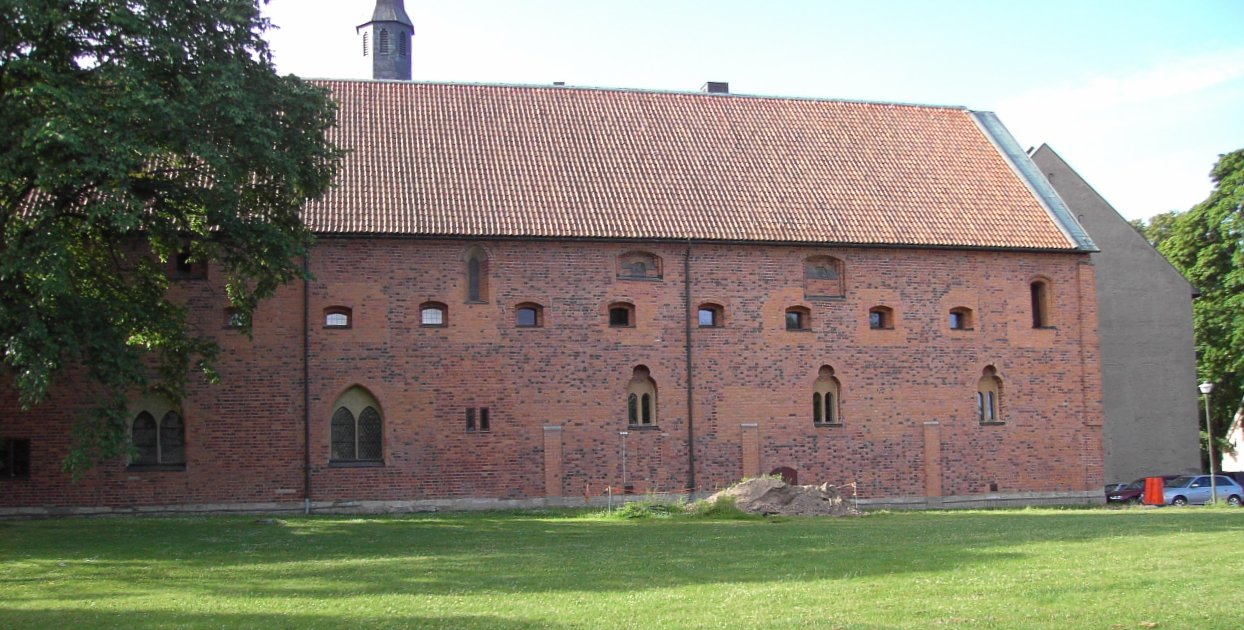
Av <a href="//commons.wikimedia.org/wiki/User:Thuresson" title="User:Thuresson">Thuresson</a> - <span class="int-own-work" lang="sv">Eget arbete</span>, CC BY-SA 2.5, Länk
Et à partir de la Réforme, pas d'ambitions à moderniser un monastère. Ni pendant les décennies qu'il restait en cette fonction, ni après, quand par exemple à partir de la Guerre de Trente Ans, ce bâtiment servait aux Invalides ... passons au chateau de la capitale, du Moyen âge et de la Renaissance :
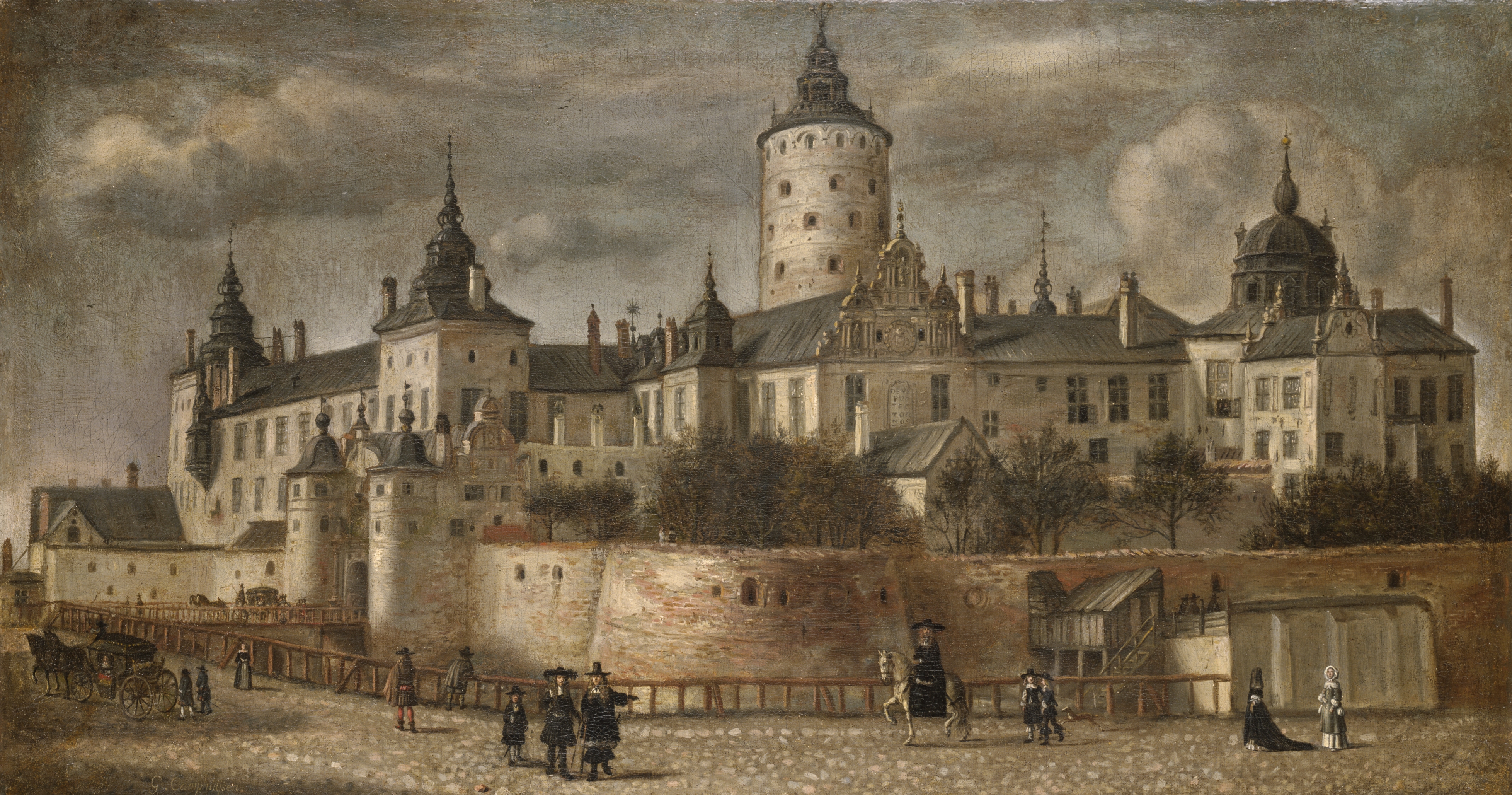
Tre Kronor från Slottsbacken, oljemålning 1661 av Govert Camphuysen. Högborgens rikssalslänga visas framför kärntornet och Johan III:s kungsvåning mellan de två tornen till vänster. Längst ner till höger lejonkulan.
Tre Kronor / Les Trois Couronnes, vu de Slottsbacken, peinture par Govert Camphuysen, en 1661 ... [domaine public]
Notons, ceci a été brûlé en 1697, le 7 mai. Je note que les incendie historiques de Stockholm commencent en 1625, après le Moyen âge. En Örebro on a eu deux incendies le Moyen âge, la première peut-être en 1369 et involontaire, peut-être plutôt déjà en 1364 et alors perpétré par Albert II de Mecklembourg. Celle de 1380 était dans la résistance nationale contre le pouvoir d'Albert de Suède (Albert III de Mecklembourg).
La survie du Moyen âge dans les pays du Nord a été inégale, la culture matérielle a été mieux préservé à son état médiévale que dans pas mal de pays sur le continent, mais si on veut les promesses de Notre Seigneur à Sainte Brigitte, la plupart du temps, depuis la Réforme, on les cherche plutôt en Espagne ou Autriche qu'en Suède.
Si on aime l'architecture médiévale et se contente des bribes de la spiritualité médiévale données de temps en temps par les curés luthériens, on peu très bien s'intégrer en Suède. C'est très chic. Si par contre on cherche un peu de cohérence, intellectuelle, spirituelle, dévotions et hagiographies dans la perspective catholique (difficile de comprendre les visions de Ste Brigitte pour quelqu'un qui nie le Purgatoire !), il vaut mieux s'exiler, plus ou moins, d'un exile interne, ou, dans mon cas, d'un exile externe, je me trouve à Paris.
Hans Georg Lundahl
Paris
St. Joseph de Cupertino*
18.IX.2023
* Le saint du jour se trouve après le Moyen âge :
Auximi, in Piceno, sancti Josephi a Cupertino, Sacerdotis ex Ordine Minorum Conventualium et Confessoris; quem Clemens Papa Decimus tertius in Sanctorum numerum retulit.
Subscribe to:
Posts (Atom)