Tuesday, June 28, 2016

Mythologies, erreurs et vérités


Ce message ou essai a été inspiré par deux faits. D'abord, j'ai trouvé un groupe de trois vidéos, intitulé La mythologie, à quoi ça sert, chaque vidéo prend trois fois une demi-heure pour trois mythes grecques par vidéo. Or, je n'ai pas vu les vidéos. Par contre, les mythes sont annoncés en dessous de chaque vidéo et sont aussi connus par moi en avance.

Les voici:

  • Vidéo I

    • 1 ère partie : Début de l'Univers,
      comment les Grecs anciens voyaient-ils la création de l'Univers?

    • 2 ème partie : La guerre des dieux,
      des querelles incessantes opposent les dieux grecs.

    • 3 ème partie : Prométhée,
      l'histoire du voleur de feu pour servir les hommes.


  • Vidéo II

    • 1 ère partie : La guerre de Troie,
      la grande épopée de la guerre entre Grecs et Troyens.

    • 2 ème partie : L'épopée d'Ulysse,
      la ruse d'Ulysse a permis aux Grecs de vaincre Troie.

    • 3 ème partie : La mort de la Méduse,
      comment Persée triompha de la mort elle-même.


  • Vidéo III

    • 1 ère partie : Dionysos,
      il est le dieu du vin, du théâtre, de la fête mais aussi de la folie.

    • 2 ème partie : Oedipe,
      l'oracle avait prédit qu'Oedipe tuerait son père et épouserait sa mère.

    • 3 ème partie : Croyances et Religions , la société grecque,
      et Jean-pierre Vernant termine en parlant de son parcours personnel.


Sur le parcours personnel de Jean-Pierre Vernant, je n'ai, avant d'écouter ces choses, strictement rien à dire.

Sur les autres, oui. Mais d'abord allons à l'autre inspiration de mon article. J'avais une conversation dans le parc. Elle mène à aborder un peu de ceci, que la théologie des mythes payens est mauvaise, mais les récits vus par les hommes pas forcément tels.

La mythologie babylonienne a une théologie atroce.

Anou se serait retiré, ses deux fils se seraient quérellés, Enlil serait le seigneur, mais un dur et de mauvaise humeur (il aurait décidé le déluge parce que le vacarme des hommes lui cassait la tête), Enki serait l'ami des hommes, mais en tant que rébelle envers Enlil.

Le vrai Dieu ne se retire pas. Il est seigneur ET ami des hommes.

Entre Zoroastre et cette mythologie, il semble y avoir un rapport, quoique les rôles sont en peu plus chrétiennes pour Ormuzd (correspond grosso modo à Dieu) et Ahriman (correspond grosso modo au diable), mais comme Enlil et Enki, ils sont frères, et donc quelque part égaux.

Pour Gnosticisme et Manichéisme, c'est un peu Zoroastrisme réchauffé, épicé de quelques miettes du Christianisme, parfois, mais une rechute vers la pensée "Enlil/Enki". Bien que, comme chez Zoroastre, le Mauvais est rébelle, il est en même temps seigneur de ce monde matériel, et donc, le Bon, quoique en soi supérieur au Mauvais, devient obligé ici-bas d'être rébelle ou quasiment.

Rébellion reste le thème d'autres mythologies aussi, celle des Grecs présente leur "très-haut" comme rébelle envers son père, ce qu'ils mitigent en ajoutant que celui-ci l'était envers le sien.

Et pour les Hindous, Brahma s'endort en créant le monde, Vichnou le maintient, Chiva le détruira en éveillant finalement Brahma du sommeil, dont les rêves sont notre réalité. Encore une fois un conflit dedans le divin lui-même, et en plus (comme chez Gnostiques et Manichéens) la réalité matérielle devient une illusion.

Si la théologie proprement dite du mythe payen est généralement atroce, il y a d'autres côtés qui ne le sont pas.

Je viens de raconter comment le mythologie babylonienne rend compte du déluge et de Noé, et ça veut biensûr dire qu'il admettaient que le déluge ait eu lieu. Ce qui est bien. Les mythomanes et mythographes qui nient même le déluge sont, comme l'a noté Saint Pierre, dans son premier ou deuxième encyclique ou bulle papale, les moqueurs des derniers temps.

Le récit du Déluge selon les babyloniens est généralement assez proche de la Genèse, sauf pour la théologie de base et pour certains détails de théologie mythologique. Le dieu du soleil serait aussi le dieu qui ait rempli de pain ce qui correspond à l'Arche. À différence de la théologie de base, ceci est, pour un payen, plutôt un signe précurseur de la vérité chrétienne.

Jésus-Christ est appelé Soleil de la Justice - et Il est aussi le Pain venu du Ciel.

Le détail dans la mythologie babylonienne pourrait même être venu du récit de Moïse sur le traversé du désert, de la Manne. Ça dépend comment les choses son plus ou moins mal datés en arrière, avant Jésus-Christ, la chronologie biblique tient, mais est-ce que Moïse est contemporain de Amenemhet III et de Sésostris, ou l'est-il plutôt de Pépi?

En partie ça dépend en son tour sur la monté de Carbone 14 dans l'athmosphère. Dans mon essai "avec un peu d'aide de Fibonacci" j'ai modélisé de manière d'avoir Moïse comme un candidat possible pour Amenemhet IV, avant qu'il ne frappe l'Égyptien et se retire au désert. Dans une autre modélisation de la montée de carbone 14, j'avais trouvé qu'il devait être contemporain de Pépi et donc de Hammourapi. Ce qui m'avait fait conclure que mon modèle était faux - mais pourtant il y a des chrétiens qui vont faire même de Salomon un contemporain de Hammourapi.

En mythologie égyptienne, le début correspond assez bien au scénario juste après le déluge. Il y a de l'eau qui couvre tout, il y a ensuite de la terre qui se lève de l'eau. Comme Noé avait un corbeau à envoyer de l'Arche, le début égyptien comporte un faucon. Les deux oiseaux sont des oiseaux carnivores, et cadavrovores. J'ignore le rôle exacte du Condor dans la mythologie andine, mais il devrait en y avoir, et ça devrait remonter au même moment en fin du déluge.

Andine, venais-je de dire. Bon, dans cette mythologie là, deux choses sont remarcables : les Andes fonctionnent comme l'Arche. Les survivants sont un frère et une soeur, l'humanité après le déluge commence donc avec une relation qui aurait pu être considéré incestueuse.

Pour nous les Chrétiens, c'est au contraire la génération après Adam et Ève qu'on doit chercher pour les mariages entre frères et soeurs. Les trois fils de Noé ont pris des femmes qui n'étaient pas leurs soeurs. Mais ça pourrait commémoriser (en forme mitigé) l'inceste entre père et filles après la destruction de Sodome (Lot et ses filles se sont aussi réfugiés en une région montagneuse), et ça sert à justifier la coûtume des Incas d'épouser leurs soeurs.

Chez les Nordiques, le Déluge est avant les hommes.

Les victimes du Déluge sont les géants. Le survivant en est Bergelmer, un géant passablement gentil, par rapport aux autres. Les dieux qui ont tué Ymer l'ont épargné en l'avertissant que le sang allait noyer les autres géants, donc Bergelmer s'est réfugié dans un bateau (fait de quoi? les arbres sont aussi postérieurs au déluge nordique!) avec sa femme, avant de repeupler le monde de géants - fait sur partie du carcasse d'Ymer. Celui-ci, aussi épélé Ymir, maintenant on pourrait l'épeler aussi Imir (Y=I en icelandais moderne) est le géant ou titan primordial.

Si, pour ces nordiques, le déluge venait avant les hommes, comment les hommes savent-ils quelque chose du déluge?

La raison réelle, celle qui est valable pour les autres mythologies ayant un déluge ou une trace du déluge, c'est que l'humanité a été repeuplé après le déluge par les survivants du déluge. Par les trois fils de Noé et leur trois femmes, Noé et sa femme étant aussi encore en vie pour le regarder.

Mais au sein de la mythologie nordique, la raison allégué aurait dû être que les dieux ou les oracles des dieux disent ainsi.

Voluspá est un chant fait par une Sibylle probablement en état de trance, donc un médium comme les médium vaoudou.

Gylfaginning raconte comment Odin avec sa famille sont venus en Suède et ont trompé les gens à les prendre pour des dieux. Il aurait à l'occasion révélé coment il aurait fait (un peu plus jeune qu'alors) pour créer le monde.

Les deux sources qui ont pu servir aux payens nordiques ici mentionnées et autres pareilles dépendent donc en grande partie du témoignage d'un être surnaturel ou supposé tel sur des choses que les hommes n'ont pas vues.

Très autrement la Bible, quasi la totalité est, comme celle de l'Iliade ou de l'Odyssé, de l'Anabase et de Mémorabiles sur Socrate par Xénophon, des choses vues par des hommes et racontés à leur postérité.

Des premiers onze chapitres de la Genèse, le récit des six jours, jusqu'en partie du sixième jour, est "posé sur l'Olympe" (j'anticipe, voir plus bas) dans le sens de ne pas avoir de témoins humains. Le reste des onze chapitres, hormis le dit de Dieu en Genèse 6, en a. Et ce dit de Dieu a pu être, comme les six jours, révélé à un homme. Mais la plupart de l'histoire biblique sont des choses qui n'avaient pas besoin d'être révélés surnaturellement. Au contraire, c'est cette histoire, naturellement connue, qui révèle le surnaturel.

Si on retourne aux 8 mythes grecs, il me semble qu'il y a lieu de faire des distinctions là-dessus.

  • Hors tout témoignage humain hormis les révélations tels que par Voluspá, ce qui ne renvoie pas à un témoin humain des faits, mais juste d'une intervention surnaturelle dans sa vie contenant un message donné par l'entité surnaturelle (ou par la trance):

    I:1 et 2 Début de l'Univers, La guerre des dieux.

    Un Chrétien n'est pas obligé d'y voir dedans que des soit purs erreurs, comme fausse théologie, soit vérités mises en tumulte, comme les déformations du récit du déluge.

  • Vu par les hommes, hormis les scènes "posés dans l'Olympe":

    II:1 et 2, III:2 La guerre de Troie, L'épopée d'Ulysse, Oedipe.

    Un Chrétien devrait les accepter tels quels, ces récits. Hormis bien-sûr les scènes mises en Olympe (comme le débat entre Zeus ou Jupiter et sa fille Pallas Athénâ ou Minerve sur le sort d'Ulysse). Avec quelque réserve sur ce qui est possible d'être le fruit d'une vantardise où les écouteurs n'ont pas eu la possibilité de vérifier.

    Quand Saint Paul dit que 500 personnes ont vu Jésus ressuscité et la plupart en sont encore en vie, et quand tout le monde savait où se trouvait Jérusalem, là où il convenait de vérifier, il y a de la possibilité à vérifier pour ses écouteurs. Et de falsifier.

    Quand Ulysse apparaît seul devant Nausicaa et son père, chez les Phéaques, il peut prétendre qu'il a confronté Polyphème et que ses compagnons pouvaient à l'époque encore vérifier, mais il ajoute bien-sûr qu'ils ne le peuvent plus. Scylla et Charybde? Ou chez Circé? De toute manière, ses compagnons sont tous désapparus, il peut dire ce qu'il veut, personne ne risque de le contredire.

    L'histoire d'Oedipe ne présuppose pas que l'oracle de Delphes avait un vrai pouvoir de prophétie. Ses prophéties étaient des pièges, auto-accomplissants. Si Laïos et Oedipe n'avaient pas cru, ils auraient pu éviter d'accomplir ces malfaits.

  • Possiblement en la plus grande partie le fruit d'une telle vantardise:

    II:3, la mort de la Méduse en est un peu suspect. Par contre, probablement la pseudo-prophétie delphique faite à Akrisios, grand-père maternel de Persée, est vraiment un fait.

    I:3 en est très suspect. Le libérateur de Prométhée est, comme on connaît, Hercule. Aucun d'autre homme (sauf les tous premiers qui n'avaient pas laissé des récits derrière eux, au moins pas aux Grecs) que lui seul a vu Prométhée. En plus, le récit de Prométhée enfin pardonné par Jupiter ressemble à une belle fin à l'histoire des frères Enlil et Enki - car Prométhée est un peu une figure d'Enki en miniature.

  • Possiblement déformé après un récit biblique (ou ses faits, plutôt) autre que le Déluge et la Destruction de Sodome:

    III:1 Dionysos, car Moïse a pu être son modèle, de manière très indirecte. Certains faits d'Hercule pourraient aussi remonter à Élie (l'histoire de délivrer Thésée de l'Enfer ou de redonner la vie à Alceste).


Donc, pour moi, "mythologie" n'est pas une seule catégorie en soi, c'est une catégorie "par convenance", parce que, par exemple, les 8 récits sont surtout soit des hexamètres en dialecte homérien, soit en sénars iambiques en dialecte vieil attique.

Les mythes, comme on les appelle, n'ont pas la même valeur théologique, ni la même valeur historique. Pour déterminer la vérité qu'elle souit théologique ou historique chez un récit, il est donc fort inutil de se demander s'il peut être comparé à un mythe comme les énumérés ou non. Poser la question de cette manière montre une insensibilité à la diversité des mythes, même chez les payens.

Hans Georg Lundahl
Nanterre, BU
Veille des Saints Apôtres
Pierre et Paul
28.VI.2016

Monday, June 13, 2016

Misunderstanding the word Myth


Quotes from this one:

The Importance of Myths and Fairy Tales for Christian Children
Crisis Magazine, May 7, 2015
http://catholicexchange.com/the-importance-of-myths-and-fairy-tales-for-christian-children


The ancient myths, for my children, fall into the same category of fairy tales, the Chronicles of Narnia, or the Legends of King Arthur. They would love to be in the same world that these things are true, but they know that they are not and will never be. When it comes to their Christian faith, they know (already) that the Eucharist is Jesus Christ, they talk about becoming nuns, they willingly pray for people, and have devotions to their favorite saints. My four year old preaches to the monsters that she believes are under the bed, “Jesus died so that we can go to Heaven.” But they do not confuse the imaginative world of nursery rhymes, fairy tales, and myths with the revealed truths in Scripture.


Distinguo, Sir!

Fairy tales like Puss in Boots are, like Narnian Chronicles, like Lord of the Rings, like Taran the Wanderer, like Sherlock Holmes and like Miss Marple, like Tintin and like Spirou and Fantasio, like Superman and like Batman (whether Dark Knight version or Dynamic Duo version), and like Mary Poppins, Father Brown and the Man who was Thursday the kind of things God thought of but did not decide to create as physical reality, but rather allow human authors to show some "creativity".

Hesiod's Theogony and Voluspá are things God allowed demons to fool people with.

Canons of Navarrone, Iliad, Odyssey, King Arthur, Sigurd, Beowulf, Skioldungs and Ynglings are more like somewhat blurred memories of what really happened some time ago, when things became exciting. Canons of Navarrone being closest in time in subject.

Greek myths do not fall into one category, but into two, since Hesiod and Ovid's Metamorphoses on the one hand are fairytales by Hesiod but no longer by Ovid mistaken for religious truth.

A few of them do reflect historic truth about Flood or about Nephelim, but in a theologically blurred way.

While, on the other hand, Iliad, Odyssey, Greek Tragedy are about real people, or mostly so.

It would be easier to pinpoint a certain departure from history in Canons of Navarrone than in these Greek sagas. Partly of course, since records of more clearly trustworthy nature, like very sober and even boring accounts, are lacking.* But partly also because the trustworthy sources we do have are less trusted than they should be.

There is a vague disbelief in Odyssey, or in Oedipus. For a Christian, it would be somewhat difficult to pinpoint any specific event which was certainly not true than for an atheist what he could not believe true. Only, the theological interpretation of events is certainly false - as is also the case when an atheist or shintoist says how no God at all or shinto gods operated during World War II - this does not necessarily mean they were not eyewitnesses and very accurate such to visible events. And, excepting Communists, not necessarily that they are lying either.

My children love to imagine that they are in fairy tales, have found the way into “princess land,” or that the imagined wardrobe in the wall will take them to Narnia. But they are really longing for Heaven, and in desiring the magical, imagined land, they are exhibiting their desire for fulfillment in union with God.


That was not necessarily what Tolkien was saying.

He says that fairy tale at its highest has a quality which is included in the pleasure we take in the truths of faith, not that all longing for faerie is in and of itself a longing for Heaven.

However, whatever children long for when reading made up stories (except when it is clearly Hellish), I think they should be allowed to read enough of that but also enough of what might be called docu-fiction - Canons of Navarrone, Iliad, Odyssey, Aeneid, Beowulf, Sigurd and Didrik sagas, Njáls saga and so on, so they can tell the difference.

I will never forget how I was very clearly reminded of how Richard Coeur de Lion was a real person:

Robin Hood legend has him as hero, while Austrian legend has him as, if not outright crook, at least the kind of stormy character who will ruin the getting along between people who should cooperate.

Even if the Austrian Duke (or were the Babenbergs still Counts?) was, in his turn, somewhat vengeful.

Or, like when the Hunde von Kuenring have very different moral status in Nether Austria and in the not so far off Liechtenstein.

When people disagree over whether someone was a goody or a baddy, that is for one thing a sign it is usually a real person.

When German labels a thing Sage rather than Märchen, it is usually also historic, more or less.

And if, in some cases not, that is also the case with other kinds of fake history, which are not labelled Sagen.

Hans Georg Lundahl
Nanterre UL
St Anthony of Padua
13.VI.2016

* Not quite. Iliad, song II, contains a ship catalogue which is famous for being as boring as the genealogies of the Old Testament. I think including Corinth in it was a joke, Homer poking fun at Corinthians without culture, but apart from that, I think it is pretty factual./HGL

Thursday, June 9, 2016

The Real Problem with that Nouveau Riche and his Invented Ancestry


LT (on a FB group's wall)
Invented ancestry.

The Latin reading blog : Ausonius on a nouveau riche.
http://thelatinreadingblog.blogspot.com/2016/06/normal-0-false-false-false-en-gb-x-none.html


HGL (my response)
Note very well that between Romulus and Remus and himself, he would NOT have dared to insert a lot of publically known persons, especially not recent ones.

The case is thus not a case against Romulus and Remus really having existed.

In fact, I can't see any reference to Romulus having had a son, so the nouveau riche was contradicting the known historic traditions. from precisely the time of Romulus and Remus.

That would to Horace and others who really knew ancient Roman History (Livy and Virgil spring to mind, and Horace at least knew the latter) have made the claim ridiculous in quite another way than it is to certain moderns considering "Romulus" a "myth".

It's not like claiming to descend from Charlemagne, it's like claiming to descend from a physical son of Jesus.

(Obviously, there could have been a legal son of Jesus among closest kin refusing to believe Resurrection law of levirate and all that).

How do we tell Romulus had no son?

Second king was a Sabine, Numa Pompilius.

Third king was grandson, not of Romulus but of a comrade.

Fourth king was grandson by his mother to Numa.

Fifth king was a stranger.

Sixth king was a freedman married to the stranger's daughter.

Seventh king was either brother or nephew in law to sixth, either son or grandson to the fifth.

None of the kings descended from Romulus.

And Romulus, like later Caesar (in a way "eighth king" - since no kings between Tarquin the Proud and himself - and "one of the seven", since deified like Romulus, since priest like Numa ...) was someone whose ancestry would have counted, had it been there. That is usually the case with people counting with a religion of their community as a god.

So, the nouveau riche was showing off his ignorance of historic traditions by the claim.

Tuesday, May 31, 2016

Note on African Linguistics


On September 8, 1897, Mary Theresa and her first companion professed their final vows as Missionary Sisters of St. Peter Claver.

For the next twenty-five years, the Foundress roamed Europe, enlisting people of all walks of life to help her congregation’s support for evangelization in Africa. Realizing that the missionaries were in urgent need of books in local languages, she expanded her work, producing everything from Bibles and hymnals to dictionaries in local languages.


Missionary Sisters of St Peter Claver of North America
Foundress
Blessed Mary Theresa Ledóchowska


1897 + 25 = 1922.

This means a great deal of African dictionaries were being produced 1897 to 1922./HGL

Story of a Cardinal's Title with Pre-Industrial Demographics


1) Φιλολoγικά/Philologica : "in a time when most people died at an average age of 35" ; 2) What others have to say about Life Expectancy through history - and my take on that ; 3) Longevity in Selected Ancestry and Inlaws of Eleanor of Montfort ; 4) Tudor Times Demographical Stats ; 5) How Many Hours are we Talking About, and How Heavy? ; 6) New blog on the kid : When "Answers" Paint Middle Ages Black ; 7) Creation vs. Evolution : CMI Provided some Lifespans of the Past ; 8)Other list from CMI of lifespans ; 9) Φιλολoγικά/Philologica : Medieval and Early Modern Lifespans, Again: Berkeleys and Related ; 10) Story of a Cardinal's Title with Pre-Industrial Demographics

The Church of S. Agnese fuori le mura (a catacomb, later basilica) was established as a titular church for a Cardinal Priest on 5 October 1654 by Pope Innocent X

I have reasoned that the archaeological discovery of house chaplains, 1:st C and 2:nd C AD, far from proving Rome had no monarchic bishop, in fact instead prove house chaplains and cardinals have an old tradition from earliest Christian times.

Here, I am not a Calvinist:
Great Bishop of Geneva! : Defense of Christ's institution of Hierarchy and Petrine Office, and of St Peter's successors being in Rome
http://greatbishopofgeneva.blogspot.com/2016/04/defense-of-christs-institution-of.html


I will be citing Italian wiki for why they left the post and when they lived, also when the title was vacant.

  • Baccio Aldobrandini[2] (5 October 1654 – 1 April 1658) Baccio Aldobrandini (Firenze, 20 agosto 1613 – Roma, 21 gennaio 1665, nella basilica Sant'Agnese 5 ottobre 1654 - 1º aprile 1658 nominato cardinale presbitero dei Santi Nereo e Achilleo.
  • Girolamo Farnese (6 May 1658 – 18 February 1668) Girolamo Farnese (6 maggio 1658 - 18 febbraio 1668 deceduto), Girolamo Farnese (Latera, 30 settembre 1599 – Roma, 18 febbraio 1668) è stato un cardinale italiano, duca di Latera.
  • Vitaliano Visconti (18 March 1669 – 7 October 1671) Vitaliano Visconti (18 marzo 1669 - 7 settembre 1671 deceduto), Vitaliano Visconti (Milano, 1618 – Monreale, 7 settembre 1671) è stato un cardinale e arcivescovo cattolico italiano.
  • Vacante (1671 - 1672)
  • Federico Borromeo (8 August 1672 – 18 February 1673), Federico IV Borromeo (8 agosto 1672 - 18 febbraio 1673 deceduto), Federico Borromeo (Milano, 29 maggio 1617 – Roma, 18 febbraio 1673) è stato un cardinale italiano. Federico Borromeo (indicato anche con il numero progressivo di Federico IV Borromeo come conte d'Arona) ...
  • Vacante (1673 - 1690)
  • Toussaint de Forbin-Janson (10 July 1690 – 28 September 1693), Toussaint de Forbin-Janson (10 luglio 1690 - 28 settembre 1693 nominato cardinale presbitero di San Callisto), Toussaint de Forbin-Janson (Mane, 1º ottobre 1630 – Parigi, 24 marzo 1713) è stato un cardinale e vescovo cattolico francese.
  • Giambattista Spinola (20 February 1696 – 7 April 1698), Giambattista Spinola (20 febbraio 1696 - 7 aprile 1698 nominato cardinale presbitero di Santa Maria in Trastevere), Giambattista Spinola detto il Vecchio (Madrid, 20 settembre 1615 – Roma, 4 gennaio 1704) è stato un cardinale e arcivescovo cattolico italiano.
  • Vacante (1698 - 1706)
  • Rannuzio Pallavicino (25 June 1706 – 30 June 1712), Rannuzio Pallavicino (25 giugno 1706 - 30 giugno 1712 deceduto),

    Appassionato di scrittura, pubblicò diverse opere, sotto lo pseudonimo di Asterio Sireo; si possono citare: L'intreccio di gigli e perle (1660), un'antologia di poesia, La Scalza di Avila (1661), una biografia di Santa Teresa, Ho Trionfi dell'Architettura (1667), che descrive il palazzo del principe elettore di Baviera, Atalanta (1667), una tragedia ed infine Ritratto di una gran Principessa (Monaco, Luca Straub, 1668), una raccolta di odi dedicate ad Enrichetta Adelaide di Savoia.

  • Vacante (1712 - 1721)
  • Giorgio Spínola (20 January 1721 – 15 December 1734), Giorgio Spinola (20 gennaio 1721 - 15 dicembre 1734 nominato cardinale presbitero di Santa Maria in Trastevere), Giorgio Spinola (Genova, 6 giugno 1667 – Roma, 17 gennaio 1739) è stato un cardinale italiano della Chiesa cattolica.
  • Serafino Cenci (27 June 1735 – 24 June 1740), Serafino Cenci (27 giugno 1735 - 24 giugno 1740 deceduto), Serafino Cenci (Roma, 20 maggio 1676 – Roma, 24 giugno 1740) è stato un cardinale e arcivescovo cattolico italiano.
  • Filippo Maria De Monti (23 September 1743 – 10 April 1747), Filippo Maria de Monti (23 settembre 1743 - 10 aprile 1747 nominato cardinale presbitero di Santo Stefano al Monte Celio), Filippo Maria de Monti (Bologna, 23 marzo 1675 – Roma, 17 gennaio 1754) è stato un cardinale italiano.

    Il cardinale de Monti è stato Segretario di Propaganda Fide.

    Here some words on that one:

    Founded in 1622 by Pope Gregory XV's bull Inscrutabili Divinae, the body was charged with fostering the spread of Catholicism and with the regulation of Catholic ecclesiastical affairs in non-Catholic countries. The intrinsic importance of its duties and the extraordinary extent of its authority and of the territory under its jurisdiction caused the Cardinal Prefect of Propaganda to be known as the "red pope".

    At the time of its inception, the expansion of colonial administrations was coming to be largely in Dutch and English hands, both Protestant countries intent on spreading these religious doctrines, and Rome perceived the very real threat of Protestantism spreading in the wake of commercial empire. By 1648, with the end of the Thirty Years' War, the official religious balance of established Christianity in Europe was permanently stabilized, but new fields for evangelization were offered by vast regions of Asia, Africa and the Americas then being explored.

    There had already been a less formally instituted cardinal committee concerned with propaganda fide since the time of Pope Gregory XIII (1572–1585), who were especially charged with promoting the union with Rome of the long-established eastern Christian communities: Slavs, Greeks, Syrians, Egyptians, and Abyssinians. This was the traditional direction for the Catholic Church to look for evangelizing. Catechisms were printed in many languages and seminarians sent to places as far as Malabar. The most concrete result was the union with Rome of the Ruthenian Catholic communion, most concentrated in modern-day Ukraine and Belarus; the union was formalized at Brest in 1596.

    The death of Gregory XV the following year did not interrupt the organization, because Cardinal Barberini, one of the original thirteen members of the congregation, became the next pope as Urban VIII (1623–1644). Under Urban VIII, a central seminary (the Collegium Urbanum) was set up for training missionaries. The Congregation also operated the polyglot printing press in Rome, printing catechisms in many languages. Their procurators were especially active in China from 1705, moving between Macau and Canton before finally settling in Hong Kong in 1842.

    In strongly Protestant areas, the operations of the Congregation were considered subversive: the first missionary to be killed was in Grisons, Switzerland, in April 1622, before the papal bull authorizing its creation had been disseminated. In Ireland after Catholic emancipation (1829), while the established church was still the Protestant Church of Ireland, the Irish Catholic church came under the control of the Congregation in 1833, and soon reformed itself with a devotional revolution under Cardinal Cullen.

    These "Cardinals in General Congregation" met weekly, keeping their records in Latin until 1657, then in Italian. The minutes are available in microfilm (filling 84 reels) at large libraries. In the course of their work, the Propaganda fide missionaries accumulated the objects now in the Vatican Museum's Ethnological Missionary Museum.

    Since 1989 the incumbent Prefect is also President of the Interdicasterial Commission for Consecrated Religious.

    In 2014 Sr. Luzia Premoli, superior general of the Combonian Missionary Sisters, was appointed a member of the Congregation for the Evangelization of Peoples, thus becoming the first woman to be appointed a member of a Roman curial congregation.

  • Frédéric Jérôme de La Rochefoucauld (15 May 1747 – 29 April 1757), Frédéric-Jérôme de La Rochefoucauld (15 maggio 1747 - 29 aprile 1757 deceduto), Frédéric-Jérôme de La Rochefoucauld de Roye (Versailles, 16 luglio 1701 – Parigi, 29 aprile 1757) è stato un cardinale, arcivescovo cattolico e abate francese, creato cardinale da papa Benedetto XIV.
  • Etienne-René Potier de Gesvres (2 August 1758 – 24 July 1774), Etienne-René Potier de Gesvres (2 agosto 1758 - 24 luglio 1774 deceduto), Étienne-René Potier de Gesvres (Parigi, 2 gennaio 1697 – Parigi, 24 luglio 1774) fu nominato cardinale della Chiesa cattolica da papa Benedetto XIV.

    Some tidbits from French wiki, in my resumé:

    He was also a bishop of Beauvais, he really cared for his diocese, he used the Lettres de cachet (that means Bastille or possibly also similar places) to extirpate Jansenism.

    He cared for the poor.

    I am not sure if the street in Paris named Gesvres is after him or after a relative. There is a police department there.

  • Vacante (1774 - 1778)
  • Luigi Valenti Gonzaga (30 March 1778 – 29 November 1790), Luigi Valenti Gonzaga (30 marzo 1778 - 29 novembre 1790 nominato cardinale presbitero dei Santi Nereo e Achilleo), Luigi Valenti Gonzaga (Roveredo di Guà, 15 ottobre 1725 – Roma, 29 dicembre 1808) è stato un cardinale italiano.

    What! A Gonzaga who lives to over 80!

    Back in the 16th C Gonzagas were dying so early I thought diabetes was hereditary. Perhaps Luigi Valenti lived after the diabetes genes had been lost of the family?

    He cared for the tomb of Dante Alighieri:

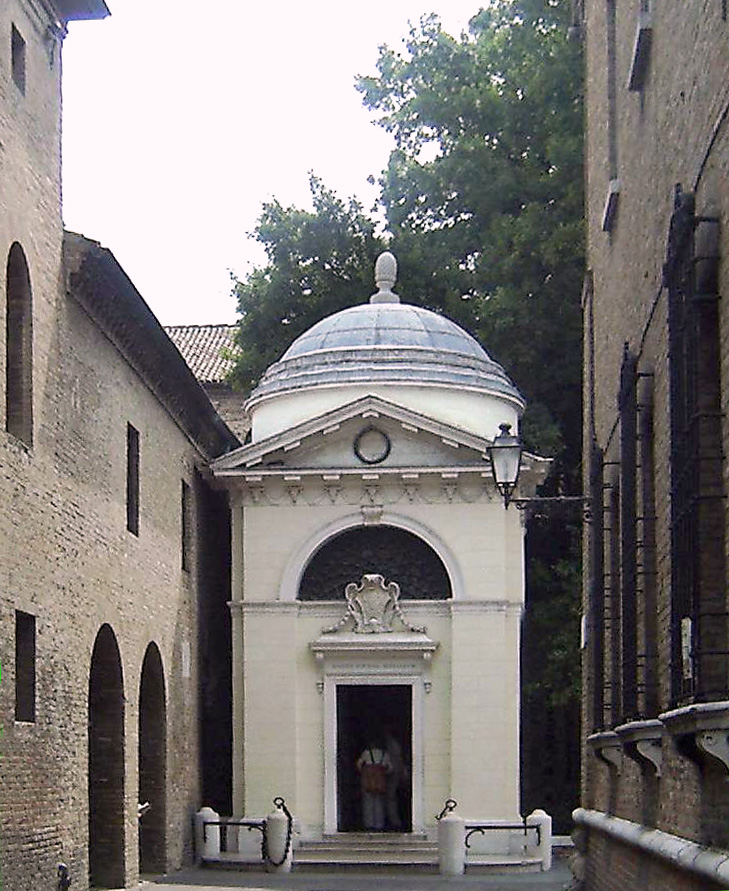
    La tomba di Dante Alighieri a Ravenna, fatta restaurare dal Valenti Gonzaga durante il suo periodo come legato pontificio in Romagna. https://it.wikipedia.org/wiki/File:TombaDante.jpg


    The most famous Gonzaga was of course short lived too:

    "Saint Aloysius Gonzaga, S.J. (Italian: Luigi Gonzaga;[1] March 9, 1568 – June 21, 1591) was an Italian aristocrat who became a member of the Society of Jesus. While still a student at the Roman College, he died as a result of caring for the victims of an epidemic. He was beatified in 1605, and canonized in 1726."

    Caring for the victims of an epidemic, sure, but perhaps his immune system was weakened when doing so? I saw other Gonzagas of Mantua in the ancestry of Marie Antoinette who also died young.

    So, seeing a Gonzaga live long was somewhat of a surprise to me!

  • Vacante (1790 - 1802)
  • Giuseppe Spina (24 May 1802 – 21 February 1820), Giuseppe Maria Spina (24 maggio 1802 - 21 febbraio 1820 nominato cardinale vescovo di Palestrina), Giuseppe Maria Spina (Sarzana, 11 marzo 1756 – Roma, 13 novembre 1828) è stato un cardinale e arcivescovo cattolico italiano.
  • Dionisio Bardaxí y Azara (27 September 1822 – 3 December 1826), Dionisio Bardaxí y Azara (27 settembre 1822 - 3 dicembre 1826 deceduto), Dionisio Bardaxí y Azara (Puyarruego, 7 ottobre 1760 – Roma, 3 dicembre 1826) è stato un cardinale spagnolo.

    He had to leave Rome to Spain due to invasion by Napoleon.

  • Ignazio Nasalli-Ratti (17 September 1827 – 2 December 1831), Ignazio Nasalli-Ratti (17 settembre 1827 - 2 dicembre 1831 deceduto), Ignazio Nasalli-Ratti (Parma, 7 ottobre 1750 – Roma, 2 dicembre 1831) è stato un cardinale italiano.

    Note the family Ratti include Pope Pius XI (Achille Ratti). Like him before his papacy (in Poland), Ignazio Nasalli-Ratti was a diplomat. Lucerne (where he was also bishop), Netherlands.

  • Vacante (1831 - 1833)
  • Filippo Giudice Caracciolo (30 September 1833 – 29 January 1844), Filippo Giudice Caracciolo, Orat. (30 settembre 1833 - 29 gennaio 1844 deceduto), Filippo Giudice Caracciolo (Napoli, 27 marzo 1785 – Napoli, 29 gennaio 1844) è stato un cardinale e arcivescovo cattolico italiano.

    Abbreviation "Orat." means he was in the Oratorium of St Philip Neri, like Cardinal Newman.

  • Hugues-Robert-Jean-Charles de la Tour d’Auvergne-Lauraquais (16 April 1846 – 20 July 1851), Hugues-Robert-Jean-Charles de La Tour d'Auvergne-Lauraquais (16 aprile 1846 - 20 luglio 1851 deceduto), Hugues-Robert-Jean-Charles de La Tour d'Auvergne-Lauraquais (Auzeville-Tolosane, 14 agosto 1768 – Arras, 20 luglio 1851) è stato un cardinale francese.

    Was not in time for the conclave which elected Pope Pius IX.

  • Girolamo D’Andrea in commendum (18 March 1852 – 14 May 1868), Girolamo d'Andrea (18 marzo 1852 - 28 settembre 1860 nominato cardinale vescovo di Sabina); in commendam (28 settembre 1860 - 14 maggio 1868 deceduto), Girolamo d'Andrea (Napoli, 12 aprile 1812 – Roma, 14 maggio 1868) è stato un cardinale italiano.

    Since he is born after 1800, I will leave him outside the study of demographics previous to industrial revolution.

    Gerolamo Marquese d' Andrea (1812–1868) was an Italian Cardinal. He was born at Naples, educated at the Collège of La Flèche, France, and was early appointed Archbishop of Mytilene in partibus infidelium.

    In 1852 he was appointed Cardinal-abbot of Subiaco, and Prefect of the Congregation of the Index, and in 1860 Bishop of Sabina.

    He took sides with the Patriotic party in 1859 on the question of the national unity of Italy, and at the same time counseled extensive liberal reforms in Church policy. He was suspended from his diocese and abbacy and threatened with permanent deposition from office. He ultimately submitted, and in 1868 was rehabilitated, without, however, being restored to his diocese and the abbacy of Subiaco.

  • Lorenzo Barili (24 September 1868 – 8 March 1875), Lorenzo Barili (24 settembre 1868 - 8 marzo 1875 deceduto), Lorenzo Barili (Ancona, 1º dicembre 1801 – Roma, 8 marzo 1875) è stato un cardinale italiano, nominato da Papa Pio IX.

  • Pietro Giannelli (31 March 1875 – 5 November 1881), Pietro Gianelli (31 marzo 1875 - 5 novembre 1881 deceduto), Pietro Gianelli (Terni, 11 agosto 1807 – Roma, 5 novembre 1881) è stato un cardinale e arcivescovo cattolico italiano.

  • Charles-Martial Allemand-Lavigerie (3 July 1882 – 25 November 1892) - the guy who inspired me to look up this list. Cardinal Lavigerie Fought Slavery

  • Georg von Kopp (19 January 1893 – 4 March 1914), Georg von Kopp (19 gennaio 1893 - 4 marzo 1914 deceduto), Georg von Kopp (Duderstadt, 25 luglio 1837 – Troppau, 4 marzo 1914) è stato un cardinale e vescovo cattolico tedesco.

    He was known for his anti-Polish views and pursued Germanization of his Polish parishioners.

    Alas.

    Not all Cardinals are perfect!

  • Károly Hornig (28 May 1914 – 9 February 1917), Károly Hornig (28 maggio 1914 - 9 febbraio 1917 deceduto), Il barone Károly Hornig von Hornburg (Budapest, 10 agosto 1840 – Veszprém, 9 febbraio 1917) è stato un cardinale e vescovo cattolico ungherese.

    On 30 December 1916, he crowned King Károl I and Queen Zita of Hungary.

    These are of course the same as Emperor Karl I and Empress Zita of Austria. And since he was the last Habsburg actual ruler in Austria, so far, he is nicknamed Karl der Letzte - Charles the Last.

  • Adolf Bertram (18 December 1919 – 6 July 1945), Adolf Bertram (18 dicembre 1919 - 6 luglio 1945 deceduto), Adolf Bertram (Hildesheim, 14 marzo 1859 – Javorník, 6 luglio 1945) è stato un cardinale e arcivescovo cattolico tedesco, nominato cardinale da papa Benedetto XV.

    He avoided openly breaking with Hitler. Racial laws of Nuremberg confronted the sacrament of matrimony, and his protest was secret.

    When Catholics of Jewish origin were deported to camps, his protest was secret.

    He did however openly protest against the state sponsored adultery of Lebensborn.

    Ronald J. Rychlak, a US Historian, denies any charge of ideological closeness with National Socialism, but considers he was a diplomat obeying orders for diplomatic reasons.

    If you want heroism among German bishops, look to the one Bishop of Munster. Clemens August Graf von Galen, nicknamed the Lion of Munster!

  • Samuel Alphonse Stritch (22 February 1946 – 26 May 1958), Samuel Alphonsius Stritch (22 febbraio 1946 - 26 maggio 1958 deceduto), Samuel Alphonsius Stritch (Nashville, 17 agosto 1887 – Roma, 27 maggio 1958) è stato un cardinale e arcivescovo cattolico statunitense.

    He was an Irish-American from Nashville Tennessee.

    He also was not participating in Vatican II, since he died in 1958, like Pius XII.

    If Pius XII was an apostate and Clement XV true pope from 1950, Samuel Stritch was not recognising that. But he was not involved in less controversial apostates like John XXIII, since he died before Pius XII.

    Entertainer Elaine Stritch was his niece.

  • Carlo Confalonieri (18 December 1958 – 15 March 1972), Carlo Confalonieri (18 dicembre 1958 - 15 marzo 1972 nominato cardinale vescovo di Palestrina), Carlo Confalonieri (Seveso, 25 luglio 1893 – Roma, 1º agosto 1986) è stato un cardinale italiano.

    Alas involved in Vatican II Sect.

    As Dean, he led the funeral Masses for Paul VI as well as Pope John Paul I. Confalonieri was not able to participate in the conclaves of August and October 1978 for he had exceeded the age limit of 80 to be an eligible elector. However, he was the first to suggest the name of Albino Luciani, who was elected John Paul I, during the period before the August conclave.

    On a lighter and brighter note:

    Confalonieri published a moving tribute to Pope Pius XI with numerous valuable anectotes.

    Like his master Pius XI, Confalonieri greatly enjoyed mountain climbing.

  • Louis-Jean Guyot (5 March 1973 – 1 August 1988), Louis-Jean-Frédéric Guyot (5 marzo 1973 - 1º agosto 1988 deceduto), Louis-Jean-Frédéric Guyot (Bordeaux, 7 luglio 1905 – Bordeaux, 1º agosto 1988) è stato un cardinale e arcivescovo cattolico francese.

    Since he is from Bordeaux and died 1988, I think he might have been pretty conservative, still.

    In 1935 Guyot obtained a Doctorate in Sacred Theology from the Pontifical University of St. Thomas Aquinas, Angelicum with a dissertation entitled L'incorporation au Christ par les sacrements d'après la doctrine de st. Thomas.

    Back then, he was certainly a Catholic and the men who made him doctor were probably right.

    Since he retired from his bishopric of Toulouse in 1973, it is also probable he was not too badly involved in the Liturgic Disasters of the Seventies.

  • Camillo Ruini (28 June 1991 – Present), Camillo Ruini, dal 28 giugno 1991 ... born 19 February 1931

    Ruini was born in Sassuolo, Emilia-Romagna. Having studied at the Pontifical Gregorian University in Rome, he obtained a licentiate in philosophy and a licentiate in sacred theology.

    He was ordained to the priesthood on 8 December 1954, by Archbishop Luigi Traglia. In 1957 he returned to Reggio Emilia and taught philosophy at the diocesan seminary until 1968. From 1958 to 1966 he served as chaplain to university graduates and from 1966 to 1970 he served as a delegate for Azione Cattolica.

    So he is at least a validly ordained priest, if perhaps not bishop. And his licentiates of philosophy and theology are of course not very contestable, unless dating from after Pius XII fell.


Here are however the years, first chronologically:

20 agosto 1613 – 21 gennaio 1665
30 settembre 1599 – 18 febbraio 1668
1618 – 7 settembre 1671
29 maggio 1617 – 18 febbraio 1673
1º ottobre 1630 – 24 marzo 1713
20 settembre 1615 – 4 gennaio 1704
19 ottobre 1633 – 30 giugno 1712
6 giugno 1667 – 17 gennaio 1739
20 maggio 1676 – 24 giugno 1740
23 marzo 1675 – 17 gennaio 1754
16 luglio 1701 – 29 aprile 1757
2 gennaio 1697 – 24 luglio 1774
15 ottobre 1725 – 29 dicembre 1808
11 marzo 1756 – 13 novembre 1828
7 ottobre 1760 – 3 dicembre 1826
7 ottobre 1750 – 2 dicembre 1831
27 marzo 1785 – 29 gennaio 1844
14 agosto 1768 – 20 luglio 1851

Now arranged in order of magnitude and provided with numbers below, for ease of determining medians and so on:

51 53 55 55 58 64 66 68 71 72 77 78 78 81 83 83 84 88
01 02 03 04 05 06 07 08 09 10 11 12 13 14 15 16 17 18

Minimum 51, lower quartile 58, median between 71 and 72, higher quartile 81, maximum 88.

All born before 1800, since that is where I finished the stats. So, born before Industrial Revolution occurred on the Continent (which as a century later than in England) did not mean a man was necessarily dying around 30, as some nincompoops have claimed:

I mean BG here:
Correspondence of Hans Georg Lundahl : Continuing with BG, trying to bring in history, getting a few dialogues on moral issues.
http://correspondentia-ioannis-georgii.blogspot.com/2016/05/continuing-with-bg-trying-to-bring-in.html


He had actually made the same claim previous in same series, as I recall, but he insisted more than once in that one not to get ANY research done by me read by himself.

NOT a great historian. And considering his occupation (see link, if you care for it), I am NOT surprised.

Hans Georg Lundahl
Nanterre UL
Queenship of the Blessed Virgin Mary
31.V.2016

Sunday, May 29, 2016

Beer and Bible


Quoting next essay in this his first essay collection:

"I remember* a pamphlet by that able and sincere secularist, Mr. G. W. Foote, which contained a phrase sharply symbolizing and dividing these two methods. The pamphlet was called "Beer and Bible", those two very noble things, all the nobler for a conjunction which Mr. Foote, in his stern old Puritan way, seemed to think sardonic, but which I confess to thinking appropriate and charming."


And the Holy Writte actually speaks of beer too. Some miss it:

There are two major opinions concerning the literal meaning of verse 1: "Cast your bread upon the waters, for after many days you will find it again." Some believe it refers to maritime commerce, advising to send ships selling grain out to many different ports, for some are bound to gain success. Others believe it refers to casting seed on the shallow areas of a river, with the hope that some will take root. Whatever the literal meaning, the figurative lesson seems to be that a daring, seemingly foolish, distribution of your assets will yield returns in the future.


Scripture Studies forgot the third one. Take a large container of fresh water, throw bread (perhaps old bread even) on it, and after some days you will find liquid bread in the basins : when cereal content of bread has first been dissolved into the water and the liquid then fermented into an oriental (and Russian/East European) type of beer.

In Russian it is called KWAS. In Hebrew it is called Shekor.

Someone missing it may come to wrong conclusions:

First, What does this mean? Try to imagine someone throwing bread upon some water. It could be a pond, pool, or even a lake. At first, it seems innocent enough and even harmless. Maybe the person is feeding some fish or there are some cute ducks nearby and the bread-feeding is a nice picture of serenity and giving. OK, that sounds plausible. We like it. Be nice and throw some bread to the poor fish and birds once in a while. But the rest of the verse says, “and after many days you will find it again.” Now we are confused because when have you ever thrown bread into the water and found it again later on? Or an even more important question would be, why would you want to find it again? I can’t speak for everyone, but bread that comes out of the water is usually pretty wet and soggy and quite unappealing. Have you ever tried eating wet and soggy bread? Yuck! So far this proverb isn’t making too much sense.


When bread is only soggy, that means there are not enough days gone, you have still not found liquid bread in return for the bread which was lost by drying out even before throwing it on the waters.

First bread goes soggy.

Then the remaining crumbs turn to fine flakes and fall to the bottom of the container. The liquid is now no longer clear.

Then the liquid starts to ferment.

Both for taste of final product and for more rapid fermentation, adding fruit is recommended.

  • Classic oriental shekor involves dates. (A shekor or "beer" which is kosher for passover is dates without the bread content).
  • Sometime in Gaul, the shekor seems to have involved apples. The word "cider" is a loan from shekor. It is now a drink made without the bread.
  • Kwas may involve peppermint flavouring ... but I was wrong to suppose it involved dried raisins, unlike Swedish "svagdricka" which according to a recipy I saw does.


"Farbe und Geschmack von Kwas sind mit Malzbier vergleichbar, allerdings ist Kwas nicht so süß. Er besitzt dafür einen leichten Zitronengeschmack, der an Radler erinnert. Der Geruch erinnert an frisches Brot. "


Colour and taste of Kwas are comparable to beer made by malt, though Kwas is less sweet (word means "sour" and might perhaps be comparable to Belgian air fermented beers, like Lambik?). On the other hand, it has a light taste of lemon, reminding of shandy. The smell reminds of fresh bread.

Yes, "the smell reminds of fresh bread". Throw thy bread on the waters, and after many days thou shalt find it again!

The word shekor actually occurs more than once in the Bible - Samson and St John the Baptist had a personal convenant with God forbidding them to drink shekor. As well as wine.

Chesterton said of such, he admired the monk who fasted on water and bread, so others might feast his day with cider and beer, on the other end of the world.

Returning to the advice of King Solomon. Sending grain to diverse places by ship is or was usually not a possibility for the common man. And Proverbs are hardly just advice for kings, inapplicable to commons.

Seeing your bread go dry, perhaps moldy and then reuse it by making bread-beer usually is.

The moral point about generosity is, that what you don't need, giving it away is no more a loss than throwing old bread on water. And getting the return for your generosity, in this life or even better in eternity, on Judgement Day is like finding that fermenting cauldron one fine morning turned to very drinkable kwas.

There is a Christological point too about this. Add normal, but stale bread (perhaps from barley breads, for shekor, or from rye bread for kwas) to water, by a normal process it will turn to one inferior type of wine, namely barley wine, or, in the case of kwas, rye wine (Herodotus calls beer "barley wine", οινος Κριθινος, would probably have described kwas as οινος Σικαλικος), so presumably the best bread in the universe could turn water into the best wine, grape wine? Well, the best bread in the universe is "the bread of angels", and at Cana he used precisely water and obedience to His orders to miraculously make the best wine there is, real οινος Αμπελικος. But now we have gotten into matters I had better leave to the ordained priests, for the rest.

One remaining difficulty, why the word "the waters" is used rather than "water". We would not describe a beaker or cauldron of water as "waters", but either use container name plus "of water" or simply "water", singular. Perhaps a quirk of Hebrew usage I don't know (I am not a Hebraist), perhaps referring to a container in King Solomon's palace where he made his shekor and being so big he called it "the waters", perhaps it was outside the palace and he threw fermented bread on it on the day of preparation, and returned to the pond after Passover, perhaps it describes waters of different tastes (one water with dates, one water with apples, one pure water, one with lemon, one with peppermint ...), perhaps he considered that the state of fermentation reminded him of the possibly unquiet waters described in Genesis 1:2.

Anyway, this point about the literal meaning of the word would obviously be missed by Puritans who are prejudiced against alcohol. I am Catholic, had a grandfather who was a distiller of Swedish vodka (and who would have hated the propaganda useage made of Absolut since his time), and perhaps owe a thing or two to some Jewish converts to Catholicism as well, via Facebook.

Hans Georg Lundahl
Paris XIII
Sunday on Corpus Christi Octave
29.V.2016

* Quoting : 2. On the Negative Spirit
from Heretics, by G. K. Chesterton
http://www.cse.dmu.ac.uk/~mward/gkc/books/heret12.txt

Saturday, May 28, 2016

Very exact, Chesterton!


"But there are some people*, nevertheless--and I am one of them-- who think that the most practical and important thing about a man is still his view of the universe. We think that for a landlady considering a lodger, it is important to know his income, but still more important to know his philosophy. We think that for a general about to fight an enemy, it is important to know the enemy's numbers, but still more important to know the enemy's philosophy."


The problem is, when generals these days TRY to, they fail.

A Muslim who bombs other people is often supposed to do so because he takes the Qoran literally, takes Puritan measures to extremes (now, bombing people out of Puritanism is extreme, that is true, killing people at café Carillon because they enjoyed wine was that extreme : but there are ways of taking Islamic Puritanism to extremes without bombing).

And after stating things like these generals do state, they conclude that one has to fight Fundamentalism, but consider all non-Fundamentalist versions of Islam as essentially benign.

False on two points. Christian Fundamentalists are not known to bomb (there was a canular about Breivik being one, but he was as little that as Ken Miller was a traditional Catholic). And adapted Muslims are profiting from the bombings, it is often they who get the jobs for the security measures.

Don't get me wrong, they have, since the shootings, often been correct to me. But they do get these jobs. And that should worry people more than a Christian being a Fundie.

And at least in the most general sense, Chesterton himself considered himself a Fundamentalist:

"For these reasons*, and for many more, I for one have come to believe in going back to fundamentals."


In his day, it seems bomb throwers were usually irrelgious (consider a chapter in The Man Who was Thursday).

Hans Georg Lundahl
Nanterre UL
St Augustine of Canterbury
28.V.2016

* Quoting : 1. Introductory Remarks on the Importance of Orthodoxy
from Heretics, by G. K. Chesterton
http://www.cse.dmu.ac.uk/~mward/gkc/books/heret12.txt