Showing posts with label gr. Show all posts

Saturday, January 16, 2021

Apollo in Modern Greek?


Φιλολoγικά/Philologica: Gematria of Apollyon / Apollon · Apollo in Modern Greek? · New blog on the kid: Did you see 91 under Omicron, Iota, Alpha?

If you go to Greek wiki for Απόλλων, fairly high up, you will find "Ο Απόλλωνας". I am now just dealing with the nominative.

This change in classically III declinsion nouns ending in nasal or liquid seems regular : instead of "o Πατηρ" you have "o Πατέρας", instead of "η Μητηρ" you have "η Μητέρα" (without s, since feminine), and Mammon is by now "o Μαμωνάς", the name Plato can take its classical form, but further down I see "Πληροφορίες για τη ζωή του Πλάτωνα" which would argue "ο Πλάτωνας", Pytho is "o Πύθων" in Mythology, but "o Πύθωνας" as to the snake.

In other words, I have not invented "Ο Απόλλωνας" to get the following:

O  AΠOΛΛΩNAΣ
 
       Ω  Σ A  
O   ΠOΛΛ N    TΛ
  A      A     B
 
            ATΛB


Omega and sigma add upp to the alpha to the left, meaning one thousand, omicrons, pi, lambdas and nu add up to tau lambda, meaning three hundred thirty, and the two alphas add up to the beta to the right, meaning two.

Now, divide 1332 by 2 ... yes, exactly that number. Again!/HGL

Wednesday, January 10, 2018

Which one is from Codex Vaticanus?


I found the first one on a video about 666 trying to link it to Muslims.

I found the second one on a wikipedian article on Codex Vaticanus.


It is very possible that Codex Vaticanus is a very early one, and is from 350 AD, it is according to wikipedian article from 4th C.

It is NOT very probable that Chi - Xi - Stigma look as above version in it, since the type of letters only came around much later, Codex Vaticanus being an Uncial Codex and the above version being a minuscule lettering and the succession of Greek writings being, as for Latin, Majuscule, Uncial and Minuscule.

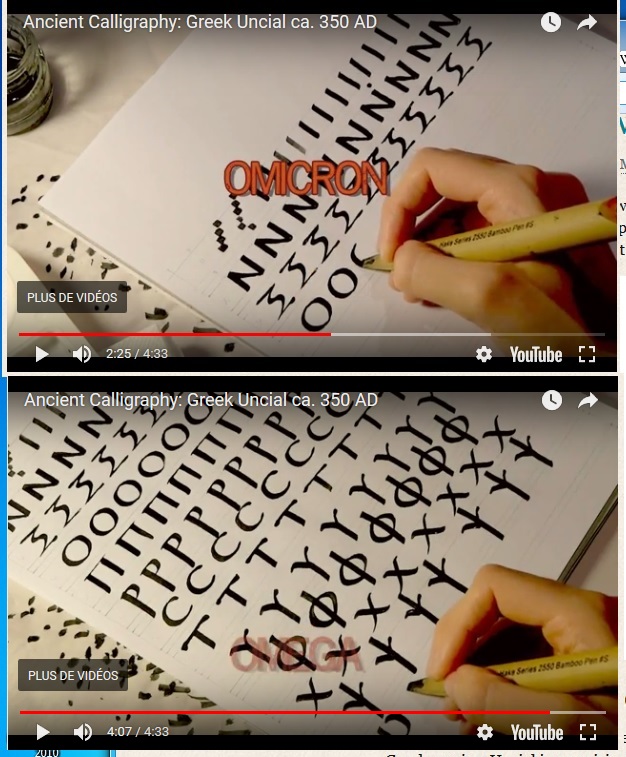
How exactly do Chi and Xi look in Uncial?

Found in Antiquity : How to write Greek Uncial
Posted on March 31, 2014 by Carla Schodde
https://foundinantiquity.com/2014/03/31/how-to-write-greek-uncial/


In the video, there are no ligatures, just the alphabet. Stigma is lacking.

However, since Omicron is directly after Xi and Omega after Chi and Psi, here are the Greek letters for 60 and for 600:


Especially the Uncial Xi is not very like the Minuscule which can be turned around for relooking like Arabic letters, is it?

And the Minuscule is not from Late Antiquity, but from Middle Ages./HGL

PS, found Uncial version of Stigma on French wiki:

Friday, September 15, 2017

There are Guys who Think Latin is an Analytic Language


I suggest they try to present Chinese as a Polysynthetic one, while they are at it, bungling language typology!

Do you know what I found? Well, first, what was I looking for? I was looking for "fishing" as in the trade practised by some of Christ's disciples on lake Genesareth. In order to contrast it with agricultura and commercium. I though piscatus could be the word, but wanted an online check to be sure.

You know what was the first hit? Or second after a totally irrelevant wiktionary hit on the Spanish and Italian word pesca, involving both the word for fishing and the word for persica, peach, which involved - unlike the relevant meaning of pesca - a reference to Latin.

Well, here is this second hit:

IDl : How to Say Fishing in Latin
https://www.indifferentlanguages.com/words/fishing/latin


And here is the explanation:

If you want to know how to say fishing in Latin, you will find the translation here. We hope this will help you to understand Latin better.

Here is the translation and the Latin word for fishing:

piscandi

Check out other translations to the Latin language:


Er, no thanks!

Piscandi is not a word, it is a word form. It is not a noun meaning fishing, it is a form of the verb "to fish", and it is the form which is the gerund in the genitive. Here is a way in which you can use it:

Ibamus ad fluvium piscandi causa / intentione.

We were walking toward the river for the sake / in the intention of fishing.

Obviously, you can also translate the latter of the two as:

We were walking toward the river in the intention to fish.

Or even more fluently ... intending to fish.

But the context where I wanted "fishing" was not this one. I said "agricultura est forsan dignior piscatu inquantum securior" commenting on Cicero's words about agriculture. And I said Cicero's preference of agriculture over fishing is doubtful, due to apostles being fishermen, but if it is in any way true, it is because of it being more secure to plow and sow than to throw your nets.

Well, in the sentence I used piscatu. This is a case form of piscatus, which is the noun for fishing, at least that would have been the noun for fishing or for fish catch if Spanish pescado is a good clue, which I hope it is, I did certainly find no better clue on the above site.

Now, if instead I had used "piscandi" I would have been wrong. Why? Piscandi means "to fish". But "to fish" is not translated piscandi in all contexts. The gerund is rivalling with the infinitive.

So here we have a full case declinsion of "to fish", singular only, since activities are no objects which can be counted:

Nominative piscare
Genitive piscandi (!)
Dative piscando (rare)
Accusative a piscare
Accusative b [ad, in] piscandum
Ablative piscando


Which of the forms could I have used to translate "agriculture is perhaps more dignified, since more secure, than to fish"?

I could have used either nominative, which is the infinitive and doesn't look like the gerund, and I could have used the ablative of comparison, I'll give you both:

Agricultura quam piscare forsan dignior, quia securior, est.

Agricultura piscando forsan dignior, quia securior, est.

In the first, but not the second case, I could also put quam piscare after dignior or securior:

Agricultura forsan dignior quam piscare est, quia securior.

Or:

Agricultura forsan dignior, quia securior, est quam piscare.

But using a verb form for the comparison after a noun for the concept taking the comparative is as clumsy (or voluntarily quirky) in Latin as it is in English to say "farming is ...er than to fish" or "agriculture is ...er than to fish". English can use "fishing" not just as a participle, but also as a noun, meaning the second as well as the first can be amended to "than fishing". Latin cannot use piscandi as a noun in the nominative after quam or as a noun in the ablative of comparison. For a noun, comparable to "agricultura" you need a noun, like piscatus.

You can either say "piscatu forsan dignior quia securior" or "forsan dignior quam piscatus, quia securior".

Do you know what the sad thing is? The guys behind the site IDl / InDifferent languages are doing this kind of thing, not just from English, but also from Spanish and from Russian. If they dared to mistreat Russian as much as they do Latin, they would be out of business fairly quickly with this site at least!

A few notes on above, to those not familiar with linguistic terminology. In linguistics, we distinguish two main directions of syntactic-morphological type, analytic and synthetic, with the former relying more on extra words and on word order, the latter more on endings or choice or stem vowels or such. English is more Analytic than Russian. Russian is more Synthetic than English. While Spanish descends from Latin, a documented fact, not just a reconstruction, though the details of the process can be disputed, Spanish is more Analytic and Latin more Synthetic. So, treating "piscandi" as "a word", a unit independent of context which is simply a unit, is treating Latin as an Analytic language which it is not, rather than as a Synthetic language which it is. I suggested, while they were at it, they could also try to present the extreme form of Analytic languages, the Isolating ones, like Chinese, as a Polysynthetic, the extreme form of Synthetic, and the real example of it would be Esquimeau / Greenlandic.

In Latin, the accusative is used both as a direct object and after certain prepositions. An infinitive is good for the direct object but in Latin unusable for accusative after preposition. "Volo" meaning "I want" can obviously take a direct object : volo panem, I want bread. Equally obviously, it can have an action as direct object, and that object is just as much as the subject behind est, an infinitive : volo piscare, I want to fish. To go cannot take a direct object. If I say "let's go fishing", English uses a form which started out as meaning sth like "let us go while we fish" or "let us go and be fishing at the occasion". In Latin it would be "eamus ad piscandum".

However, to express purpose, Latin has after the classical period borrowed a Greek usage, since Greek has no gerund, but uses infinitive for all cases. Hence, we can now, after Caesar, in Christian times, also say "eamus piscare".

But neither Classical, nor now, there is no going "piscandi". There is only an intent of piscandi. The site was simply wrong. Now, I will give them some feedback, and later you can check if they took notice or bungled on with a Latin they certainly are not qualified of mastering.

Or qualified to master.

Hans Georg Lundahl
Nanterre UL
Our Lady of Sorrows
15.IX.2017

PS, feedback submitted.

Saturday, August 12, 2017

Why Creationists should Not Believe IE Single Protolanguage


Φιλολoγικά/Philologica : Why Creationists should Not Believe IE Single Protolanguage · Assorted retorts from yahoo boards and elsewhere : ... on Negations with N

Very simple. The same arguments which lead to an IE* protolanguage, with that interpretation of facts, will also lead to a proto-language before both Proto-IE and Proto-Uralic, or even Proto-Ural-Altaic.

  Greek  Finnish
I   -(ον)   -en
thou   -εις   -et
he/she   -ει   -ee
we   -ομεν   -eme
ye   -ετε   -ete
they   -ουσι   -evat


For "I", Greek needs another tense. For "they" the endings are different. For "he/she", the match is considered as accidental. For "thou" we have a half-good match, but for "we" and "ye" we have excellent matches.

However, Greek is IE, inside IE language family, thought to descend from Proto-IE, PIE. Finnish is Uralic, outside IE language family, thought NOT to descend from PIE. The kind of motives leading mainstream linguists (but not Trubetskoy, founder of Balkan linguistics) to accept IE group as descending from a single language are the kind of motives leading logically to accept this and Uralic had an even older common Proto-language, explaining why Finnish and Greek have so similar verb endings.

Present day Slavonic languages, as well as Germanic ones, have a verb tense system closer to Finnish than to more typically IE ones, like Greek, Latin, Sanskrit. Old Bulgarian or Church Slavonic is known to be different, but could have picked up some categories from Greek - while living close to it on Balkan.

The other idea explaining commonalities - and which would explain Finnish ones without involving an even older Proto-language - is mutual loans while languages are neighbours in a restricted geographic area. And if the spread out from Babel was gradual, that is also what we can expect.

This would also explain instant sound changes applied to words when switching from a language to another./HGL

*Indo-European.

Monday, March 3, 2014

How the name of Our Lord was transliterated into Greek.

1) Φιλολoγικά/Philologica : How the name of Our Lord was transliterated into Greek., 2) Great Bishop of Geneva! : Where is Papist in Bible Code?, 3) Φιλολoγικά/Philologica : The Most Precious Name of Jesus - Two More Aspects, or Three

I saw a page which stated two things:

  • 1) As identified previously, the letter “J” is a recent addition to our language and is really only slightly older than America itself. It hasn’t been around a very long time, therefore, we can know for certain that Our Saviour’s name could not have been Jesus nor could Our Heavenly Father’s name have been Jehovah.

  • 2) There is no question that the true and proper names of Our Saviour and Creator could have been transliterated properly in any phonetic based language. Many other Hebrew names were transliterated in Scripture. Why not this one? The most important Name of all!


I answered, with a footnote longer than answer itself, and here add a new one:

Ieshua transliterated to Greek Ιησους (oblique cases Ιησου).*

Ιησους transliterated into Latin Iesus or Ihesus or Jesus (oblique cases Jesu, except accusative Jesum).

Letter shape J is a pretty old device for distinguishing I from L when the L began to look like l. What is only slightly older than US is calling I one letter** and J another letter./HGL

*One could have expected a transliteration as Ιησουας as well, since dative would have been Ιησουαι, Accusative Ιησουαν, Vocative Ιησουα (exact match), but in that case Genitive would have been Ιησουου … so Ιησου in Genitive, Dative and Vocative (Ιησουν in Accusative, I think) and hence Ιησους in Nominative was simpler.

The -s ending is unavoidable in Greek masculine singular nominatives. Transliterate Iohanan, you get an Accusative Ιω'αννην (pretty close match) but the Nominative is still Ιωαννης, with an -s. Lithuanian is similar. Vladimiras Vladimirovičius Putinas = Владимир Владимирович Путин. Obviously in Nominative, in Genitive you get Vladimiro, in Dative Vladimirui …

** Under all the Middle Ages they were the same letter and used interchangably, as also u and v in Latin. In English you could distinguish uu/vv/w from u/v, but then uu was regarded as a digraph, as Ll in Welsh.

Saturday, September 8, 2012

De Quoi=De Ce Que


On le trouve en Montaigne. "Se plaindre de quoi ..." = "se plaindre de ce que ..."

Alors, on pourrait écrire aussi "Que Quoi" pour "Que Ce Que"="Quam Ut"/"Quam Quod"?

La phrase est indetté à la Syntaxe du Grec Attique: "de quo" pour "de eo quod" n'est pas si bon Latin (ou alors c'est ma lecture thomasienne qui me trompe, référence cicéronienne ou tacitienne reste à vérifier) que les phrases correspondantes sont égales ou la plus courte même meilleure en Grec. Avec le Datif, par exemple: 'oi paides proseikousi tois 'oi goneis eisin e autois eikousi = 'oi paides proseikousi 'ois goneis eisin e autois eikousi. Les progénitures ressemblent à ceux qui sont leur parents ou ressemblent à eux. 'ois= tois 'oi.

Si on peut faire la phrase "que quoi" dans le sens de "quam ut" / "quam quod", alors la syntaxe française a une liberté que manquent les autres langues romanes. La phrase "que ce que" est atroce par l'homonymie entre "que" = "quam" et "[ce] que" = "quod" / "ut".

Ex: "Sous Mola aurait été plus important que vivent les hommes que quoi passent les voitures."

Ceci est inspiré par une épisode peu récommendable du régime Franco, lu dans un livre d'instruction de la langue castellane. Il imposait à un village un réaménagement infrastructurel, les villageois se sont assis pour bloquer, et si ce n'est pas un mensone, les soldats ont tiré sur les villageois et il y a eu des morts. Le carlisme me semble plus respectueux des libertés locales que le franquisme proprement dit.

L'espagnol doit dire:

Ex à éviter: "Bajo Mola habría sido más importante lo que viva la gente que lo que pasen los coches."

Ex corrigé: "Bajo Mola habría sido más importante la vida de la gente que el pasaje de los coches."

D'où certaines différences syntactiques entre les langues romanes et germaniques. En anglais, allemand ou suédois la traduction de "quam ut" ne pose pas de problème:

Ex "Under Mola it would have been more important that the people live than that the cars pass."

Ex "Under Mola hade det vägt tyngre att låta menniskor lefva än att låta bilar passera."

Ex "Unter Mola wäre es wichtiger gewesen daß die Menschen leben als daß die Autos passieren."

Hans-Georg Lundahl
Mouffetard / Paris
Nativité de Notre Dame
la Bienheureuse Vierge Ma rie
le 8-IX-2012

PS, l'épisode en question (même si elle est vraie) n'empêche pas une gratitude envers Franco pour avoir battu l'épouvantable Azaña.

Saturday, March 24, 2012

Is Romanides accurate?

Series straddling three blogs: 
 
Assorted retorts from yahoo boards and elsewhere : ...on linguistic evolution
...on Tower of Babel or language evolution
Φιλολoγικά/Philologica : Milk and Gollum, and Nostratic M-L-Q
Is Boromir a mimsy borogove?
"If God spoke a language" - to correct Grimm
On the "Reformed Egyptian" of the "Nephites"
side issue on previous, Theology: A Gerald Smith on the theme of "Great Apostasy" and "Restored Gospel" - answered
Is Romanides accurate?
Was Romanides accurate? Bis! Not very much at all!
Linguistics for Romanides: Greek, Latin, Patois
Coniectura linguistica, pro casu unitatis vetustissimae indo-europaeae linguae.
Creation vs. Evolution : 32 language families for 72 nations ...
To this essay: 


Mettius* Fufetius, the Latin King of Alba Longa, claims that the Romans of Tullus Hostilius (672-640 BC), the Latin King of Rome, are no longer pure Greeks, whereas his Albanians (Alvanoi) are still pure Greeks.[ 3 ]


Is that exactly what he said? Not quite:

[ 3 ] Dionysius of Halicarnassus*, Roman Antiquities, III, x, 1-6. Mettius Fufetius argued that "...one cannot point to any race of mankind, except the Greeks and Latins, to whom we (Albanians) have granted citizenship; whereas you (Romans) have corrupted the purity of your body politic by admitting Tyrrhenians, Sabines, and some others..." Evidently the Sabines, who were Lacedaemonians, as we shall see, had intermarried with non-Greeks.


His "evidently" is balderdash.

Mettius Fufetius is not arguing that Rome is no longer "Greek only", but that it is no longer "Greek and Latin" only.

Tyrrhenians are Etruscans. Unlike Greeks and Latins not even Indo-European in language.

Sabines are related to Latins, but more rustic.

But let us first see what Dionysius of Halicarnassus actually says** about origin of Aborigines:

10 There are some who affirm that the Aborigines, from whom the Romans are originally descended, were natives of Italy, a stock which came into being spontaneously24 (I call Italy all that peninsula which is bounded by the Ionian Gulf25 and the Tyrrhenian Sea and, thirdly, by the Alps on the landward side); and these authors say that they were first called Aborigines because they were the founders of the p33families of their descendants, or, as we should call them, genearchai or prôtogonoi.26 2 Others claim that certain vagabonds without house or home, coming together out of many places, met one another there by chance and took up their abode in the fastnesses, living by robbery and grazing their herds. And these writers change their name, also, to one more suitable to their condition, calling them Aberrigenes,27 to show that they were wanderers; indeed, according to these, the race of the Aborigines would seem to be no different from those the ancients called Leleges; for this is the name they generally gave to the homeless and mixed peoples who had no fixed abode which they could call their country.28 3 Still others have a story to the effect that they were colonists sent out by those Ligurians who are neighbours of the Umbrians. For the Ligurians inhabit not only many parts of Italy but some parts of Gaul as well, but which of these lands is their native country is not known, since nothing certain is said of them further.

11 But the most learned of the Roman historians, among whom is Porcius Cato, who compiled with the greatest care the "origins"29 of the Italian cities, p35Gaius Sempronius30 and a great many others, say that they were Greeks, part of those who once dwelt in Achaia, and that they migrated many generations before the Trojan war. But they do not go on to indicate either the Greek tribe to which they belonged or the city from which they removed, or the date or the leader of the colony, or as the result of what turns of fortune they left their mother country; and although they are following a Greek legend, they have cited no Greek historian as their authority. It is uncertain, therefore, what the truth of the matter is. ...


OK, Denys of Halicarnass is not quite on Romanides' side, to say the least. He goes on to give an account of what might just possibly be true about Cato's guess. Or claim. And his reasoning** is that those Greeks are the first to leave Greece for Italy, thus most likely to have lost track of, most likely to have changed langued into what is known as Latin:

... But if what they say is true, the Aborigines can be a colony of no other people but of those who are now called Arcadians; 2 for these were the first of all the Greeks to cross the Ionian Gulf, under the leadership of Oenotrus, the son of Lycaon, and to settle in Italy. This Oenotrus was the fifth from Aezeius and Phoroneus, who were the first kings in the Peloponnesus. For Niobê was the daughter of Phoroneus, and Pelasgus was the son of Niobê and Zeus, it is said; Lycaon was the son of Aezeius and Deïanira was the daughter of Lycaon; Deïanira and Pelasgus were the parents of another Lycaon, whose son Oenotrus was born seventeen generations before the Trojan expedition. This, then, was the time when the Greeks sent the colony into Italy. 3 Oenotrus left Greece because he was dissatisfied with his portion of his father's land; for, as Lycaon had twenty-two sons, it was necessary to divide Arcadia into as many shares. For this reason Oenotrus left the Peloponnesus, p37prepared a fleet, and crossed the Ionian Gulf with Peucetius, one of his brothers. They were accompanied by many of their own people — for this nation is said to have been very populous in early times — and by as many other Greeks as had less land than was sufficient for them. 4 Peucetius landed his people above the Iapygian Promontory, which was the first part of Italy they made, and settled there; and from him the inhabitants of this region were called Peucetians. But Oenotrus with the greater part of the expedition came into the other sea that washes the western regions along the coast of Italy; it was then called the Ausonian Sea, from the Ausonians who dwelt beside it, but after the Tyrrhenians became masters at sea its name was changed to that which it now bears.


No, I do not find that the oldest Romans necessarily talked Greek only, as he claimed. Aeneas may have brought along Greek, unless the language both he and Latinus spoke was Canaanean. But Latinus did hardly have Greek as his mother tongue, or if he did, it was because it was a luxury.

Hans-Georg Lundahl
BpI, Paris
St Gabriel's Day, 24-III-2012

*CHARLEMAGNE'S LIE OF 794 AD, THE GREEK LATINS OF ALBA LONGA AND OF ROME, THE BYZANTINE EMPIRE LIE AND BALKANIZATION
© John S. Romanides
http://www.romanity.org/htm/rom.21.en.the_ethnic_cleaning_of_roman_history.01.htm


**Dionysius of Halicarnassus
Roman Antiquities
p29 (Book I, continued)
http://penelope.uchicago.edu/Thayer/E/Roman/Texts/Dionysius_of_Halicarnassus/1B*.html

Tuesday, May 31, 2011

If a Greenlander had a Greek dictionary but did not know the grammar ...

  • µεγaλoπoλιc ...

    In Greenlandic as in Greek there is a possibility to compose words with adjectives meaning big. In Greenlandic this is even compulsory in such a case, since in Greenlandic big is not a word but a suffix, meaning also it comes out on the other side as compared to Greek:

  • polimegale

    But actually a concept as city would also be composed in Greenlandic, as in "many households" and "many" also is an ending: oikiopolys. And since "big" also is an ending we would get:

  • oikiopolymegale

    But on top of that a word like household might be composed as "place to inhabit" and "inhabit" is "oikein" and place "topos" but unlike Greek, "place for-" would be an ending too in Greenlandic:

  • oikeotopopolymegalos

    or with haplology:

  • oikeotopolymegalos.

    Going back to Greek we could make a phrase like "to have a megalopolis":

  • µεγaλoπoλιv εχειv

    But of course "to have ..." is also a suffix in Greenlandic:

  • oikeotopolymegalechein.

  • µεγaλoπoλιv εχει o τυραvvoc

    So what would Greenlandic make out of that?

  • tyrannos
  • basileukakos

    You have guessed it, Greenlandic has an ending meaning bad and since a tyrant is a bad ruler, tyrant would be replaced by "bad-ruler" of course not dysbasileus but basileukakos, or even ...

    You have guessed it! Greenlandic has an ending meaning "someone who is doing something" and so we would start with the verb to rule, "archein" and hence "to rule badly" "archikakein" and hence to the person doing that:

  • archeikákôn

    Which is really pretty close to a real Greek word árchôn (archont). Except it includes a suffix meaning bad. So where Greek says in so many words:

  • µεγaλoπoλιv εχει o τυραvvoc

    Greenlandic adjusted with Greek morphemes would make it:

  • oikéotopòlymègaléchei ho àrcheikákoon.

    Guess why I find Greenlandic less likely to learn at age 42, especially in its real morphemes, which are not Greek ones? Anyone who finds this interesting can try his hand at real Greenlandic.

    Hans-Georg Lundahl
    Boulogne-Billancourt
    Feast of St Petronilla
    31-V-2011